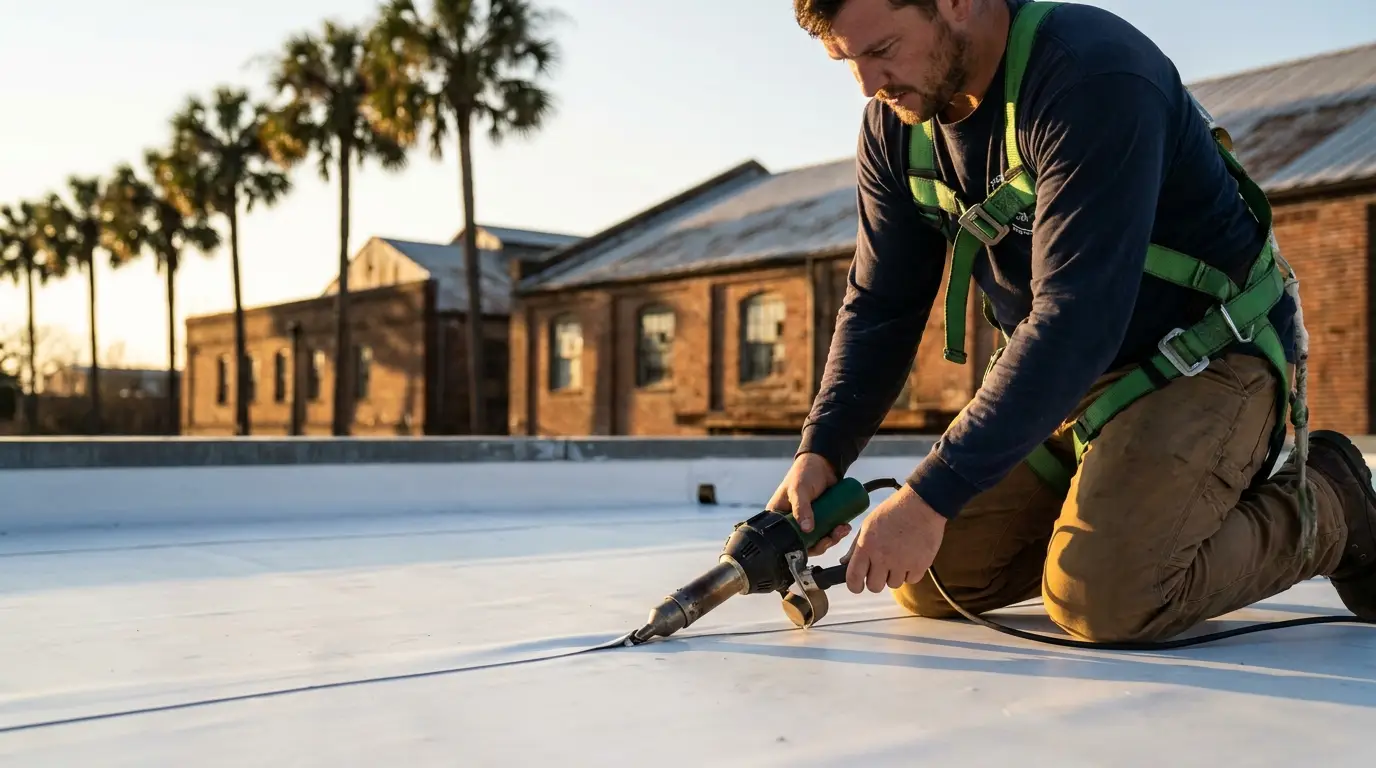

When you search "best flat roof contractor near me" in Savannah, you get a mix of true commercial flat-roof specialists, residential roofers who'll bid the job and subcontract the install, and out-of-state crews that landed in Coastal Georgia after the last named storm. The wrong choice on a $30,000–$120,000 flat roof can mean ponding water within 18 months, seam failures at the 5-year mark, or a system that doesn't qualify for the manufacturer's 20-year material warranty because the install didn't follow Carlisle, Firestone Building Products, or GAF spec.
This guide is the vetting checklist a commercial building owner should use before signing anything: the questions that separate flat-roof specialists from generalists, the material decisions that actually matter on the coast, and the verification steps any Savannah business or property manager can complete in under five minutes.
Key Takeaways
- ✓ Flat roofing is a separate specialty from steep-slope residential — most Savannah residential roofers lack the membrane-welding equipment, drainage math, and commercial-permit experience.
- ✓ Material choice depends on the building: TPO is the most common (15–25 year life), EPDM is the most forgiving for retrofits, PVC handles chemical exposure, modified bitumen is best for high-traffic.
- ✓ Real flat-roof estimates list membrane mil thickness (60-mil min residential / 80-mil commercial), attachment method, seam-welding method, and tapered-insulation drainage plan.
- ✓ Chatham County's 130 mph wind code requires uplift calc at corners and perimeters — corner zones often need 2× the fastener density of field zones.
- ✓ Top-rated Savannah flat-roof contractors carry: manufacturer certification (GAF, Carlisle, Firestone Building Products, Mule-Hide), commercial GL $1M+ with you named as additional insured, and 20+ completed flat-roof jobs in coastal Georgia in the last 24 months.
Why Flat Roofing Is a Different Skill Set From Residential
Residential steep-slope roofing is, mechanically, an asphalt shingle nail-gun operation. Flat roofing is closer to industrial fabric installation — the membrane is welded or adhered (not nailed in the field), drainage is engineered (not gravity-assumed), and the wind-uplift physics are completely different. Mechanically fastened TPO at the building corners can need 12-inch fastener spacing where the field-zone needs only 24-inch — get that wrong and the corner peels in the first hurricane.
The tooling is different too. A commercial flat-roof crew needs hot-air welders (electric and propane), seam probes for QC, tapered-insulation cutting templates, vacuum lifting for membrane rolls, and access equipment (scissor lifts, swing stages, or boom lifts depending on building height). A residential crew with ladders and a nail gun is not equipped for any of this. When a residential roofer bids a flat job and subcontracts the install, you're paying a markup for a middleman who's not on site during the install — and won't be reachable for warranty issues three years later.
In Savannah specifically, the additional factors are: Chatham County's 130 mph wind code (which requires registered design professionals for any commercial re-roof permit), salt-air exposure on properties near the river or coast (which accelerates fastener corrosion if galvanized vs. stainless), and the high humidity that makes adhesive cure times longer than the manufacturer datasheet assumes. A specialist who's done 50 Savannah flat roofs knows these adjustments; a generalist quoting flat as a side business doesn't.
The 6 Vetting Questions for Any Savannah Flat Roof Contractor
Print this and bring it to every flat-roof estimate. The answers separate flat-roof specialists from residential roofers bidding a commercial job.
| # | Question | What a Good Answer Looks Like |
|---|---|---|
| 1 | Which membrane manufacturer are you certified by, and at what tier? | A specific manufacturer + tier + verification URL on the manufacturer's contractor portal (GAF Master Select, Carlisle Authorized Applicator, Firestone Building Products Red Shield, Mule-Hide Warranty Eligible). |
| 2 | What membrane mil thickness are you proposing, and why that one? | 60-mil minimum residential or low-traffic light commercial. 80-mil for high-traffic roofs, restaurants, schools. A specialist will reference the traffic load and the warranty length that mil unlocks. |
| 3 | What's your attachment method — mechanically fastened, fully adhered, or ballasted? | Each has trade-offs: mechanically fastened is cheapest but slightly noisier under wind; fully adhered is best for wind uplift but costs 20–30% more; ballasted is rare on coastal Georgia commercial. The contractor should justify the choice for your specific building's wind-uplift requirement. |
| 4 | How are you handling drainage? What's the tapered-insulation plan? | A specialist will walk you through the existing slope, identify low spots, and propose tapered ISO board to direct water to the drains/scuppers within 48 hours of rain (per NRCA recommendation — Chatham County code is stricter on commercial than residential). |
| 5 | What's the wind-uplift calc for the corners and perimeters? | Reference to ASCE 7 wind loads for the Chatham County 130 mph zone. Corner-zone fastener spacing typically tightens to 12–16" vs. 24" in field. If they can't answer this, they're not pulling commercial permits. |
| 6 | Can you show me three flat-roof installs you've completed in coastal Georgia in the last 24 months? | A specific list with building types (warehouse, restaurant, office park), membrane systems, and the manufacturer-issued warranty doc. Vague answers mean they don't actually have the commercial volume. |
TPO vs EPDM vs PVC vs Modified Bitumen — Which One Fits Your Building
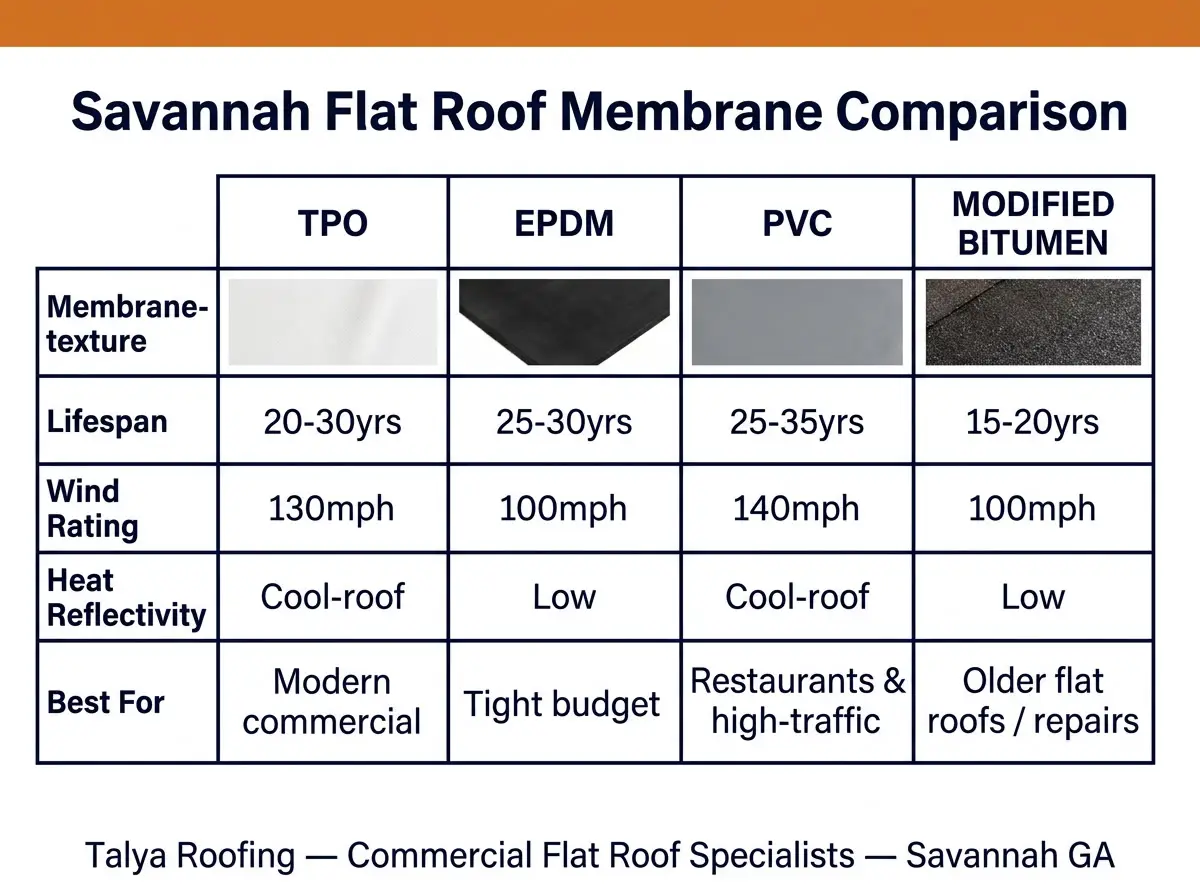
Membrane selection in Coastal Georgia depends more on the building use and budget than on brand preference. A correctly-spec'd 60-mil TPO from a regional manufacturer beats an incorrectly-spec'd premium-brand membrane every time. The decision matrix:
| System | Best For | Coastal GA Life | Relative Cost |
|---|---|---|---|
| TPO (60-mil / 80-mil) | Most commercial buildings, cool-roof energy savings, mechanically fastened or fully adhered. Heat-welded seams. | 15–25 yrs | $ — most affordable |
| EPDM (45-mil / 60-mil) | Retrofits over existing roofs, forgiving install, single-component rubber. Best for buildings without strict cool-roof requirements. | 20–30 yrs | $ — comparable to TPO |
| PVC (60-mil / 80-mil) | Chemical exposure (restaurants with grease vents, dry cleaners, laboratories). Best fire performance. White-reflective. | 20–30 yrs | $$ — 15–25% premium over TPO |
| Modified Bitumen (2-ply / 3-ply) | High-traffic roofs (HVAC service-heavy buildings), schools, parking decks. Multi-ply system with redundancy. | 15–25 yrs | $$ — comparable to PVC |
| BUR (Built-Up Roof, 4-ply) | Traditional commercial — gravel-surfaced asphalt + felt layers. Largely replaced by single-ply for new construction. | 15–30 yrs | $$$ — labor-intensive |
For most Savannah commercial buildings — retail, office park, warehouse, HOA clubhouse — we recommend 60-mil mechanically fastened TPO with a manufacturer-issued 20-year material warranty. For restaurants and food-service buildings, we recommend 60-mil PVC because of the grease-exhaust exposure. For retrofits over existing intact systems where tear-off would be expensive, EPDM is often the right call.
Certifications That Matter for Commercial Flat Roofing in Coastal Georgia
Trade-association memberships are easy to buy and don't unlock anything substantive. The certifications that actually matter for commercial flat roofing are the manufacturer ones, because those are the warranty gates.
| Certification | What It Unlocks | Verify In < 60 Seconds |
|---|---|---|
| GAF Master Select / EverGuard Specialist | GAF Diamond Pledge warranty on EverGuard TPO + PVC + Liberty SBS modified bitumen. | Find-a-Roofer search at gaf.com/en-us/roofing-contractors (filter Commercial). |
| Carlisle Authorized Applicator / Sure-Seal / Sure-Weld | Carlisle Total Roofing System warranty on Sure-Weld TPO + Sure-Seal EPDM + SureFlex PVC. | Contractor search at carlislesyntec.com. |
| Firestone Building Products Red Shield / Master Contractor | Firestone Red Shield warranty on UltraPly TPO + RubberGard EPDM + UltraPly PVC. | Contractor lookup at firestonebpco.com. |
| Mule-Hide Warranty Eligible Contractor | Mule-Hide warranty on TPO + EPDM + modified bitumen systems. | Contractor list at mulehide.com. |
| City of Savannah Business License + Commercial Permit Record | Permission to pull commercial roof permits inside Savannah city limits. Verify with the City Revenue + Building Safety departments. | Request a copy of the current license + ask for 3 recent commercial permit numbers you can look up. |
| Commercial GL + Workers' Comp ($1M+ aggregate) | Required by most commercial property owners and almost all commercial property insurers before any work begins. Building owner named as additional insured for the project duration. | Carrier-issued Certificate of Insurance — real contractors send within 24h. |
Red Flags on Flat Roof Quotes (Especially After a Hurricane)
Post-hurricane is when bad commercial roofing contracts get signed. Out-of-state crews flood Coastal Georgia after each named storm and commercial buildings are their preferred target — bigger ticket sizes, less savvy buyers (property managers vs. individual homeowners), and faster decision cycles because the building has tenants waiting for repairs. Watch for:
- ⚠A single-number estimate with no membrane mil / attachment / seam spec. Real commercial flat-roof estimates are 4+ pages with itemized line items including membrane type, mil, attachment method, seam-welding method, tapered insulation R-value, drains/scuppers, walk pads at HVAC, perimeter flashing, and parapet detail. A back-of-business-card price is a residential approach to a commercial job.
- ⚠"We'll just cover over the existing roof — no tear-off needed." Sometimes a cover-over is appropriate (sound structural deck, sound existing system, ≤2 existing layers per Chatham County code). Often it's a way to skip the labor of tear-off and the cost of disposal. Get the contractor to certify in writing that the existing system passes a moisture survey before agreeing to any cover-over.
- ⚠No mention of wind-uplift calc or asymmetric fastener spacing at corners. Required by code for any commercial re-roof permit in Chatham County. If the contractor isn't doing the calc, the permit application won't pass review.
- ⚠Refusal to provide manufacturer-issued material warranty documents pre-install. Manufacturer warranties (GAF Diamond Pledge, Carlisle Total Roofing System, Firestone Red Shield) require manufacturer inspection of the install before the warranty is issued. Ask to see the warranty paperwork from a recent comparable install.
- ⚠"We'll handle the drainage on-site as we go." Drainage on flat roofs is engineered before tear-off, not improvised during install. A real flat-roof contractor produces a drainage plan as part of the estimate showing low spots, drain locations, and tapered-insulation slopes.
- ⚠No GL + workers' comp COI naming you as additional insured. A commercial roof install involves multiple trades on-site (carpentry, sheet metal, HVAC coordination, sometimes crane work). Without the COI, any worker injury or third-party damage becomes the building owner's liability.
How to Verify Any Savannah Flat Roof Contractor in 5 Minutes
The verification process for flat-roof contractors is the same one we recommend for any commercial roofing decision — works for vetting Talya Roofing or any competitor.
5-Minute Verification Checklist
- 1
Confirm a permanent local commercial address
Search the contractor on Google Maps. A real commercial roofer in coastal Georgia has a physical office with the equipment (welder trucks, vacuum lifts, materials staging) visible at the property. Not a P.O. box, not a residential address.
- 2
Verify any claimed manufacturer certification on the manufacturer's website
GAF, Carlisle, Firestone Building Products, and Mule-Hide all publish their certified-contractor lists with search-by-name. The contractor's business name must appear on the official list. If it doesn't, the certification is being misrepresented.
- 3
Request three recent commercial permit numbers + the addresses
Commercial roof permits are public record in Chatham County. Look up the contractor's name in the City of Savannah and unincorporated Chatham building permit databases to confirm they're actually pulling commercial work — not just claiming to.
- 4
Request a sample line-item flat-roof estimate (with another client's identifying info redacted)
Real flat-roof estimates list membrane manufacturer + system name + mil thickness + attachment method + seam method + insulation R-value + drainage plan + walk pads + flashing + warranty terms. Anything less and you're not buying a real spec.
- 5
Verify $1M+ commercial GL + workers' comp via Certificate of Insurance
Real commercial contractors carry $1M general liability minimum, often $2M aggregate. Workers' comp limits per the state requirement. COI must name you (or your management company) as additional insured for the project duration.
Talya Roofing's commercial flat-roof credentials, for reference: City of Savannah business-licensed for commercial work, manufacturer-certified on GAF EverGuard and Mule-Hide systems, full $1M general liability + workers' comp with COI on request, and dozens of completed flat-roof projects across Chatham, Bryan, Effingham, and Liberty counties since 2023 — TPO retrofits, EPDM repairs, modified bitumen on schools and HOA buildings, and PVC on restaurant projects. Want more detail before you commit? Our flat roofing service page walks through the full process, our TPO roofing page covers the most common single-ply membrane in detail, and our Savannah commercial roofing guide covers everything from building-type matching to ROI math.
Free Commercial Flat-Roof Site Walk
On-site measurement, drainage assessment, membrane-system recommendation, written line-item estimate — no charge.
Serving Savannah, Pooler, Richmond Hill, Hinesville, Bluffton, and Coastal Georgia commercial property owners.
Sources: GAF Commercial · Carlisle SynTec · Firestone Building Products · National Roofing Contractors Association · ASCE 7 Wind Load Standard (Chatham County 130 mph zone)