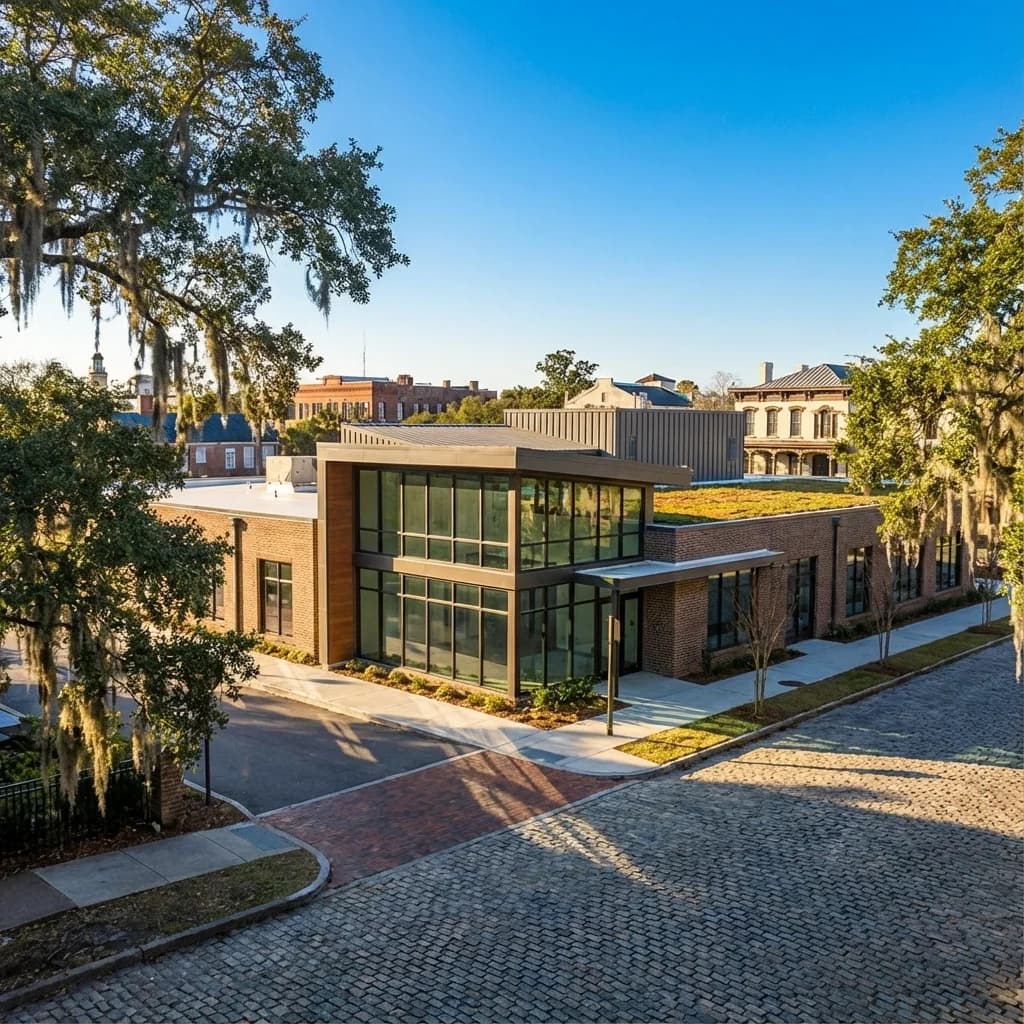

Key Takeaways
- Commercial roofing in Savannah requires specialized systems — TPO, EPDM, modified bitumen, and metal — engineered for flat and low-slope applications with heavy equipment loads and strict building code compliance.
- Chatham County's commercial building code requires wind uplift resistance rated for the design wind speed on the permit, proper drainage engineering, and fire classification documentation.
- Proactive maintenance programs extend commercial roof life by 30–50% and prevent the catastrophic interior damage that business interruption insurance often doesn't fully cover.
- Talya Roofing provides full-service commercial roofing for offices, warehouses, retail, restaurants, and industrial facilities across the Savannah metro area.
- Contact us at (912) 999-7989 for a commercial roof assessment and maintenance proposal.
Commercial Roofing in Savannah: A Different Discipline
Commercial roofing and residential roofing share a goal — keeping water out — but that's where the similarities end. Commercial roofing systems deal with vastly larger surface areas (often 10,000–100,000+ square feet), flat or low-slope geometries that create unique drainage challenges, heavy rooftop mechanical equipment loads, complex penetration patterns for HVAC, plumbing, and electrical systems, and stringent building code requirements that exceed residential standards significantly.
In Savannah's climate, commercial roofing faces the added pressures of intense solar loading that degrades membrane materials, tropical rain events that dump 2–4 inches in a single hour, hurricane-force winds that create enormous uplift forces on large flat surfaces, and persistent humidity that promotes biological growth and accelerates membrane aging. Roof specifications and maintenance plans should address these conditions, with warranty terms confirmed for the proposed system.
Commercial Roofing Systems Explained
Talya Roofing's commercial flat-roof work focuses on TPO single-ply membrane and silicone restoration coatings, plus standing seam metal for steep-slope and visible-roof buildings. The other membrane families below — EPDM and modified bitumen — are described for comparison so you can understand the full market before choosing a system.
TPO (Thermoplastic Polyolefin)
TPO is the most specified commercial membrane in the Savannah market, and for good reason. Its heat-welded seams create a monolithic waterproof surface with weld strengths that exceed the membrane material itself — meaning the seam is stronger than the surrounding membrane. TPO's white reflective surface reduces cooling loads by 15–25% (a significant factor for warehouses and retail spaces with large roof footprints), and the material resists the UV degradation, ozone exposure, and biological growth common in Coastal Georgia.
Talya Roofing installs 60-mil and 80-mil TPO systems (60-mil is code minimum for commercial; we recommend 80-mil for buildings intended for long-term occupancy). Our installations include fully adhered or mechanically attached application depending on the substrate and wind zone, tapered insulation systems engineered for positive drainage to all roof drains and scuppers, reinforced termination bars and edge metal rated for Chatham County's wind exposure, and manufacturer-registered warranties (typically 20–30 years) backed by third-party installation inspections.
EPDM (Ethylene Propylene Diene Monomer)
EPDM — commonly known as rubber roofing — has a 50+ year track record in commercial applications. This synthetic rubber membrane is prized for its flexibility (it accommodates building movement and thermal expansion without cracking), chemical resistance, and proven longevity. EPDM is available in 45-mil, 60-mil, and 90-mil thicknesses and can be ballasted, mechanically attached, or fully adhered.
In Savannah's market, EPDM is most commonly specified for warehouses and industrial buildings (where its chemical resistance is valuable), smaller commercial buildings where cost efficiency is prioritized, and buildings with irregular roof geometries that benefit from EPDM's flexibility. One consideration: EPDM's black surface absorbs solar energy, which can increase cooling loads. For buildings where energy efficiency is a priority, TPO or cool-coated metal may be more appropriate.
Modified Bitumen
Modified bitumen (mod-bit) is a multi-layer asphalt-based system that provides the most robust puncture resistance of any commercial membrane. It's the system of choice for roofs with heavy foot traffic (restaurants with rooftop equipment requiring frequent service access, for example) and buildings in industrial areas where airborne debris is a concern. Mod-bit is installed in two or more layers — a base sheet and one or two cap sheets — creating a redundant waterproofing system.
In Savannah commercial applications, SBS (styrene-butadiene-styrene) modified bitumen maintains flexibility in high temperatures — critical for a membrane that will experience surface temperatures exceeding 160°F in summer. Torch-applied, cold-adhered, and self-adhered options exist depending on the building's fire code requirements and substrate conditions. Talya Roofing does not install modified bitumen; for low-slope work we recommend TPO membrane or a restoration coating instead.
Commercial Metal Roofing
Standing seam metal is increasingly specified for commercial applications in the Savannah area, particularly for visible-roof buildings (retail, office, and mixed-use), structures requiring the strongest wind resistance (rated to 160+ mph for structural standing seam), and buildings where 40–60+ year lifespan without replacement is a priority. Talya Roofing installs structural standing seam metal systems in 22-gauge and 24-gauge steel with Kynar 500 coatings, as well as aluminum for coastal commercial buildings near Tybee Island and the waterfront.
Chatham County Commercial Code Requirements
Commercial roofing in Savannah and Chatham County must comply with the Georgia State Minimum Standard Codes (based on the International Building Code) with local amendments. Key requirements that affect commercial roofing include:
- Wind uplift resistance: Must meet FM Global or UL wind uplift ratings for the specific building location, height, and exposure category. The design wind speed for the site is set on the permit.
- Fire classification: All commercial roofing assemblies must achieve Class A, B, or C fire rating per ASTM E108. Most Savannah commercial specifications require Class A.
- Drainage: Positive drainage is required — no ponding water permitted 48 hours after rainfall. Tapered insulation or cricket/saddle configurations must be engineered to achieve this.
- Energy code: Georgia Commercial Energy Code (based on ASHRAE 90.1) mandates minimum roof insulation values and cool roof requirements for certain building types.
- Permits and inspections: All commercial roofing work requires Chatham County building permits and is subject to inspection at multiple stages.
Commercial Roof Maintenance Programs
Why Maintenance Is Non-Negotiable
A commercial roof is a capital asset that depreciates — but the rate of depreciation is almost entirely within the building owner's control. A well-maintained commercial roof in Savannah can last 25–35 years. The same roof without maintenance may fail in 12–18 years. The maintenance investment is typically 1–2% of the roof's replacement cost annually, while premature replacement costs 100%. The math is unassailable.
Beyond the roof itself, a commercial roof failure creates cascading costs that maintenance prevents: interior damage to inventory, equipment, and finishes; business interruption during emergency repairs; tenant disputes and potential lease liabilities; insurance claim complications (many policies require documented maintenance); and accelerated deterioration once water enters the system.
Talya Roofing's Commercial Maintenance Program
Our structured maintenance program includes semi-annual inspections (spring and fall) with documented reports and photography, post-storm inspections following named tropical systems or severe weather events, drain and scupper clearing to prevent ponding, sealant renewal at penetrations, flashings, and termination points, membrane repair of punctures, blisters, and seam separations, gutter and downspout maintenance for buildings with perimeter drainage, and annual condition scoring to track deterioration trends and plan capital expenditures.
Each maintenance visit produces a detailed report with photographs, condition assessments, completed repair documentation, and recommendations for future attention. These reports become a valuable asset when negotiating insurance renewals, planning capital budgets, or preparing a building for sale.
Industries We Serve in Savannah
Commercial roofs across the Savannah metro area cover different building types, including office buildings and professional complexes in downtown Savannah and Pooler, retail centers and shopping plazas, restaurants and hospitality (where kitchen exhaust penetrations need attention), warehouses and distribution centers in the Savannah industrial corridor, medical and dental offices requiring uninterrupted climate control, churches and institutional buildings, and multi-family residential (apartment complexes and condominiums) in Richmond Hill and across Chatham County.
Each building type presents unique challenges — from the historic district's aesthetic requirements to the Savannah port area's industrial exposure — and our team has the experience to address them with the right system, the right materials, and the right maintenance plan.
Protect Your Commercial Investment
Whether you need a new commercial roof installation, a comprehensive roof inspection, emergency repairs, or a proactive maintenance program, Talya Roofing delivers professional commercial roofing services across Savannah, Pooler, Richmond Hill, and Chatham County.
Request a Commercial Roof AssessmentOr call us directly: (912) 999-7989