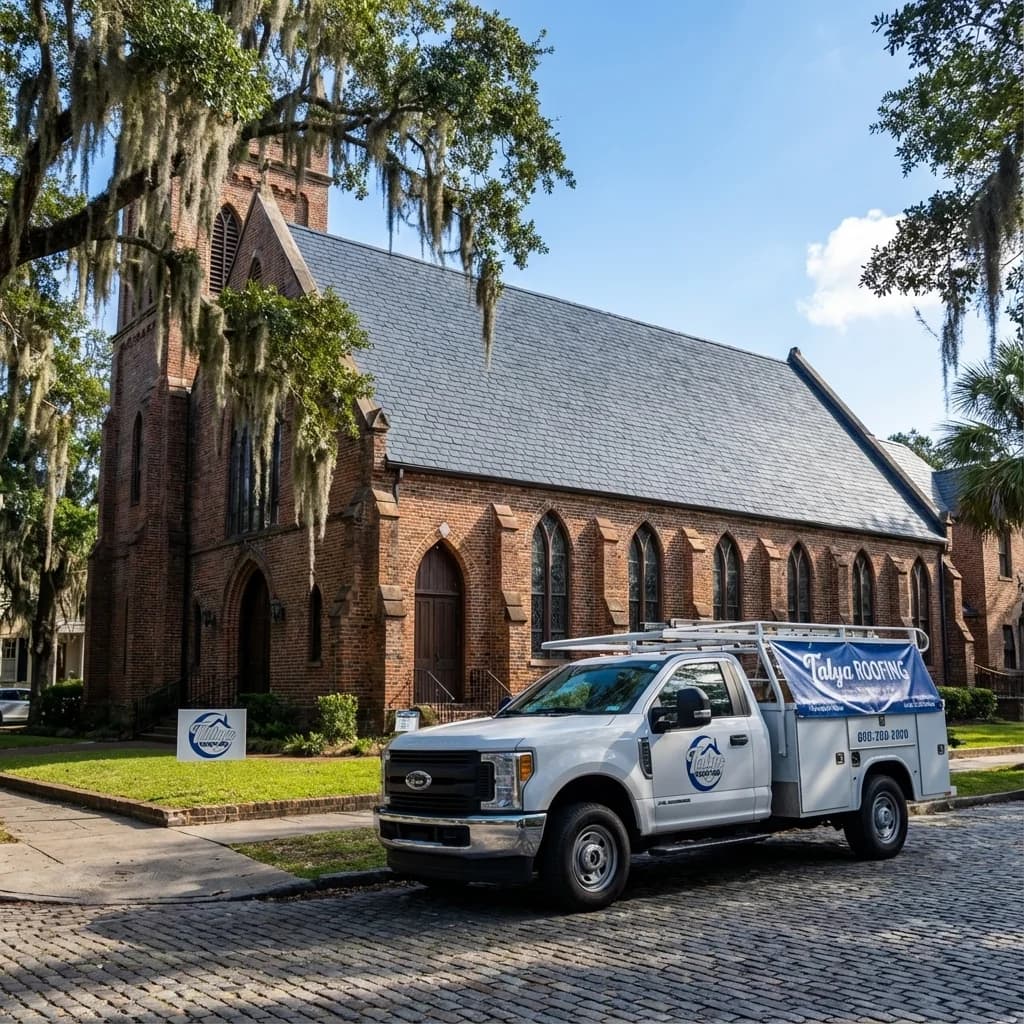

⛪ Church Roofing Considerations
- ✓ Large roof areas require phased project planning to minimize disruption
- ✓ Older sanctuaries may have structural issues that need assessment before re-roofing
- ✓ Budget-friendly options exist — financing and phased payment plans available
- ✓ Energy-efficient roofing can significantly reduce HVAC costs for large buildings
- ✓ Historic buildings may require specific materials for preservation compliance
Churches and religious buildings have roofing needs that are fundamentally different from residential properties. Larger roof areas, complex architectural features (steeples, dormers, bell towers), budgets managed by committees, and the need to minimize disruption to a busy weekly schedule all factor into the roofing process.
This guide covers what church leaders and building committees in the Savannah area need to know about commercial and church roofing — from material selection and budgeting to project planning and long-term maintenance.
Understanding Church Roof Costs
Church roof replacements cost more per square foot than residential projects because of the complexity involved. Factors that affect pricing:
- Roof area: Most church buildings have significantly more square footage than residential homes
- Steep pitches and complex geometry: Steeples, dormers, and complex roof lines require more labor and safety equipment
- Height and accessibility: Taller buildings require more advanced scaffolding and safety measures
- Material choices: Architectural grade shingles, standing seam metal, or commercial membrane systems each have different cost profiles
- Disposal volume: Larger tear-off projects generate more waste removal costs
Roofing System Options for Churches
Asphalt Shingles
Traditional and cost-effective for churches with steep-slope roofs. Architectural shingles from Atlas or GAF provide a 30+ year lifespan with multiple color and style options to match your building's aesthetic. This is the most budget-friendly option for steep-slope church roofs.
Standing Seam Metal
Higher upfront cost but a 50+ year lifespan with minimal maintenance. Standing seam metal is ideal for churches planning long-term — the initial investment is higher, but the total cost of ownership over 50 years is lower than two rounds of shingle replacement. Metal roofing also reflects solar heat, reducing HVAC costs in Savannah's hot summers.
Commercial Membrane Systems
For flat or low-slope portions of church buildings — fellowship halls, education wings, office sections — TPO or EPDM membrane systems provide reliable waterproofing. These systems are typically more cost-effective per square foot than steep-slope options.
Budgeting and Payment Options
We understand that church budgets are managed carefully, often with input from building committees and congregational votes. To help make church roofing projects feasible:
- Phased projects: For very large buildings, we can divide the work into phases spread over 2-3 budget cycles
- Financing options: Flexible financing is available for qualified organizations
- Insurance-related roof work: If storm damage triggered the need, we provide roof-condition documentation and an itemized construction estimate; the policyholder and carrier handle the claim
- Detailed proposals: We provide line-item estimates that building committees can review and present to congregations
Minimizing Disruption
Churches operate on a weekly schedule that cannot be interrupted. Our project planning for church roofing includes midweek work windows that avoid Sunday services, noise-free zones during scheduled events, daily cleanup to maintain safe access to the building, and clear communication with church staff about daily progress and next steps.
Church Roofing Project? Let's Talk.
Free building assessment. Detailed proposals for committee review.
Unique Challenges of Church Roofing in Savannah
Savannah's churches and worship facilities present roofing challenges that differ significantly from residential and standard commercial buildings. Steeple penetrations, large open spans without intermediate support, stained glass window flashing, and the need to maintain historic aesthetic character all require specialized expertise.
The most common church roofing issues in the Savannah area include aging slate or tile on historic sanctuaries (many dating to the 1800s), flat membrane roofs on fellowship halls and educational wings, and complex multi-level roof systems where additions from different decades meet the original structure.
Material Recommendations by Building Section
| Section | Recommended Material | Why | Expected Life |
|---|---|---|---|
| Historic sanctuary | Synthetic slate or metal shingle | Preserves appearance, lighter weight | 40-75 years |
| Fellowship hall (flat) | TPO or PVC membrane | Watertight, energy-efficient | 20-30 years |
| Education wing | Architectural shingles | Cost-effective, easy maintenance | 25-30 years |
| Steeple | Standing seam copper or metal | Durability at extreme pitch | 50-100 years |
Budget Planning for Congregations
Church roofing projects require careful financial planning because most congregations fund capital improvements through a combination of building reserves, special campaigns, and sometimes denominational grants. Here are budgeting considerations specific to Savannah-area worship facilities:
- Phase the project: Replace the most urgent section first (typically the flat-roof fellowship hall), then address the sanctuary roof in a subsequent phase when additional funds are raised
- Explore grants: Historic churches in Savannah may qualify for preservation grants from the Georgia Trust for Historic Preservation, the Savannah-Chatham County Historic Foundation, or National Trust for Historic Preservation
- Tax considerations: As a 501(c)(3) organization, churches are exempt from Georgia sales tax on building materials — ensure your contractor applies this exemption
- Multi-year maintenance agreements: Post-installation maintenance agreements with fixed annual costs help congregations budget predictable roofing expenses for the next 10-15 years
Working Around Worship Services
Unlike residential projects, church roofing must be scheduled around the congregation's activities. Most Savannah churches prefer Monday-Friday work windows with the project paused over weekends. For sanctuaries, noise-sensitive phases (tear-off, compressor-driven nail guns) must be coordinated around midweek services, prayer meetings, and choir rehearsals. Experienced church roofing contractors develop a day-by-day schedule that maps each phase to the congregation's calendar, ensuring the building is clean and safe for every event.