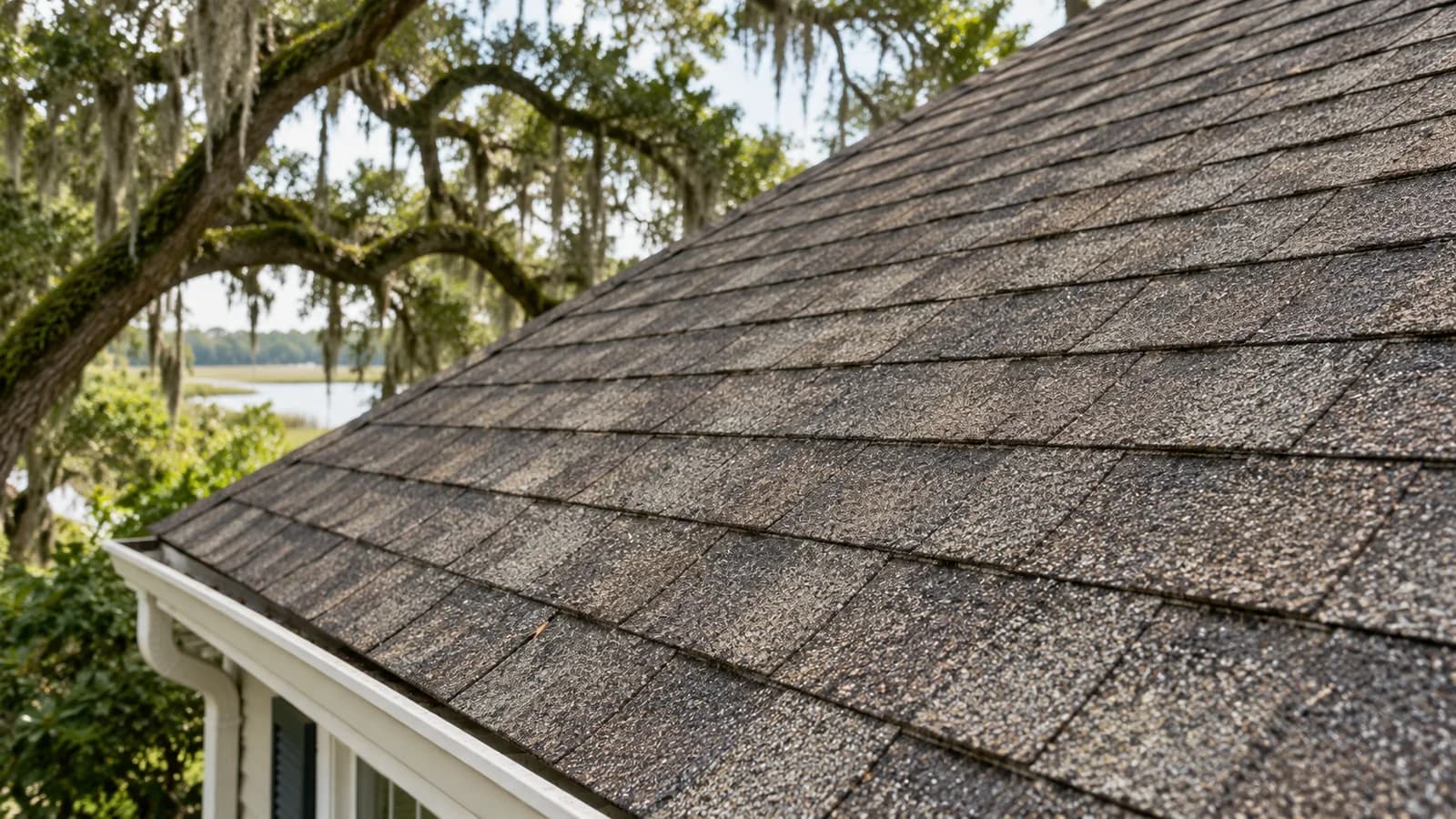

Illustration: AI-generated depiction of weathered asphalt shingles.
If you own a home in Savannah or elsewhere in Coastal Georgia, you've probably seen the ads: a crew sprays your roof in an afternoon, and your old shingles supposedly get years of extra life for a fraction of the cost of a new roof. It's a fair thing to wonder about.
This guide covers what sprays and coatings are meant to do, what the evidence does and doesn't show, how insurance fits in, and when a real repair is the better call. It is about rejuvenation treatments on installed asphalt shingles, not engineered roof-coating systems designed for other kinds of roofs. One disclosure up front: Talya Roofing does repairs and replacements, so we have a stake in this topic. That's why our sources are listed at the end, so you can check them yourself.
What a roof rejuvenation treatment is meant to do
As asphalt shingles age, their asphalt binder can become stiffer. Some rejuvenators use oil-derived ingredients intended to soften that binder. Results depend on the formulation. Laboratory improvements do not by themselves establish additional service years for a particular roof.
What the published lab work shows:
- A peer-reviewed study first published in August 2025 tested particular soybean-oil formulations on shingle samples. A 10 wt% semi-epoxidized soybean-oil treatment improved several measured properties; a 30 wt% treatment caused excessive softening. The findings do not establish added roof-service years. Six of the ten authors disclosed ownership of shares in SoyLei Innovations.
In plain terms: in that lab study, some treated aged shingle samples became more flexible. That is not the same as proof of extra years on your roof.
What we don't know yet
- Lab results are not field years. The laboratory evidence discussed here does not establish how many additional years a particular treatment will provide on a Savannah roof. Ask the seller for product-specific field evidence, its limitations, and the written treatment warranty.
- The shingle industry advises caution. The Asphalt Roofing Manufacturers Association (ARMA) revised its technical bulletin in July 2026. It "strongly advises against the field application of any type of coatings or rejuvenators over installed asphalt shingles," notes "limited available documentation" of benefits, and says these treatments "may be detrimental." ARMA is a shingle-industry trade association. Its bulletin is advisory guidance, not a product-specific field trial or a determination that every application is unlawful. Atlas Roofing's technical bulletin also raises cautions about coatings on installed shingles.
- Warranty fine print. Warranty consequences depend on the terms applicable to your shingles. Owens Corning's current standard warranty excludes shingle damage caused by specified post-installation alterations, including coatings. Atlas says aftermarket coatings are not approved for shingles featuring Scotchgard Protector and may affect algae-resistance and other applicable coverage. Obtain the warranty in effect when your shingles were installed and written manufacturer guidance before treatment. (Disclosure: Talya Roofing is an Atlas PRO+ Member.)
- A rejuvenation treatment is not a substitute for diagnosing damaged shingles, failed flashing or wet decking. Those conditions need their own repair plan.
What about insurance?
This is general information, not insurance advice. Your policy and your insurer make the decisions, so confirm anything important with your agent.
A treatment doesn't change your roof's age. A treatment does not change the date the shingles were installed. Whether an insurer recognizes it when assessing condition, eligibility, premiums or coverage is a separate question. Ask your insurer for a written answer specific to your roof and policy. Georgia also limits when insurers can nonrenew existing policyholders because of changes in their eligibility or underwriting rules.
Georgia's mitigation discounts. Georgia's mitigation-discount law recognizes qualifying FORTIFIED construction and other Commissioner-approved mitigation standards, subject to certification and documentation. A surface-applied shingle rejuvenation treatment alone does not establish eligibility.
Don't assume the policy pays for it. Do not assume your homeowners policy will pay for the proposed treatment. Ask your insurer which policy terms apply.
Penetrating rejuvenators and film-forming coatings
Some products are intended to penetrate the shingle; others form a surface film. The formulation and resulting layer matter when evaluating performance and moisture behavior.
Shingle makers warn that a film that doesn't let vapor through may seal the gaps around and between shingles, creating a vapor-retarding layer. Atlas says this "can trap moisture within the roofing system, potentially leading to long-term damage." ARMA also reports coatings shrinking and causing curling, cupping, and loose granules. Note the word "may": it is a real warning, not a proven outcome for every roof.
Savannah averages about 48 inches of rain a year, wettest June through August (NOAA). Roof moisture behavior depends on the whole assembly, including indoor humidity, air leakage, insulation, underlayment and drying paths. Manufacturers warn that some coatings may restrict drying or contribute to moisture accumulation. The effect of a particular treatment requires product- and assembly-specific assessment. Ventilation alone does not establish suitability.
Earlier laboratory work proposed inward solar-driven moisture through asphalt shingles; later ORNL analysis and an unvented-home experiment found no significant contribution under the conditions studied.
When to repair (or replace) instead
An active leak, missing or damaged shingles, failed flashing, or soft decking calls for an inspection and repair plan before any surface treatment is considered. Do not rely on rejuvenation as a substitute for needed repairs. Delaying those repairs can allow water damage to spread.
And when a roof is near the end of its life, replacement is usually the more reliable spend.
Whoever you talk to, us included, ask them to show you the evidence and put their recommendation in writing.
Talk to a local roofer
Not sure whether your roof needs a repair, a replacement, or nothing at all yet? Call Talya Roofing at (912) 999-7989 for a free roof-replacement estimate.
For wind/hail roof-replacement customers working with Talya, the roof assessment, photos and needed measurements supporting our roofing estimate are included at no separate charge. A standalone or home-purchase inspection with a written report is $250.
Talya Roofing LLC · 6606 Abercorn St Suite 119, Savannah, GA 31405 · (912) 999-7989
Sources
- ARMA, "Application of Coatings or Rejuvenators on Asphalt Shingles After Installation," technical bulletin, rev. July 2026: https://www.asphaltroofing.org/wp-content/uploads/2021/04/Coating-of-Asphalt-Shingles-After-Installation_20260723-FINAL.pdf
- Atlas Roofing, "Coating of Asphalt Shingles After Installation": https://www.atlasroofing.com/img/Literature/Coating-of-Asphalt-Shingles.pdf
- Kuehl et al. (Iowa State University), "Restoring Asphalt Shingle Integrity with Soybean Oil-Based Emulsions: A Case Study on Performance, Durability, and Sustainability," International Journal of Pavement Research and Technology, first published August 21, 2025 (see the article's conflict-of-interest statement): https://link.springer.com/article/10.1007/s42947-025-00612-6
- Owens Corning, roofing warranties (current Standard Limited Warranty): https://www.owenscorning.com/en-us/roofing/warranty
- Georgia HB 279 (2024), mitigation discounts, O.C.G.A. 33-32-10/-11: https://gov.georgia.gov/document/2024-signed-legislation/hb-279/download
- IBHS, 2025 FORTIFIED Home Standard: https://fortifiedhome.org/wp-content/uploads/2025-FORTIFIED-Home-Standard.pdf
- Georgia OCI Bulletin 24-EX-2, Nonrenewal Requirements and Prohibitions: https://oci.georgia.gov/document/bulletin/bulletin-24-ex-2-nonrenewal-requirements-and-prohibitions/download
- Building Science Corporation, RR-0306, "Unvented Roofs, Hot-Humid Climates and Asphalt Roofing Shingles": https://buildingscience.com/documents/research-reports/rr-0306-unvented-roofs-hot-humid-climates-and-asphalt-roofing-shingles
- Boudreaux, Pallin & Jackson (Oak Ridge National Laboratory), "Investigation of the proposed solar-driven moisture phenomenon in asphalt shingle roofs," Journal of Building Physics 40(4), 311–323 (2017; first published online January 19, 2016): https://journals.sagepub.com/doi/10.1177/1744259115624183
- NOAA NCEI 1991–2020 climate normals, Savannah International Airport: https://www.ncei.noaa.gov/access/services/data/v1?dataset=normals-monthly-1991-2020&endDate=9996-12-31&format=pdf&startDate=0001-01-01&stations=USW00003822