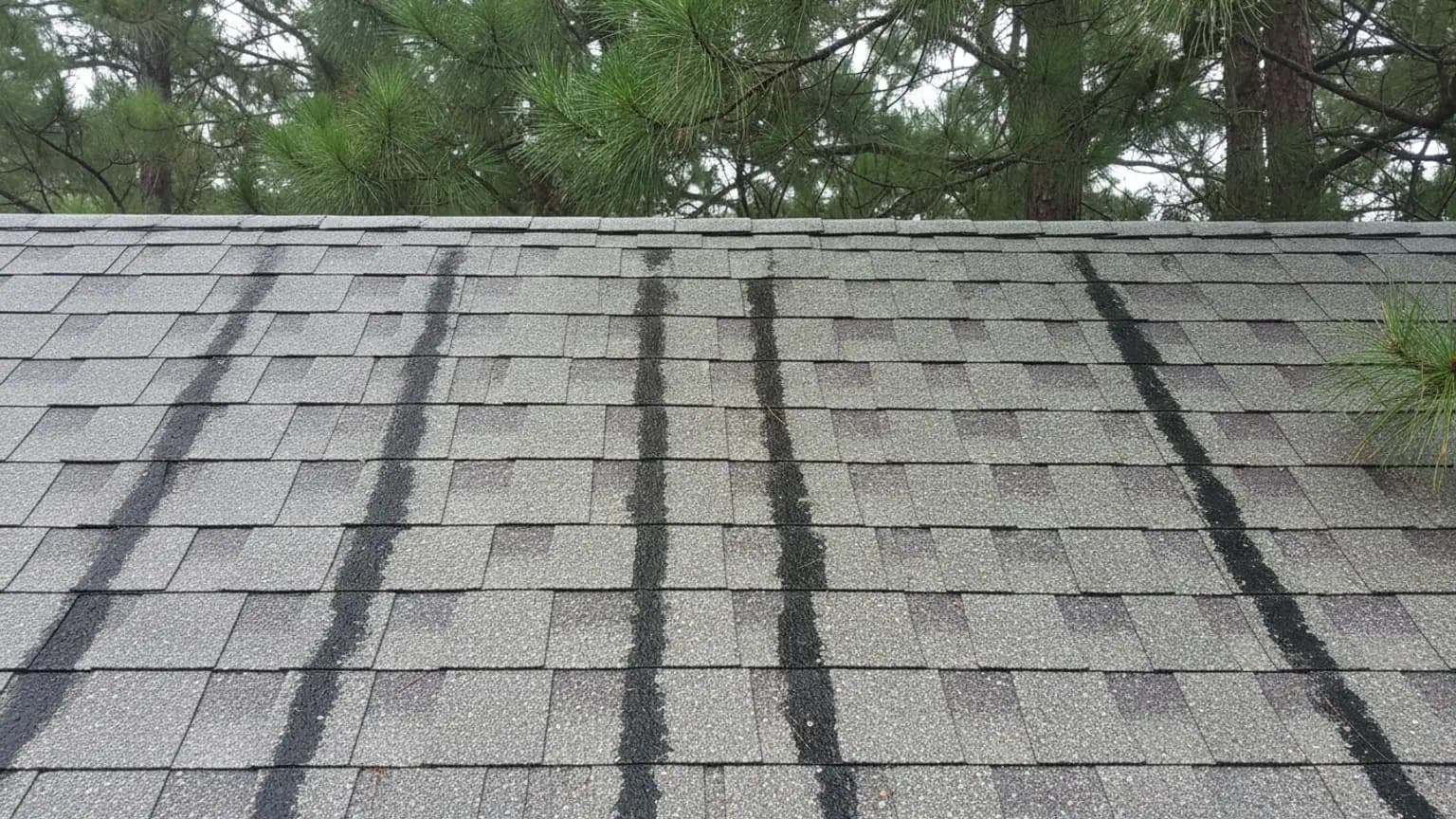

Richmond Hill has a moisture profile the rest of Bryan County does not share, and that profile is what puts dark vertical stains on 31324 roofs faster than on comparable roofs sixteen miles up the road in Savannah. This guide explains the mechanism, what it actually costs you, and the one specification decision that ends the cycle.
Key Takeaways
- The Ogeechee River wraps the south side of Richmond Hill and the Belfast River cuts in from the east — morning fog sits heavier inside 31324 than across the rest of Bryan County.
- Add 49 inches of annual rainfall and the pine canopy shading Richmond Hill Plantation and the Belfast Keller subdivisions, and shaded slopes never get a long dry window.
- In Talya's Bryan County field observations, untreated shingles streak inside about three years here.
- The streaks start cosmetic. The condition behind them — shaded slopes that stay wet — is what matters.
- Never pressure wash an asphalt roof. The granules are the shingle's UV armor.
- At replacement, algae-resistant architectural shingles with copper or zinc granules are the practical Richmond Hill spec.
Why do Richmond Hill roofs streak black before Savannah roofs do?
Because Richmond Hill sits between two rivers and holds morning moisture longer than the rest of Bryan County. The Ogeechee wraps the south side of town and the Belfast River cuts in from the east. That fog, plus the pine canopy shading many 31324 subdivisions, keeps shaded slopes damp long enough for roof algae to take hold and spread.
This is the part that surprises people. Roof algae is a coastal Georgia problem generally — we cover the biology, the safe removal method, and the shingle chemistry in our full guide to black streaks on Savannah roofs. But the shade source differs. In Savannah, the roofs we see streak first are the ones under live-oak canopy. In Richmond Hill it is river fog between the Ogeechee and the Belfast, with pine rather than oak doing the shading.
That distinction matters because it changes the fix. Oak canopy can sometimes be thinned back off a roof. A river you cannot move. When the moisture source is the landscape itself, the durable answer is to change what is on the roof rather than what is around it. That is why our Richmond Hill roofing crews quote algae-resistant products by default on Bryan County replacements rather than treating it as an upgrade line item.
What makes the fog heavier inside 31324?
Two rivers on two sides of town. The Ogeechee runs along the south edge of Richmond Hill and the Belfast River comes in from the east. Between them, morning fog is heavier here than across the rest of Bryan County. That sustained moisture is what contributes to black algae streaking on roofs inside 31324.
Layer the rainfall total on top. Richmond Hill averages 49 inches of rain a year, with hurricane risk for the area rated medium and salt exposure low.
Then add the tree cover. Richmond Hill Plantation is characterised by mature pine canopy over 1990s-era homes, and pine shades many of the Belfast Keller subdivisions too. Pair sustained moisture with that canopy and algae-resistant architectural shingles stop being an upgrade and start being the practical specification.
How fast do untreated shingles streak in Richmond Hill?
In Talya's Bryan County field observations, standard non-treated shingles show visible black streaking inside about three years here. That is faster than most homeowners expect. The microclimate is simply feeding the algae harder. The variable that actually changes the outcome is whether the shingle carries algae-resistant copper or zinc granules.
It helps to separate two different clocks. The first is the shingle's service-life clock, which is governed by heat, ultraviolet exposure, wind events, and how well the attic underneath breathes. The second is the appearance clock, which here is driven by moisture and shade. A Richmond Hill roof can be structurally sound and mechanically fine while still carrying visible streaking.
The practical consequence is a resale one. Richmond Hill homes change hands often inside the Fort Stewart and Hunter Army Airfield housing market, and PCS season runs hard from May through August. That is when a written second opinion is worth having in hand: in August 2024 we completed a written second-opinion inspection and reroof for a Fort Stewart family in Richmond Hill Plantation before their closing date.
Where in Richmond Hill does the streaking show up?
Along Belfast Keller Road and inside the Plantation neighborhoods. Those are the Richmond Hill roofs where sustained moisture shows up as black algae streaking. Separately, the bulk of our Richmond Hill work sits in subdivisions built between roughly 1995 and 2008 — Buckhead South, the Belfast River neighborhoods, Sterling Creek, and Richmond Hill Plantation.
Alongside algae on shaded slopes, the common conditions on Richmond Hill roofs of that era are lifted starter strips at the eaves, backed-out fasteners, and ridge-cap granule loss. Most of those homes are still running original builder-grade 3-tab on a wind code that was not enforced the same way it is now.
The estates along the Ogeechee near the Ford Plantation adjacency are a different market. Those are larger lots where premium materials are expected, and standing seam metal is most common there — a May 2024 Ford Plantation-adjacency install used Hartford Green Galvalume with a 50-year material warranty and a hurricane uplift rating that exceeded the Bryan County code minimum.
Are black streaks cosmetic, or are they actually damaging my roof?
The streaking starts cosmetic — but the condition producing it is worth looking at. A slope shaded and damp enough to grow algae is a slope that stays wet. On Richmond Hill reroofs we document decking conditions after tear-off, and decking that needs replacing where pine-straw-and-humidity rot is found can add a second day to the job.
Treat the stain as a symptom rather than a defect. On a young roof, streaking is genuinely an appearance issue and cleaning it is a reasonable maintenance decision. On an older roof in a shaded 31324 subdivision, it is worth having someone look at what is underneath before deciding.
Ventilation belongs in the same conversation. Ridge-and-soffit ventilation tuned for pine-canopy shade is part of our Richmond Hill replacement approach, alongside ice-and-water shield on every valley and penetration. If you want the mechanics of that, see our breakdown of common attic ventilation failures in coastal Georgia.
Can I pressure wash the black streaks off my Richmond Hill roof?
No. The Asphalt Roofing Manufacturers Association is explicit that pressure washing an asphalt roof causes granule loss and very likely premature failure of the roof system. The granules on the shingle surface are its ultraviolet armor. You trade a cosmetic problem for a structural one, and the algae returns anyway.
The safe method is an appropriate cleaning solution left to dwell and then rinsed off with low-pressure water, and the work belongs with an insured professional rather than a rented machine — a wet, algae-covered slope is genuinely slick. Our full removal walkthrough, including the recommended solution and dwell time, lives in the Savannah black-streak guide and applies unchanged in Bryan County.
One other thing not to do. ARMA does not recommend retrofitting zinc or copper strips onto an existing roof: fitting them means either driving exposed nails through the shingles, which creates a path for leaks, or breaking the factory sealant bond between courses, which compromises wind resistance.
Do algae-resistant shingles really work in a river-fog microclimate?
Yes. Algae-resistant architectural shingles embed copper, and sometimes zinc, granules that release into rainwater and suppress algae growth from the day the roof goes on. With 49 inches of rain a year across 31324, that release happens with every rainfall.
A September 2024 job in the Belfast River neighborhoods paired an algae-streak remediation with an 1,800 square foot reroof in copper-treated CertainTeed Landmark, colour Moire Black; the black streaks were gone within the cleaning cycle. Colour choice matters on the appearance side too — ARMA notes that streaking is far less visible on darker shades than on light-coloured roofs.
A note on shopping it. Algae-resistance warranty terms differ by manufacturer and by product line, and some depend on whether the home qualifies. Do not accept "it's algae resistant" verbally — ask for the specific SKU and the specific warranty document. If you want the material-by-material comparison, start with our guide to the best shingles for coastal Georgia conditions.
Should I clean the streaks now or wait and spec AR shingles at replacement?
It depends on where your roof sits in its service life. If the shingles have real years left, clean them properly and keep them. If the roof is already inside its replacement window, cleaning one you will tear off in two or three years is money spent twice — put the algae resistance into the new roof instead.
For a large share of Richmond Hill that question has an obvious answer right now. Thousands of 1990s and 2000s subdivision homes inside 31324 are hitting their 20 to 25 year reroof window simultaneously, and most are still running original builder-grade 3-tab. If your roof is in that cohort and it is streaked, you are not choosing between cleaning and replacing — you are choosing when to replace.
| Approach | What it does | What it does NOT do |
|---|---|---|
| Pressure washing | Removes the stain fast | Causes granule loss and very likely premature roof failure — never do it |
| Professional low-pressure cleaning | Safely clears existing streaks | Does not prevent regrowth on a non-AR roof |
| Retrofit zinc / copper strips | Suppresses some future growth | Does not remove existing stains; retrofit risks leak paths |
| AR architectural shingles at reroof | Suppresses growth from day one across the whole field | Does not remove stains from a roof you are keeping |
On budget: most Richmond Hill replacements land between $8,500 and $17,000 depending on square footage, pitch, and material. Architectural shingles run $4–$7 per square foot installed; standing seam metal — common on the Ford Plantation-adjacent estates — runs $10–$16 per square foot. The 1990s–2000s subdivision homes off Belfast Keller and inside Richmond Hill Plantation usually fall in the middle of that range. Written project estimates are available across 31324, and each quote states its validity period.
Whatever you choose, the permit path is the same. Every full replacement inside Richmond Hill city limits and across unincorporated Bryan County requires a permit through the Richmond Hill Business Development office. Bryan County enforces the 2018 Georgia Building Code with 2024 amendments; inside city limits, the City of Richmond Hill's residential permit packet requires plans designed to meet the 130 mph wind zone (unincorporated parcels confirm their figure with Bryan County), and permits typically clear in three to five business days. For the full local picture — construction eras, HOA expectations, and material recommendations — see our Richmond Hill roofing guide, or go straight to roof replacement services.
Storm context for Bryan County — during Hurricane Helene (Sep 26–27, 2024), pine snapping was the dominant rural damage mode across Bryan, Bulloch and Effingham counties, and the heavily wooded Richmond Hill Plantation and Belfast Keller subdivisions saw repeated pine strikes through the night. Most local claims were tree strikes rather than wind uplift. Source: NHC Tropical Cyclone Report — Helene
Streaked roof in Richmond Hill? Find out which clock you're on.
Talya Roofing works across 31324 — Buckhead South, the Belfast River neighborhoods, Sterling Creek, Richmond Hill Plantation, and the Ford Plantation adjacency. Request a complimentary project assessment and estimate; a documented homeowner inspection report is a separate $250 service.