
Key Takeaways
- Request a storm-damage assessment as soon as weather, safe access, location, storm volume, and scheduling allow.
- Not all storm damage is visible from the ground; professional inspectors identify hail bruising, lifted seal strips, and micro-fractures invisible to untrained eyes.
- Accurate photographs and measurements can document visible conditions, but do not guarantee coverage or payment.
- Georgia homeowners have the right to choose their own contractor — don't let a storm chaser pressure you into signing before you've vetted them.
What Happens to Savannah Roofs During Storms
Savannah's storm season runs roughly from May through November, with peak activity June through September. During this period, your roof faces three primary threats: high winds that lift, break, and remove shingles; hail that bruises, cracks, and dislodges granules; and wind-driven rain that penetrates every compromised seal, flashing joint, and damaged shingle. Tropical systems and nor'easters add sustained wind events that test even new roofs to their rated limits.
After any significant weather event, a thorough storm damage inspection is essential. Here's what the process involves, what inspectors look for, and how to navigate the insurance claim process effectively.
Immediate Steps After a Storm
As Soon as Conditions Are Safe
- Safety first — do not go on the roof; downed power lines, weakened structures, and wet surfaces create serious hazards
- Ground-level assessment — walk the perimeter of your home looking for shingles on the ground, visible gaps in the roof surface, displaced ridge caps, damaged gutters, and debris impact marks on siding
- Interior check — inspect every ceiling in your home for water stains, drips, or bulging drywall; check the attic for daylight, water, or new stains on the decking underside
- Photograph everything — document all visible damage with date-stamped photos from multiple angles; these become critical evidence for your insurance claim
- Limit interior exposure — if water is entering, move people and belongings away and use interior containers when safe; do not attempt roof work yourself
After the Immediate Safety Check
- Review your policy and carrier instructions — notice requirements and deadlines vary, and the carrier controls its claim process
- Request a professional inspection — timing depends on weather, safe access, location, storm volume, and scheduling
- Do NOT sign contracts with door-knockers — storm chasers descend on Savannah after every major event; vet any contractor before signing anything
What a Professional Storm Damage Inspection Covers
Roof Surface Assessment
A trained inspector gets on the roof (when safe) and examines every plane systematically:
- Missing shingles — the most obvious damage; entire shingles or tabs ripped away by wind
- Lifted shingles — shingles that have been lifted and re-seated but whose seal strips are broken; they look intact from the ground but will leak in the next rain
- Creased shingles — wind can bend shingles backward over the ridge or hip, creasing them permanently; creased shingles never lay flat again and will fail prematurely
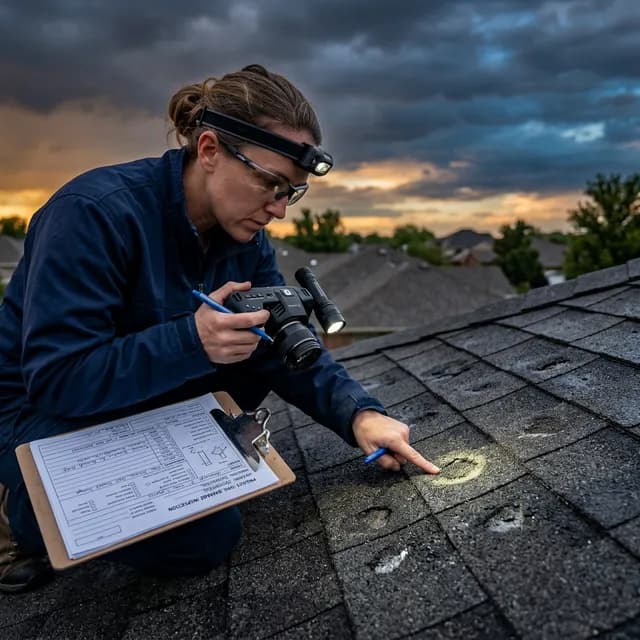
- Hail damage — appears as dark, circular depressions where granules have been knocked loose; may also show as cracks in the shingle mat; inspectors mark hits with chalk and count them per test square
- Granule displacement — even without visible depressions, hail can loosen granules across the roof surface, accelerating UV degradation
Flashing and Penetration Check
- Chimney flashing — checked for lifting, separation from the masonry, and cracked counter flashing
- Pipe boot seals — wind can tear rubber boot flanges; already degraded boots may split completely during a storm
- Wall step flashing — checked for bending, displacement, and sealant failure
- Skylight seals — frames and flashing examined for impact damage and seal integrity
Ridge and Hip Assessment
Ridge cap shingles are the most wind-exposed components on the roof. Inspectors check for displaced, cracked, or missing ridge caps. Even a single missing ridge cap creates a direct path for water into the ridge vent and attic below.
Gutter and Drainage Inspection
- Gutters checked for denting, separation from fascia, and impact damage from falling branches
- Downspouts checked for disconnection or crushing
- Granule accumulation in gutters — excessive granules indicate widespread shingle surface damage
Attic and Interior Inspection
The attic often reveals damage invisible from outside. Inspectors look for new water staining on the decking, wet insulation, daylight through nail holes or gaps, and any structural displacement of rafters or trusses from wind loading.
Navigating the Insurance Claim Process
Step 1: Your Contractor's Report
A professional storm damage report should include: photographs of all damage points (marked and annotated), measurements of the affected area, identification of the damage type (wind, hail, debris impact), and a scope of work needed for proper repair or replacement. This report becomes the foundation for your insurance claim.
Step 2: The Insurance Adjuster's Visit
Your insurance company will send an adjuster to verify the damage. Having your contractor present during the adjuster's inspection is strongly recommended — they can point out damage the adjuster might miss and explain the scope of work needed. Professional contractors are accustomed to working with adjusters and speaking the same technical language.
Step 3: Estimate Review and Supplemental Claims
If hidden conditions change the construction scope, your contractor can provide the property owner with new photographs, measurements, and an updated itemized estimate. The policyholder or an appropriately licensed representative decides whether and how to submit additional information to the carrier, which independently decides coverage and payment.
Step 4: Choose Your Contractor — It's Your Right
Georgia law gives you the absolute right to choose your own roofing contractor. Your insurance company cannot require you to use a specific company or their "preferred vendor." Choose a local, established contractor with storm damage experience and manufacturer certifications — not the company that knocked on your door the day after the storm.
Storm Chaser Warning Signs
After every major storm in Savannah, out-of-state contractors flood the area. While some are legitimate, many are not. Watch for:
- Door-to-door solicitation within days of a storm
- Out-of-state license plates on work vehicles
- No local business address — just a phone number and a truck
- Pressure to sign a contract before your insurance adjuster has visited
- Offering to "cover your deductible" (this is insurance fraud)
- Requesting large upfront payments before any work begins
Storm Damage? Get a Professional Assessment Fast
Talya Roofing provides thorough storm damage inspections and works directly with insurance companies for homeowners across Savannah, Pooler, Richmond Hill, and Tybee Island. Local, licensed, and ready when you need us.
Schedule Your Storm Damage InspectionEmergency line: (912) 999-7989