
Key Takeaways
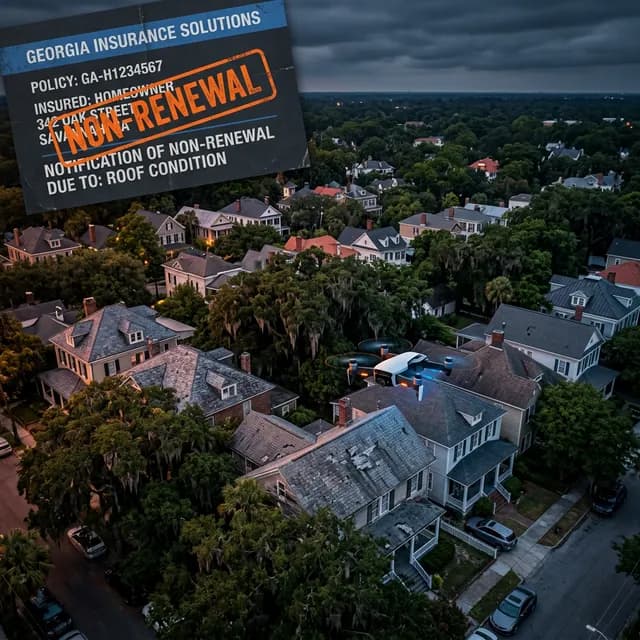
- Georgia Act 277 (signed 2024) allows insurance companies to factor roof age and condition into policy pricing, deductibles, and coverage decisions.
- Roofs older than 15–20 years may face higher premiums, reduced replacement coverage, or ACV-only (actual cash value) payouts instead of full replacement cost.
- Coastal Georgia homeowners in Savannah, Tybee Island, and Chatham County are disproportionately affected due to higher wind and storm exposure ratings.
- A professional roof inspection can document your roof's current visible condition for discussions with your carrier or agent, but it does not determine coverage terms or guarantee an underwriting result.
- Proactive roof maintenance and timely replacements are now financially critical — not just for protecting your home, but for maintaining affordable insurance.
What Is Georgia Act 277?
Georgia Act 277, formally known as the "Insurance Reform Act," was signed into law to give insurance carriers greater flexibility in how they underwrite homeowner policies — particularly concerning the age and condition of residential roofs. Before this legislation, Georgia insurers had limited ability to adjust premiums or coverage terms based solely on roof age. Act 277 changes that equation significantly.
Under Act 277, insurance companies operating in Georgia can now implement roof age schedules that affect your policy in several ways: adjusting your premium based on roof age, modifying deductibles for roof-related claims, offering actual cash value (ACV) coverage instead of replacement cost value (RCV) for roofs that exceed a certain age threshold, and in some cases, requiring a roof inspection as a condition of policy renewal.
For homeowners in Savannah, Pooler, Richmond Hill, and across Chatham County, this law has real and immediate financial implications that demand attention.
How Act 277 Affects Your Insurance Premiums
The Roof Age Schedule
While each insurance carrier implements Act 277 differently, the general pattern emerging across Georgia's insurance market follows a tiered structure based on roof age:
| Roof Age | Typical Coverage Impact | Premium Effect |
|---|---|---|
| 0–10 years | Full replacement cost (RCV) | Standard or discounted |
| 10–15 years | Full RCV, may require inspection | Slight increase possible |
| 15–20 years | RCV or ACV depending on condition | Moderate increase |
| 20+ years | ACV only; higher deductibles | Significant increase; non-renewal possible |
RCV vs. ACV: Why This Distinction Matters
The shift from replacement cost value (RCV) to actual cash value (ACV) is the single most impactful change for homeowners. Here's the practical difference: if a storm damages your 22-year-old roof and you have RCV coverage, your insurer pays the full cost of a new roof minus your deductible. With ACV coverage, your insurer pays only the depreciated value of your old roof — which on a 22-year-old shingle roof might be 15–25% of its original value. On a $15,000 roof replacement, the gap between RCV and ACV can be $10,000 or more out of your pocket.
Why Coastal Georgia Homeowners Are Hit Hardest
Act 277's impact is not uniform across Georgia. Homeowners in Chatham County, including Savannah, Tybee Island, Wilmington Island, and Richmond Hill, face amplified effects for several reasons:
- Higher wind exposure ratings: Coastal locations carry inherently higher storm risk scores, which insurers now compound with roof age factors.
- Salt air degradation: Roofs near the coast age faster due to salt corrosion, meaning a 15-year-old roof in Tybee Island may be in worse condition than a 20-year-old roof in Macon.
- Hurricane deductibles: Many Coastal GA policies already carry separate (higher) hurricane deductibles — Act 277 can stack additional roof-age-based increases on top of these.
- Limited carrier options: Fewer insurance companies are willing to write policies on the Georgia coast, giving remaining carriers more pricing power.
- Higher replacement costs: Roofing labor and materials cost 10–20% more in coastal areas due to demand, code requirements, and material specifications.
How to Protect Yourself Under Act 277
1. Get a Professional Roof Inspection
A documented professional roof inspection is now one of your most powerful tools for managing insurance costs. Many insurers will accept a certified inspector's report showing that an older roof is in good condition, potentially qualifying you for better coverage terms than the age-based default. Talya Roofing provides detailed inspection reports with photographs, remaining-life estimates, and condition documentation that insurers accept.
2. Maintain Meticulous Records
Keep documentation of every repair, maintenance visit, and upgrade performed on your roof. This paper trail records the work completed and may help an insurer understand the roof's maintenance history. Talya Roofing is City of Savannah business licensed and insured and provides project documentation for completed work.
3. Consider Proactive Replacement Before the Premium Cliff
If your roof is approaching the 15–20 year mark and showing signs of wear, the math on a proactive roof replacement may now favor acting sooner rather than later. Here's why: a new roof immediately drops your age-based premium surcharges, qualifies you for full RCV coverage, may earn you wind mitigation credits (especially with metal or impact-resistant shingles), and eliminates the risk of being caught with ACV coverage when the next hurricane hits.
4. Upgrade to Wind-Resistant Materials
When you do replace, choosing materials rated for higher wind speeds can earn additional insurance credits that offset the cost difference. Impact-resistant Class 4 shingles, standing seam metal roofing, and fortified roof-to-wall connections all qualify for premium reductions under most Georgia carriers — savings that stack on top of the new-roof age benefit.
5. Shop Multiple Carriers Annually
Act 277 implementation varies significantly between carriers. Some apply aggressive roof-age penalties while others take a more moderate approach. Shopping your policy annually — especially after any roof work — can reveal substantial savings. Provide your inspection report and maintenance records to each prospective carrier.
Act 277 and Roof Material Considerations
Not all roofing materials are treated equally under Act 277's framework. Materials with longer proven lifespans fare better in age-based assessments:
- Metal roofing: 40–60+ year lifespan means your roof stays in the favorable age tiers for decades. Many insurers offer the most aggressive discounts for metal roofs, recognizing both the longevity and wind resistance.
- Architectural shingles: 20–30 year rated lifespan keeps you in favorable tiers for 15–20 years. Algae-resistant, impact-rated Class 4 shingles earn the best rates within the shingle category.
- 3-tab shingles: 15–20 year lifespan means you may enter unfavorable premium territory within 10–12 years. If you're replacing and budget allows, upgrading from 3-tab to architectural is strongly recommended.
- Tile and slate: Extremely long lifespans (50–100 years) but limited application in Chatham County due to structural weight requirements. Where applicable, they receive excellent insurer treatment.
What Happens If You Ignore Act 277
Doing nothing is a choice — and under Act 277, it's an increasingly expensive one. Homeowners who let aging roofs deteriorate without documentation or maintenance face a compounding problem: rising premiums year over year, reduced coverage that leaves you exposed to catastrophic out-of-pocket costs, difficulty finding any carrier willing to write a policy (some Savannah homeowners with 25+ year roofs have already experienced non-renewals), and a potential gap in coverage if you can't find a replacement policy, which also violates most mortgage agreements.
The homeowners in Pooler and Richmond Hill who are proactively managing their roofs — through inspections, targeted repairs, and timely replacements — are the ones maintaining affordable insurance and full replacement coverage.
Talya Roofing's Act 277 Support for Chatham County Homeowners
Talya Roofing's role is limited to the roof's construction scope. We can inspect roof conditions and provide photos, measurements, and an itemized construction estimate and, when requested, explain that scope during an on-site meeting. The policyholder or an appropriately licensed representative handles claim requests and negotiations; the policy and carrier determine coverage, payment, and any available credits.
We understand that a roof replacement is a major investment. We explain the repair or replacement construction options and provide written pricing so you can compare them. Ask your carrier or an appropriately licensed insurance professional about policy implications, credits, coverage, and payment.
Concerned About Act 277's Impact on Your Insurance?
Start with a professional roof inspection from Talya Roofing. We can document visible roof conditions with photos and measurements and provide an itemized construction estimate. The policyholder or an appropriately licensed representative handles insurance submissions, and the carrier and policy determine coverage and payment. Serving Savannah, Pooler, Richmond Hill, Tybee Island, and all of Chatham County.
Schedule Your Roof InspectionOr call us directly: (912) 999-7989