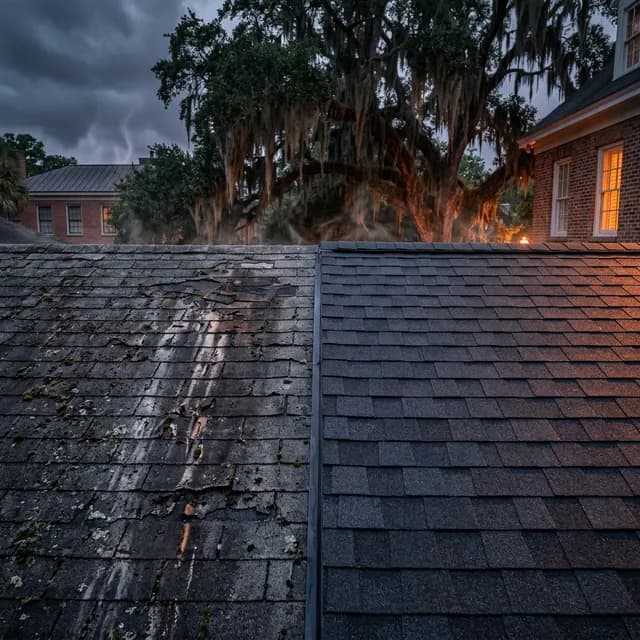

🌡️ Why Savannah Roofs Don't Last as Long
- ✓ A "30-year" shingle may perform for 15-20 years in Savannah's climate — not a scam, just physics
- ✓ UV intensity + heat + humidity creates an accelerated aging environment
- ✓ Algae growth reduces reflectivity, trapping more heat in the shingle granule layer
- ✓ Coastal salt-air (especially within 5 miles of the coast) accelerates all metal components
- ✓ Proper ventilation can extend shingle life by 30-40% in our climate
Shingle manufacturers rate their products for lifespan, but those ratings assume average climatic conditions — typically derived from mid-Atlantic or Midwestern baseline environments. Savannah's climate is not average. The combination of factors at play on a Chatham County roof creates one of the more demanding environments for asphalt shingle performance in the continental United States.
UV and Thermal Cycling
Savannah receives significantly higher UV radiation than northern markets where many shingle performance studies are conducted. South-facing roof slopes in Savannah absorb 20-30% more ultraviolet radiation than equivalent slopes in New England or the Midwest. UV accelerates asphalt oxidation — the process that makes shingles brittle, causes granule loss, and leads to cracking.
Humidity and Moisture Cycling
Savannah's annual average humidity of 70-75% means shingles repeatedly absorb and release moisture — expanding and contracting with each cycle. This thermal-moisture cycling fatigues the asphalt binders that hold the granule layer in place. Combined with UV oxidation, it is why granule loss is more dramatic and earlier on Savannah roofs than in drier climates.
Algae and Biological Growth
The black streaking visible on most residential roofs in Savannah is Gloeocapsa magma — a cyanobacterium that feeds on the limestone filler in shingle granules. Beyond aesthetics, algae growth darkens the shingle surface, increasing heat absorption and accelerating the degradation cycle. Atlas shingles with Scotchgard Protector and similar algae-resistant products are significantly more effective in Savannah than standard algae-resistant options.
What You Can Do
Proper attic ventilation is the highest-impact intervention for extending shingle life in Savannah. An overheated attic heats shingles from below while the sun heats them from above — this dual thermal load is far more damaging than either source alone. Ensure your ridge and soffit ventilation is functional before or during any roof replacement.
Installed for Savannah's Climate — Not Generic Specs
Every Talya Roofing installation addresses ventilation, algae resistance, and wind rating for Coastal Georgia conditions.
The Science Behind Shorter Roof Lifespans in Savannah
When shingle manufacturers rate a product for "30 years," they're testing under controlled laboratory conditions that don't account for Savannah's unique combination of environmental stressors. Understanding why roofs age faster here helps homeowners make smarter material and maintenance decisions.
Factor 1: Extreme UV Exposure
Savannah receives an average of 218 sunny days per year with a UV index regularly reaching 10-11 (extreme) during summer months. UV radiation breaks down the petroleum-based asphalt in shingles through photodegradation, causing them to become brittle, crack, and lose granules. A roof in Savannah absorbs approximately 30% more cumulative UV radiation over its lifetime compared to one in the Mid-Atlantic region.
Factor 2: Humidity and Moisture Cycling
Savannah's average annual relative humidity of 74% — with summer months regularly exceeding 85% — creates a constant moisture cycle that few other U.S. cities match. Shingles absorb moisture, swell slightly, then dry and contract. This daily expansion-contraction cycle accelerates material fatigue, particularly at nail holes and overlapping seams where movement is concentrated.
Factor 3: Salt Air Corrosion
Homes within 15 miles of the Atlantic coast (which includes all of Savannah, Tybee Island, and Wilmington Island) experience salt air exposure that corrodes metal components — flashing, drip edge, gutter fasteners, and nail heads. Salt crystals also embed in shingle granules, creating micro-sites for accelerated weathering. Coastal homes lose an estimated 15-20% of roof lifespan compared to identical materials installed 50+ miles inland.
Factor 4: Biological Growth
Savannah's warm, humid climate is ideal for Gloeocapsa magma (the algae that causes black roof streaks), moss, lichen, and mold. These organisms don't just look bad — they actively damage roofing by:
- Retaining moisture against shingle surfaces (accelerating granule loss)
- Producing acidic byproducts that erode limestone-based granules
- Creating root-like structures (moss/lichen) that physically lift shingle edges
- Trapping debris that blocks drainage and holds standing water
Factor 5: Storm Events
Savannah sits in the Atlantic hurricane corridor. Even when a major hurricane doesn't make direct landfall, the city regularly experiences tropical storms and severe thunderstorms with 60-80 mph gusts, heavy rain, and hail. Each storm event causes cumulative micro-damage — lifted shingle edges, loosened nails, displaced granules — that individually is minor but collectively shortens roof life by years.
What You Can Do About It
While you can't change Savannah's climate, you can extend your roof's useful life by 3-7 years through:
| Strategy | Estimated Life Extension | Cost |
|---|---|---|
| Annual professional inspection | 2-3 years | $150-$250/year |
| Algae-resistant shingles (next replacement) | 3-5 years | $200-$500 premium |
| Proper attic ventilation | 3-5 years | $500-$2,000 one-time |
| Tree trimming (6ft clearance) | 2-3 years | $200-$600/year |
| Post-storm inspection | 1-3 years | Free (many roofers) |
Best Material Choices for Maximum Savannah Lifespan
Given the accelerated aging from Savannah's climate, material selection becomes even more critical than in temperate regions. The materials that perform best in our specific conditions aren't always the ones with the highest national ratings — they're the ones engineered for humid, UV-intense, salt-air environments.
Our top recommendation for maximum lifespan in Savannah is standing seam metal roofing with Galvalume or painted aluminum finish. While the upfront cost is 2-3x higher than architectural shingles, metal roofing lasts 40-60 years in coastal Georgia versus 22-28 years for premium shingles — making the cost-per-year actually lower over the roof's lifetime.
How to Maximize Your Savannah Roof Lifespan
You cannot change Savannah's climate, but you can take specific steps that add measurable years to your roof's functional life. Each of these strategies addresses one or more of the environmental factors that shorten roof lifespans in our region:
- Material selection at installation: When choosing materials for a roof replacement, invest in products engineered for our conditions. Premium architectural shingles with enhanced UV stabilizers, thicker asphalt mats, and algae-resistant granules (like Atlas Pinnacle Pristine or GAF Timberline HDZ) outperform builder-grade products by 5–8 years in Savannah's climate. The cost difference is typically $500–$1,500 for a whole-roof upgrade — a fraction of the cost of premature replacement.
- Ventilation optimization: Proper attic ventilation is the single highest-impact investment for roof longevity in Savannah. An overheated attic (regularly exceeding 150°F in summer) bakes shingles from below while the sun bakes them from above. This dual thermal load is far more destructive than either heat source alone. Ensure your soffit intake vents are clear and unblocked by insulation, your ridge vent is properly cut and installed, and the total ventilation meets the 1:150 ratio (1 sq ft of net free ventilation per 150 sq ft of attic floor). Adding or upgrading ventilation during a roof replacement costs $500–$2,000 and can extend shingle life by 3–5 years.
- Regular maintenance schedule: Periodic observations can identify a cracked pipe boot, lifted flashing, blocked drainage, or another localized condition before water entry expands the repair scope. Pricing depends on the documented condition, access, material match, and any supported damage.
- Tree management: Savannah's beautiful live oaks, pines, and magnolias are constant sources of roof debris. Pine needles trap moisture in valleys, leaves clog gutters causing fascia rot, and overhanging branches scrape shingles during wind events and deposit organic matter that feeds moss and algae. Maintain at least 6–10 feet of clearance between tree canopy and roof surface, and keep debris cleared from valleys and around penetrations after every significant leaf-drop or storm.
- Prompt storm response: After every severe weather event, schedule an inspection. Cumulative storm micro-damage — a few lifted shingles here, some displaced granules there, a loosened flashing seal — individually looks minor but collectively shortens roof life by years. Catching and repairing storm damage promptly prevents the cascading deterioration that accelerates in Savannah's wet, humid environment.
Expected Lifespan by Material Type in Savannah
Manufacturer lifespan ratings assume moderate climatic conditions. In Savannah's demanding environment, actual performance is consistently shorter. Here is what to realistically expect from each roofing material in our specific climate:
- 3-tab asphalt shingles: Manufacturer rating of 20–25 years; Savannah actual lifespan of 12–18 years. The thin, single-layer construction of 3-tab shingles makes them the most vulnerable to Savannah's UV intensity and thermal cycling. They are no longer recommended for new installations in Coastal Georgia due to insufficient wind ratings (60 mph) and accelerated deterioration.
- Architectural (dimensional) asphalt shingles: Manufacturer rating of 30–50 years; Savannah actual lifespan of 20–28 years. Premium architectural shingles with enhanced UV protection and algae-resistant granules perform at the upper end of this range. Builder-grade architectural shingles land at the lower end. The thicker, multi-layer construction and stronger adhesive bonds provide meaningfully better performance than 3-tab in our climate and wind conditions.
- Standing seam metal roofing: Manufacturer rating of 40–70 years; Savannah actual lifespan of 35–55 years. Metal roofing is the longevity champion in coastal Georgia. Galvalume-coated steel and painted aluminum panels resist UV degradation, shed water instantly, and provide no surface for biological growth. The primary degradation factor is salt air corrosion on homes within 5 miles of the coast — specify marine-grade fasteners and aluminum or stainless components for maximum coastal durability.
- Flat roof membranes (TPO/PVC): Manufacturer rating of 20–30 years; Savannah actual lifespan of 15–22 years. Flat roof systems face unique challenges in Savannah: intense direct solar exposure on horizontal surfaces, the potential for standing water after heavy rainfall, and extreme surface temperatures that can exceed 170°F. TPO and PVC's reflective surfaces help manage heat, but ponding water and UV exposure reduce lifespan compared to pitched roof applications.
- Modified bitumen (flat/low-slope): Manufacturer rating of 15–20 years; Savannah actual lifespan of 12–17 years. Modified bitumen performs adequately for budget-conscious flat roof applications but degrades faster than single-ply membranes in Savannah's heat. Annual maintenance inspections are essential to catch seam separations and blister formation before they become leaks.
The cost-per-year calculation often favors premium materials. A metal roof at $15,000 lasting 45 years costs $333/year. Architectural shingles at $10,000 lasting 24 years cost $417/year. When maintenance and repair savings are factored in, the premium material advantage is even more pronounced in Savannah's demanding climate.