
Key Takeaways
- Understanding your roof's anatomy helps you communicate effectively with contractors and catch problems early.
- Every roof system has structural, waterproofing, and ventilation layers that work together to protect your home.
- Savannah's coastal climate puts extra stress on flashing, soffit vents, and drip edges — know where to look.
- Regular awareness of key components like ridges, valleys, and fascia can save thousands in preventable repairs.
Why Every Savannah Homeowner Should Know Their Roof
Your roof is the single most important protective barrier between your family and Savannah's punishing weather. From July thunderstorms that dump inches of rain in minutes to the relentless UV exposure that bakes shingles year-round, every square foot of your roofing system is working overtime. Yet most homeowners in Savannah, Pooler, Richmond Hill, and Tybee Island couldn't name more than two or three parts of their roof if asked.
That knowledge gap costs real money. When you can't describe what's wrong, you're at a disadvantage when talking to a contractor, filing an insurance claim, or even deciding whether a problem needs immediate attention. This guide walks you through every major component of a residential roof — from the structural skeleton to the outermost shingles — so you can speak the language and protect your investment.
The Structural Framework: What Holds Everything Up
Roof Trusses and Rafters
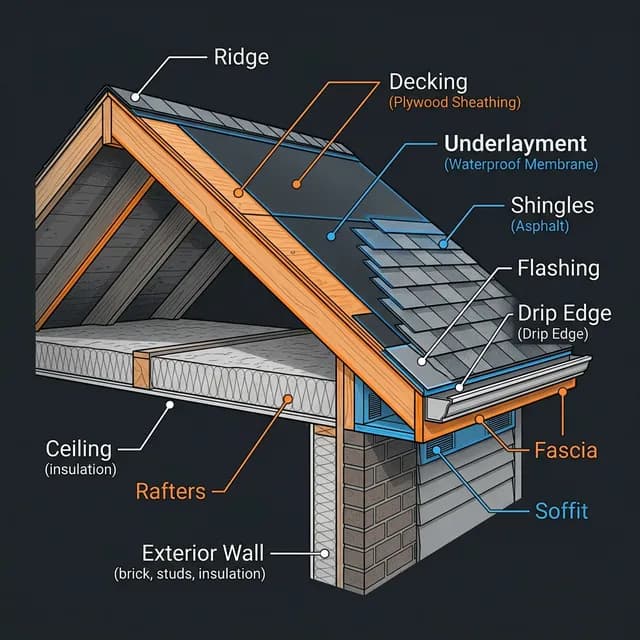
Trusses and rafters form the skeleton of your roof. Rafters are individual beams that run from the ridge (the peak) down to the eaves (the edges). Modern homes in subdivisions throughout Pooler and Richmond Hill typically use factory-built trusses — pre-assembled triangular frames that are lighter, faster to install, and engineered for specific load requirements. Older homes in Savannah's historic districts may have traditional stick-framed rafters cut and assembled on-site.
Roof Decking (Sheathing)
Decking is the flat surface — usually plywood or oriented strand board (OSB) — nailed across the trusses. It's the foundation that everything else attaches to. In Coastal Georgia, moisture is the enemy of decking. OSB is more affordable but absorbs water faster than plywood, which matters when a shingle blows off during a storm and exposes the deck to rain. During a professional roof inspection, checking decking integrity is one of the most critical steps.
The Waterproofing System: Keeping Water Out
Underlayment
Underlayment is a water-resistant or waterproof barrier installed directly on top of the decking, beneath the shingles. Think of it as your roof's second line of defense. There are three common types: felt (tar paper), synthetic, and self-adhering ice-and-water shield. In Savannah's climate, synthetic underlayment is the standard for most of the roof, while ice-and-water shield is applied in vulnerable areas like valleys and around penetrations.
Flashing
Flashing is thin metal — typically aluminum or galvanized steel — installed at every joint, transition, and penetration point. You'll find flashing where the roof meets a wall (step flashing), around chimneys (counter flashing), in valleys where two roof planes meet, and around vent pipes. Improperly installed or corroded flashing is the number-one source of roof leaks in Coastal Georgia. Salt air accelerates corrosion on Tybee Island and Wilmington Island properties, making flashing material selection critical.
Drip Edge
Drip edge is an L-shaped metal strip installed along the eaves and rakes (the sloped edges) of your roof. It directs water away from the fascia board and into the gutters. Georgia building code requires drip edge on all new roof installations. Without it, water wicks back under the shingles by capillary action, rotting the fascia and soffit over time. If your home was built before modern codes required drip edge, adding it during a roof replacement is a smart upgrade.
The Outer Layer: What You Actually See
Shingles
Shingles are the outermost covering on most Savannah homes. Architectural (dimensional) shingles are the current standard — they're thicker, more wind-resistant, and more aesthetically appealing than the older three-tab style. Premium options from brands like GAF and Atlas offer wind ratings up to 130 mph, which is essential for homes near the coast. Shingles take the brunt of UV, rain, and wind, so their quality directly determines how long your roof lasts.
Ridge Cap
Ridge cap shingles are specially shaped pieces installed along the peak of your roof where two slopes meet. They're thicker than field shingles and are designed to shed water in both directions. A common issue we see during inspections is ridge cap shingles that have been lifted or torn by wind — they're the most exposed point on any roof.
Hip and Valley Lines
Hips are the raised edges where two sloping roof planes meet at an outer angle. Valleys are the opposite — the interior angles where slopes converge and channel water downward. Valleys handle enormous volumes of water during Savannah's intense summer storms, making them high-maintenance zones that require careful flashing and shingle weaving or cutting techniques.
Ventilation: The Hidden Performance Driver
Soffit Vents
Soffits are the underside of the roof overhang. Soffit vents allow cool outside air to enter the attic space. Without adequate soffit ventilation, hot, humid Savannah air gets trapped in the attic, accelerating shingle deterioration from below and promoting mold growth on the decking.
Ridge Vents and Exhaust Vents
Ridge vents run along the roof peak and allow hot air to escape naturally as cooler air enters through the soffits. This passive convection cycle is the most efficient attic ventilation method. Some homes also use powered attic ventilators, box vents, or turbine vents. Proper ventilation balance — equal intake and exhaust — can extend shingle life by several years and lower your cooling bills throughout Savannah's long summer.
The Trim and Edge Components
Fascia
Fascia is the vertical board that runs along the lower edge of the roof, right behind the gutters. It's typically wood or composite material and serves as the mounting surface for gutters. In Savannah's humidity, wood fascia is prone to rot if not properly protected by drip edge and functioning gutters. Composite or aluminum-wrapped fascia lasts significantly longer.
Gutters and Downspouts
While technically not part of the roof itself, gutters are integral to the roof drainage system. They collect water from the drip edge and channel it away from the foundation. Clogged gutters in Savannah — often caused by pine needles and live oak debris — can cause water to back up under the shingles, creating the same damage as a missing drip edge.
Roof Penetrations: Every Hole Is a Risk
Every pipe, vent, skylight, or satellite dish that passes through your roof creates a penetration point that must be sealed. Common penetrations include:
- Plumbing vent pipes — sealed with rubber boot flashings that degrade over time in UV exposure
- HVAC exhaust vents — kitchen and bathroom fans that exit through the roof
- Skylights — require continuous flashing around all four sides
- Chimney — needs step flashing, counter flashing, and often a cricket (small diverter) to prevent water pooling
Rubber boot flashings around plumbing vents are one of the most common failure points on Savannah roofs. The rubber cracks after 10–15 years of UV exposure, allowing water to drip directly into the attic. This is one of the easiest and cheapest fixes during a routine roof repair visit.
Putting It All Together: How Components Work as a System
No single roof component works in isolation. The decking supports the underlayment, which protects the decking from moisture that gets past the shingles. Flashing seals the joints that shingles can't cover. Ventilation protects the entire assembly from moisture damage caused by trapped humidity. And the drip edge, fascia, and gutters manage the final stage of water removal. When any one element fails, it creates a cascade. A missing drip edge leads to fascia rot, which loosens the gutter, which causes foundation erosion. A blocked soffit vent leads to attic condensation, which rots the decking, which causes the shingles to buckle.
Understanding this interconnection is what separates a well-maintained Savannah home from one facing a premature roof replacement. Schedule a professional inspection annually to catch component failures before they cascade.
Know Your Roof — Protect Your Investment
Talya Roofing provides thorough roof inspections for homeowners across Savannah, Pooler, Richmond Hill, and Tybee Island. We'll walk you through every component and explain exactly what your roof needs.
Schedule Your InspectionOr call us directly: (912) 999-7989