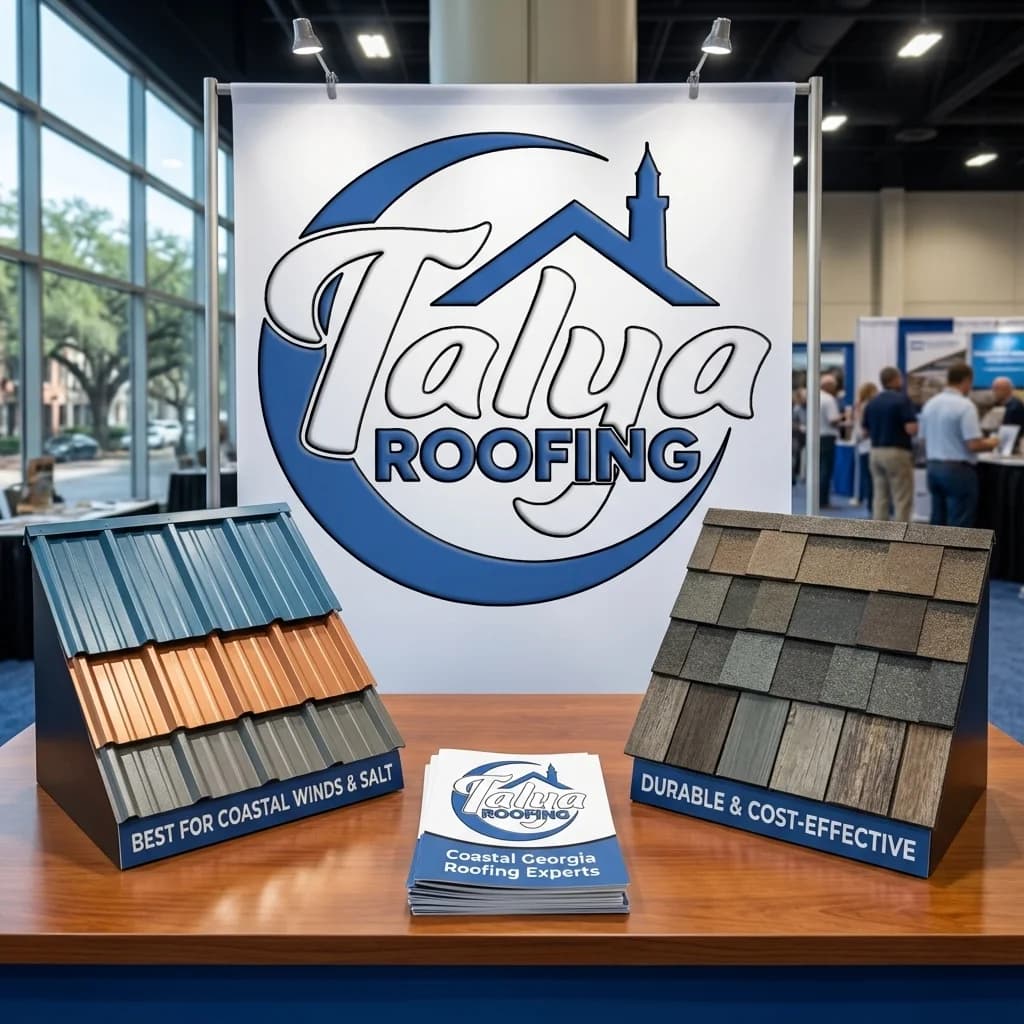

🏠 Quick Summary
- ✓ Architectural shingles (Atlas, GAF, Owens Corning, CertainTeed) offer the best balance of cost and performance for most Coastal Georgia homes
- ✓ Standing seam metal roofing delivers 40–70 year lifespan and superior hurricane resistance
- ✓ TPO and modified bitumen are the go-to options for flat and low-slope roofs
- ✓ Salt air, humidity, UV exposure, and hurricane-force winds are the four factors that define material selection in our region
- ✓ Algae-resistant granule technology is non-negotiable in Coastal Georgia's climate
- ✓ Material selection should match your roof's pitch, your budget, and your insurance requirements
Choosing roofing material for a Coastal Georgia home is not the same decision as choosing material for a house in Atlanta, Charlotte, or anywhere inland. The combination of 75%+ average humidity, salt-laden air from the Atlantic, 50+ inches of annual rainfall, punishing UV exposure, and the real threat of hurricane-force winds creates an environment where the wrong material fails years ahead of schedule.
This guide covers every mainstream roofing material available to Savannah, Pooler, Richmond Hill, and Tybee Island homeowners — with honest assessments of how each performs in our specific climate. As a contractor who has installed all of these materials across Chatham County, we are sharing what we have seen on actual local roofs, not what a manufacturer's brochure promises from a test lab in Ohio.
Architectural Shingles: The Coastal Georgia Standard
Architectural (dimensional) shingles account for roughly 80% of the residential roofs we install. They provide the best balance of cost, performance, aesthetic variety, and contractor familiarity in our market. Here is how the four major brands perform locally.
Atlas Pinnacle Pristine
Atlas built their reputation on algae resistance, and in Coastal Georgia, that matters more than almost any other feature. Pinnacle Pristine Scotchgard SKUs use a minimum 10% blend of 3M copper-ceramic granules — versus the 3–5% typical of standard algae-resistant shingles — to prevent the black algae streaks (Gloeocapsa magma) that plague roofs under heavy tree canopy and high humidity. That heavier copper dose is why Atlas backs it with a lifetime algae warranty on qualifying single-family homes — the longest algae coverage in the category. Wind rating hits 130 mph with proper installation.
GAF Timberline HDZ
GAF is the largest shingle manufacturer in North America, and the Timberline HDZ is their workhorse. The LayerLock nailing zone technology provides a 130 mph wind warranty with just four nails. StainGuard Plus algae protection carries a 25-year warranty. The HDZ is widely available, competitively priced, and every roofing crew in Savannah knows how to install it. It is a safe, reliable choice.
Owens Corning Duration
The SureNail technology is the standout here — a woven fabric strip in the nailing zone that provides exceptional grip strength. In our hands, it is the easiest shingle to install correctly in high-wind zones because the nailing target is visible and wide. TruDefinition color technology produces some of the most vibrant, high-contrast shingle colors on the market. StreakGuard algae protection carries a 10-year warranty.
CertainTeed Landmark
CertainTeed offers one of the deepest warranty structures in the industry — their Landmark Pro line carries a Lifetime Limited warranty with SureStart coverage (material and labor) and a non-prorated first 10 years. StreakFighter algae resistance carries a 30-year warranty on Landmark Pro (25 years on standard Landmark) — longer than GAF's 25 years; only Atlas's lifetime coverage beats it. The Max Def color palette is attractive but more subdued than Owens Corning's vibrancy.
Metal Roofing: Maximum Longevity and Storm Protection
Standing Seam Metal
Standing seam is the premium metal option and arguably the best-performing residential roofing material available for Coastal Georgia. Panels interlock at raised seams with concealed fasteners — no exposed screws to back out, no rubber washers to degrade. A properly installed standing seam roof handles 150+ mph winds, sheds water instantly, resists salt air corrosion (with Galvalume or aluminum substrate), and lasts 40–70 years with minimal maintenance.
The tradeoff is cost — standing seam typically runs 2–3x the price of architectural shingles installed. For homeowners planning to stay in their home long-term, the math often favors metal when you factor in zero replacements over a 50-year period.
Exposed Fastener Metal
Exposed fastener metal panels (5V-crimp, R-panel) are the budget-friendly metal option. They perform well for 20–30 years and cost significantly less than standing seam. The weakness is the fasteners themselves — every screw penetration is a potential leak point. The rubber washers beneath each screw head degrade in Savannah's UV and heat, requiring maintenance or replacement around year 15–20.
Flat and Low-Slope Roof Options
TPO (Thermoplastic Polyolefin)
TPO is the dominant flat-roof membrane in our market for both commercial and residential applications. It is heat-welded at the seams (creating a monolithic waterproof surface), highly reflective (reducing cooling costs in Savannah's 8-month warm season), and resistant to UV degradation. Typical lifespan is 20–30 years. We install TPO on flat roof sections of residential homes, screened porches, and carports throughout Savannah.
Modified Bitumen
Modified bitumen is a torch-applied or self-adhered asphalt membrane with excellent waterproofing characteristics. It performs well in Coastal Georgia and is particularly suited to small flat sections, dormers, and areas where detail work around penetrations is critical. Lifespan is 15–25 years depending on maintenance.
Tile Roofing
Concrete and clay tile roofs are rare in the Savannah market but not unheard of, particularly on Mediterranean-style or high-end custom homes on Skidaway Island and Wilmington Island. Tile lasts 50–100 years and handles UV exposure excellently. The challenge in Coastal Georgia is weight — tile is heavy, and older home framing may not support it without structural reinforcement.
Coastal Georgia Material Comparison
| Material | Lifespan | Wind Rating | Salt Air Resistance | Cost per Sq Ft | Best For |
|---|---|---|---|---|---|
| Architectural Shingles | 25–35 years | 110–130 mph | Good | $4.50–$7.00 | Most residential homes |
| Standing Seam Metal | 40–70 years | 140–160 mph | Excellent | $10.00–$18.00 | Long-term homeowners, coastal |
| Exposed Fastener Metal | 20–30 years | 110–140 mph | Good | $5.00–$9.00 | Budget metal, outbuildings |
| TPO Membrane | 20–30 years | Excellent | Excellent | $6.00–$10.00 | Flat/low-slope roofs |
| Modified Bitumen | 15–25 years | Good | Good | $5.00–$8.00 | Small flat sections, dormers |
| Concrete/Clay Tile | 50–100 years | 125–150 mph | Excellent | $12.00–$25.00 | Custom homes |
The Four Factors That Define Material Selection
1. Humidity and Algae Growth
Savannah's average relative humidity sits above 75% for much of the year. This creates ideal conditions for Gloeocapsa magma — the blue-green algae responsible for black streaks. Any material you choose must include algae-resistant technology or be inherently resistant (metal, TPO).
2. Salt Air Corrosion
Homes on Tybee Island, Wilmington Island, and along the Savannah River face salt air exposure that corrodes unprotected metal. Always specify Galvalume-coated steel or aluminum for any metal roofing component within 5 miles of the ocean.
3. Hurricane and High-Wind Exposure
Chatham County sits in a high-wind zone. Georgia building code requires roofing materials rated for the local design wind speed, which ranges from 110–140 mph in our area.
4. UV Degradation
Coastal Georgia receives intense UV radiation for 8+ months per year. UV breaks down asphalt binders, fades colors, and degrades rubber gaskets and sealants. Materials rated for high UV exposure outlast their expected lifespan here.
Which Material Should You Choose?
Best all-around value: Architectural shingles (Atlas Pinnacle Pristine or Owens Corning Duration)
Best for waterfront properties: Standing seam metal in aluminum or Galvalume
Best for flat roof sections: TPO membrane
Best budget metal: Exposed fastener 5V-crimp
The right answer depends on your roof's pitch, your budget, how long you plan to stay, and your insurance carrier's requirements. A professional roof inspection is the best starting point.
Need Help Choosing the Right Material?
Talya Roofing installs architectural shingles, standing seam metal, and TPO single-ply membrane across Savannah, Pooler, Richmond Hill, and Tybee Island. Request a complimentary project assessment and estimate to compare suitable material options for your home and budget.
Sources: Atlas Roofing Products • ENERGY STAR Roof Products