
Key Takeaways
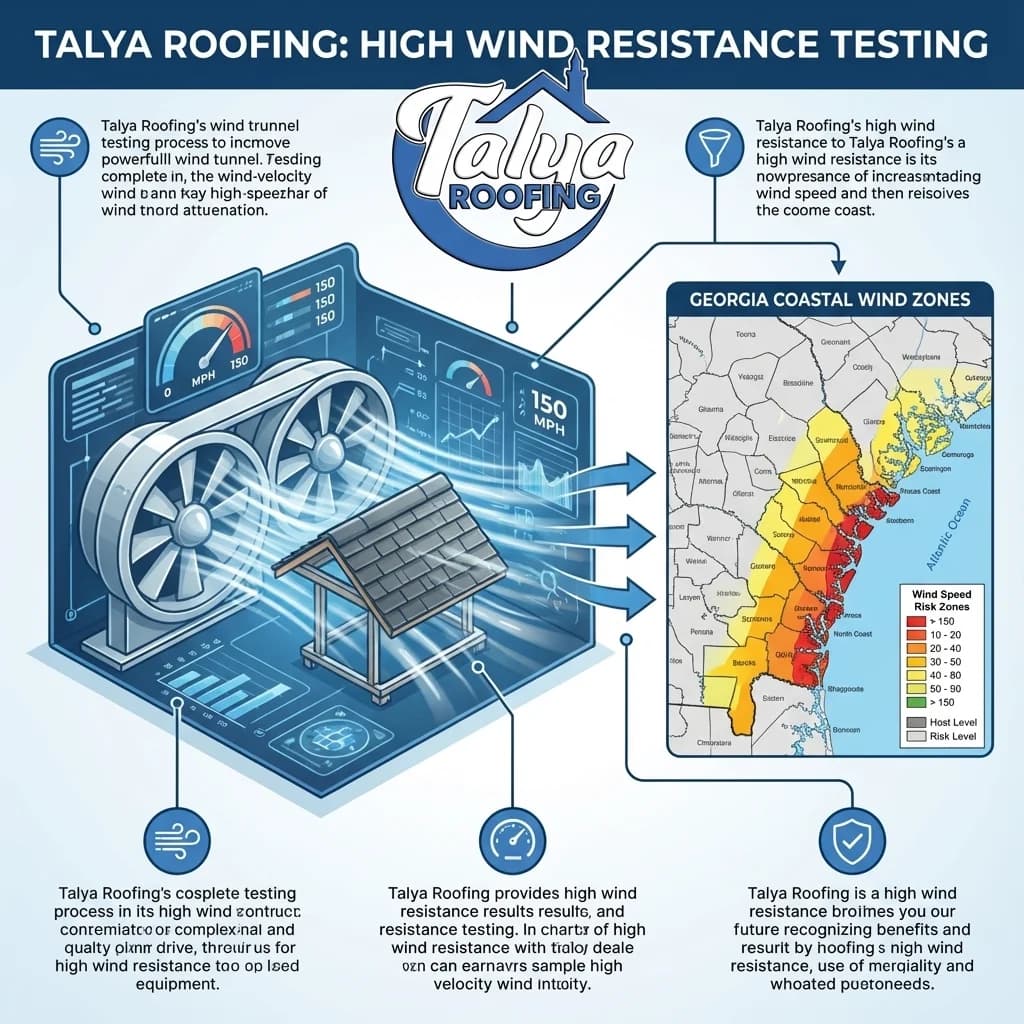
- Coastal Georgia falls within a high-velocity hurricane zone (HVHZ), requiring roofing systems rated for wind speeds of 130 mph or higher under the 2021 International Building Code adopted by the state.
- Chatham County enforces additional local amendments on fastener spacing, underlayment type, and drip-edge requirements that go beyond state minimums.
- A building permit is required for every roof replacement in unincorporated Chatham County, Savannah, Pooler, and Richmond Hill — working without one can void your insurance and warranty.
- Talya Roofing pulls all permits, schedules inspections, and installs to standards that exceed code — not just meet it.
- Understanding wind ratings (Class D, Class F, Class H) helps you choose shingles that actually protect your Coastal GA home.
Why Coastal Georgia Has Stricter Roofing Codes
Living along the Georgia coast means your roof faces a threat profile that inland homes never encounter. The combination of sustained tropical-storm-force winds, salt-laden air, and wind-driven rain creates conditions that expose every weakness in a roofing system. That is exactly why state and local building codes in Savannah, Pooler, Richmond Hill, Tybee Island, and the rest of Chatham County demand more from roofing contractors than almost anywhere else in the state.
Georgia adopted the 2021 International Building Code (IBC) and the 2021 International Residential Code (IRC) as its baseline. But the real teeth come from the wind-speed maps in ASCE 7-22, which assign Coastal Georgia a basic design wind speed of 130 mph for Risk Category II structures — the category that covers most single-family homes. In practical terms, every component of your roof — from the decking nails to the ridge cap — must be engineered and installed to survive that wind speed without failure.
Understanding Wind Zone Designations in Chatham County
Wind zones are not arbitrary labels. They are derived from decades of meteorological data, storm modeling, and post-hurricane damage assessments. For Chatham County, the relevant designations break down as follows:
| Zone | Design Wind Speed | Typical Coverage Area |
|---|---|---|
| Zone 1 (Inland) | 115 mph | Areas 60+ miles from coast |
| Zone 2 (Coastal Transition) | 120–130 mph | Pooler, Garden City, western Chatham |
| Zone 3 (Coastal High-Wind) | 130–150 mph | Savannah metro, Richmond Hill, Tybee Island |
Tybee Island and barrier-island properties face the most extreme requirements because they sit in the wind-borne debris region. Roofs on these structures must resist not only direct wind uplift but also the impact of airborne objects traveling at hurricane speeds.
Shingle Wind Ratings Explained: Class D, F, and H
When shopping for shingles, you will see wind-resistance ratings that reference ASTM D3161 (the standard test) and ASTM D7158 (the performance test). Here is what the letter grades mean:
Class D — Up to 90 mph
Class D shingles are the entry-level wind rating. They are acceptable in low-wind inland zones but do not come close to meeting Chatham County code requirements. Installing Class D shingles on a Savannah home will fail inspection every time.
Class F — Up to 110 mph
Class F offers moderate wind resistance. While better than Class D, this rating still falls short of the 130 mph design wind speed required for most Coastal Georgia homes. Some contractors install Class F to save money — and it passes in inland Georgia — but it is non-compliant here.
Class H — Up to 150 mph
Class H is the highest standard wind-resistance rating for asphalt shingles. These shingles are engineered with reinforced nailing strips, enhanced adhesive zones, and heavier mat weights. They are the minimum we install on every Talya Roofing project in Coastal Georgia — even when code technically allows a lower class in certain zones.
The Permit Process for Roof Replacements in Coastal GA
Every full roof replacement in Chatham County requires a building permit. This is not optional. The process involves several steps that a qualified contractor handles on your behalf:
- Application submission — The contractor submits the scope of work, material specifications, and engineering data to the Chatham County Department of Building Safety (or the relevant municipal office for Savannah, Pooler, or Richmond Hill).
- Plan review — The building department verifies that the proposed materials and installation methods meet the applicable wind-speed requirements for the property's location.
- Permit issuance — Once approved, the permit is posted at the job site. Work cannot begin before this step.
- Progress inspections — An inspector examines the decking, underlayment, and flashing before the final shingle layer is applied. This mid-roof inspection catches problems that would be hidden after completion.
- Final inspection — The completed roof is inspected for compliance with the permitted plans. The inspector checks nail patterns, drip-edge installation, valley treatment, and ventilation.
Skipping the permit is not just a code violation — it puts your homeowners insurance at risk. If a storm damages an unpermitted roof, your insurer can deny the claim entirely. At Talya Roofing, we handle the entire permit process from application to final sign-off, so you never have to worry about compliance gaps.
Specific Code Requirements That Affect Your Roof
Fastener Patterns
In wind zones above 120 mph, Georgia code requires a six-nail pattern for each shingle rather than the standard four-nail pattern used in lower-wind areas. The nails must penetrate the roof decking by at least 3/4 inch or pass completely through panels less than 3/4 inch thick. We use ring-shank nails for superior pull-through resistance — a step above what code requires.
Underlayment Standards
For Chatham County properties, a self-adhering modified bitumen underlayment is required along eaves, valleys, and around penetrations. The IRC mandates that in high-wind zones, the entire roof deck receives a minimum of one layer of synthetic underlayment with a perm rating that prevents moisture accumulation. We go further by using a two-layer system on every project: a peel-and-stick ice and water shield on all critical areas, plus a full-coverage synthetic underlayment beneath the shingles.
Drip Edge Requirements
Metal drip edge is required on all eaves and rakes. The drip edge must be secured with fasteners at no more than 12 inches on center, and it must extend at least 2 inches back from the roof edge. This prevents wind from getting underneath the shingle edges — one of the most common failure points during hurricanes in Savannah and Tybee Island.
How Talya Roofing Exceeds Code Requirements
Meeting code is the legal minimum. It is the floor, not the ceiling. Our installation practices exceed Georgia building code in several measurable ways:
- Six-nail pattern on every roof — regardless of the specific wind zone, we never use the four-nail pattern.
- Ring-shank nails — superior holding power compared to smooth-shank nails permitted by code.
- Full-coverage peel-and-stick underlayment — code only requires it in specific areas; we apply it to the entire deck on most projects.
- Atlas PRO+ Silver membership — we identify the Atlas products and system being quoted and provide the applicable manufacturer warranty information. Membership alone does not establish code compliance or automatically qualify a project for maximum coverage.
- Class H shingles as standard — we never install shingles rated below Class H (150 mph) in Coastal Georgia.
- Post-installation photo documentation — every critical phase is documented so you have proof of code-compliant installation for insurance purposes.
What Happens When a Roof Is Not Code-Compliant
Non-compliant roofing work creates a chain of problems that compound over time. First, the immediate risk: a roof that does not meet wind-speed requirements is more likely to fail during a storm, exposing your home's interior to catastrophic water damage. Second, your insurance company can deny coverage for storm damage on a roof that was not installed to code. Third, when you sell the property, a home inspector will flag the non-compliant roof, potentially killing the sale or requiring a full replacement before closing.
We have seen homes in Pooler and Savannah where a previous contractor installed shingles with a four-nail pattern in a six-nail zone, or skipped the self-adhering underlayment entirely. These roofs look fine on a sunny day. But the first tropical storm reveals every shortcut. A professional roof inspection can identify these hidden compliance issues before they become expensive emergencies.
Navigating Insurance Requirements Alongside Building Codes
Insurance companies operating in Coastal Georgia often have their own requirements that layer on top of building codes. Many insurers in Chatham County now require impact-resistant shingles (Class 4 rated under UL 2218) for new roof installations. Some offer premium discounts of 10–28% for roofs that exceed code with features like fortified roof-to-wall connections and sealed roof decks.
The IBHS FORTIFIED Roof designation is one of the most valuable upgrades for Coastal Georgia homeowners. It requires specific installation techniques — including a sealed roof deck, ring-shank nails, and enhanced flashing — that Talya Roofing already uses as standard practice. We can help you understand which upgrades qualify for insurance discounts and ensure your roof replacement is documented to the insurer's satisfaction.
Frequently Asked Questions
Do I need a permit for a roof repair in Savannah?
Minor repairs (patching a small area, replacing a few shingles) typically do not require a permit. However, any work that involves more than 100 square feet of decking replacement or structural modifications does require a permit. When in doubt, call Talya Roofing at (912) 999-7989 — we will tell you whether your roof repair needs a permit.
Can I re-roof over existing shingles in Chatham County?
Georgia code allows a second layer of shingles over the first in some circumstances. However, in high-wind zones like Coastal Georgia, we strongly recommend against it. The added weight compromises the roof structure, the existing shingles hide damage to the decking, and the new shingles cannot bond properly. Most insurance companies in Chatham County will not cover a layover installation.
What wind rating do I need for Tybee Island?
Tybee Island falls within the highest wind-speed zone in the Savannah metro area, requiring materials rated for at least 150 mph. We exclusively install Class H shingles or standing-seam metal roofing on Tybee properties.
Ensure Your Roof Meets Coastal Georgia Code
Not sure how observed roof conditions relate to current Chatham County requirements? Talya Roofing's $250 documented homeowner inspection includes a physical assessment when safe, annotated condition photographs, AI-assisted image organization with human review, and a written report. It is not an engineering opinion or a guarantee of code compliance; permitting officials and other authorities determine applicable requirements.
Or call us directly: (912) 999-7989