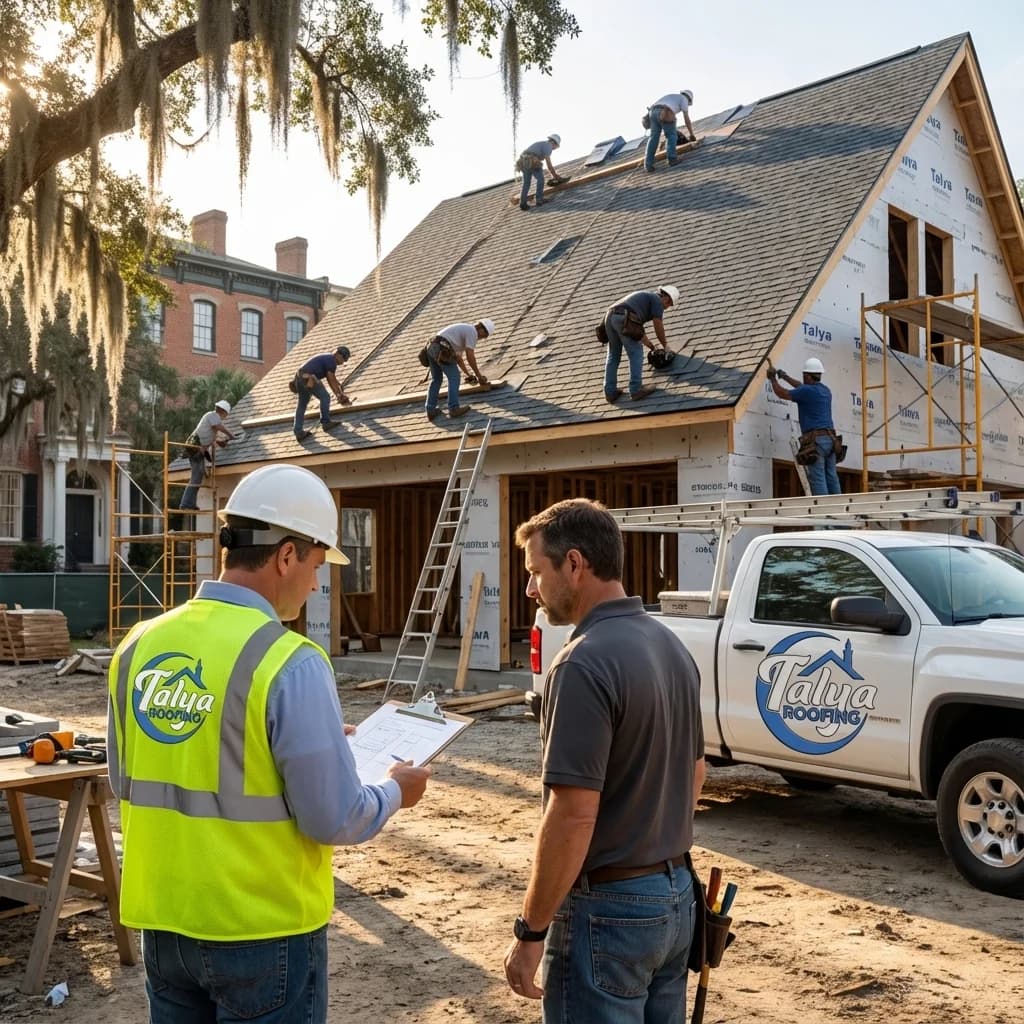

2026 Coastal Georgia Building Codes
- X New codes place significantly higher requirements on nailing patterns and deck attachment
- X High Wind Zones inside Chatham County have strict guidelines for underlayment types
- X Energy performance standards for insulation and reflectivity are tightening
- X Non-compliant roof replacements will fail municipal inspection and complicate future home sales
Coastal Georgia's building codes governing residential roofing update periodically to reflect both new material technology and updated weather modeling. For 2026 and beyond, Chatham County and adjacent coastal municipalities enforce standards designed specifically to mitigate hurricane wind uplift and water intrusion.
Key Code Requirements in Savannah
- High Wind Exposure: Coastal zones require shingles rated for the design wind speed on the permit, demanding proper 6-nail patterns rather than standard 4-nail applications.
- Deck Attachment: Replacing the roof covering now frequently triggers a requirement to re-nail the roof deck to trusses with 8d ring-shank nails to current spacing standards.
- Secondary Water Barrier: High wind zones increasingly expect synthetic underlayment or sealed decking to prevent massive water intrusion if shingles are lost.
Roofing Planned for Coastal Requirements
We pull the permits required for contracted work and build to the approved project documents and applicable requirements. Request a complimentary project assessment and estimate.
Georgia Building Code Requirements for Coastal Roofing
Coastal Georgia operates under the International Building Code (IBC) and International Residential Code (IRC), as adopted by the Georgia Department of Community Affairs. For Chatham County (Savannah, Tybee Island, Pooler) and surrounding coastal counties, additional wind-speed and flood-zone requirements apply that directly impact roofing material selection, installation methods, and inspection protocols.
Wind Speed Design Requirements
Design wind speeds (3-second gust, Category II structures) are set site by site across the Savannah metropolitan area, and the permit states the figure that applies:
| Location | Design Wind Speed | Exposure Category | Required Shingle Rating |
|---|---|---|---|
| Savannah (inland) | Per permit | B or C | ASTM D3161 Class F (110 mph) |
| Tybee Island | Per permit | C or D | Rated for the permit's design wind speed |
| Pooler / Richmond Hill | Per permit (City of Richmond Hill plans: 130 mph wind zone) | B | ASTM D3161 Class F (110 mph) |
| Barrier Islands | Per permit | D | Rated for the permit's design wind speed + enhanced fastening |
Nailing Pattern Requirements
Georgia's coastal amendments specify enhanced nailing patterns for high-wind zones. Standard (4-nail) patterns are only acceptable in inland areas with wind speeds below 110 mph. Savannah and coastal areas require:
- Standard zone: 6 nails per shingle, manufacturer-specified nail line placement
- High-wind zone: 6 nails per shingle with enhanced edge and rake fastening, 4-inch nail penetration into decking
- Hurricane zone: 6 nails per shingle plus roof deck adhesion (peel-and-stick membrane) on all vulnerable areas
Underlayment and Deck Requirements
Georgia code requires a minimum of one layer of approved underlayment (ASTM D226 Type I or ASTM D4869 Type I) for all asphalt shingle installations. For wind speeds above 120 mph, a self-adhering polymer-modified bitumen sheet (ice and water shield) is required at eaves, valleys, around penetrations, and at sidewall-to-roof intersections extending at least 24 inches from the inside edge.
Roof decking must be minimum 7/16-inch oriented strand board (OSB) or 15/32-inch plywood with 8d ring-shank nails at 6 inches on center at panel edges and 12 inches in the field. Clips or H-clips are required at unsupported panel edges for spans greater than 24 inches.
Permit and Inspection Process
Chatham County requires a building permit for any roof replacement or structural repair. The permit application requires: contractor license number, project scope description, material specifications, and wind-load calculations for the proposed system. Inspections occur at two stages: deck inspection (after old roof removal and before new installation) and final inspection (completed installation). Failing to obtain a permit can result in fines up to $1,000 per day and may void your homeowner's insurance coverage for any future claims on the roof.
Special Requirements: Historic Districts and Flood Zones
Properties in Savannah's National Landmark Historic District require an additional Certificate of Appropriateness (COA) from the Metropolitan Planning Commission Historic Preservation Office before any exterior work. Properties in FEMA flood zones must comply with additional elevation and moisture-barrier requirements, including enhanced flashing specifications at roof-to-wall connections.
2026 Code Update Summary
The Georgia Department of Community Affairs adopted several amendments to the International Residential Code (IRC) effective January 2026 that impact roofing in coastal counties. Key changes include increased fastener requirements for the Chatham County wind zone, updated energy efficiency standards that affect reflective roofing material requirements, and revised inspection protocols that add a deck integrity checkpoint before shingle installation begins.
For homeowners planning a 2026 roofing project, the most impactful change is the mandatory photographic documentation requirement during the deck inspection stage. Contractors must now photograph the exposed deck before covering it with underlayment, providing evidence of structural integrity for both the building inspector and the homeowner's records.
Working With Chatham County Inspectors
Building permits for roofing work in Chatham County are processed through the Development Services department. The typical permit timeline is 3-5 business days for straightforward residential reroof permits. Your contractor should handle the entire permitting process as part of their scope of work — if a contractor asks you to pull the permit yourself, that's a warning sign of potential licensing issues.
Inspections are required at two points: deck inspection (after tear-off, before new installation) and final inspection (completed project). Scheduling inspections promptly avoids weather-related delays, as the exposed deck must not remain uncovered overnight if rain is forecast. Most experienced Savannah roofers schedule the deck inspection for the morning of tear-off day, completing it before beginning the new installation.
Key Code Requirements for Chatham County
Chatham County — covering Savannah, Pooler, Tybee Island, Bloomingdale, Garden City, and unincorporated areas — enforces some of the strictest roofing codes in Georgia due to its coastal wind exposure. Here are the specific requirements every Savannah homeowner should understand before starting a roofing project.
Wind Rating Requirement
The most impactful code requirement for Chatham County homeowners is the design wind speed on the permit — confirm the figure with Chatham County Building Safety. This means every shingle must carry a wind classification that covers that speed, validated by the manufacturer's testing documentation. Budget shingles rated below it are non-compliant and will fail the building inspection.
6-Nail Pattern
Standard residential roofing in moderate wind zones uses a 4-nail pattern per shingle. Chatham County's high-wind designation requires a 6-nail pattern — two additional fasteners per shingle, placed according to the manufacturer's specified nail line. This enhanced pattern increases wind uplift resistance by approximately 25% compared to the standard 4-nail installation. Inspectors verify nail count and placement during the final inspection, and non-compliant installations must be corrected before passing.
Underlayment Specifications
The minimum underlayment in Chatham County's wind zone is one layer of ASTM D226 Type I (No. 15 felt) or ASTM D4869 Type I synthetic underlayment. However, for areas where wind speed exceeds 120 mph, a self-adhering polymer-modified bitumen sheet (commonly called "ice-and-water shield") is required at all eaves extending at least 24 inches beyond the interior wall line, in all valleys, around all penetrations, and at all sidewall-to-roof intersections. Synthetic underlayment is strongly recommended over felt for Savannah installations because it resists the heat and humidity that causes felt paper to wrinkle and deteriorate during the installation process.
Deck Attachment Standards
When a roof replacement triggers a deck inspection (which it always does in Chatham County), the decking must meet current attachment standards: minimum 7/16-inch OSB or 15/32-inch plywood, fastened with 8d ring-shank nails at 6 inches on center at panel edges and 12 inches on center in the field. Older homes may have decking attached with smooth-shank nails at wider spacing. If the existing attachment does not meet current code, re-nailing is required before the new roofing can be installed — an additional cost of $500-$1,500 that homeowners should anticipate.
Drip Edge and Flashing
Metal drip edge is required at all eaves and rakes in Chatham County. The drip edge must extend a minimum of 2 inches back from the roof edge under the underlayment and extend over the fascia board into the gutter. All flashing at chimneys, walls, and other transitions must be corrosion-resistant metal (aluminum or galvanized steel minimum) installed with proper step, counter, and kickout flashing configurations per the IRC.
Permit Requirements
Understanding the permit process before starting your roofing project avoids delays, ensures code compliance, and protects your investment. Here is how the permit and inspection process works in Chatham County.
When You Need a Permit
A building permit is required for any roof replacement in Chatham County — period. This applies in the City of Savannah, Pooler, Bloomingdale, Garden City, Thunderbolt, and unincorporated Chatham County. The permit is also required for major structural repairs (replacing more than a few sheets of decking) and for any work that changes the roof's profile or adds penetrations. Minor repairs (replacing a handful of shingles or sealing flashing) generally do not require a permit, but any work exceeding 100 square feet of area typically does.
Permit Cost
Chatham County residential roofing permits typically run $150-$350 depending on the scope of work and the specific municipality. Some areas charge a flat fee; others calculate based on the project value. Your contractor should include the permit fee as a line item in their estimate and handle the entire application process on your behalf. If a contractor asks you to pull the permit yourself or suggests skipping the permit to save money, treat that as a serious red flag — it may indicate licensing issues or intent to cut corners on code compliance.
The Inspection Process
Chatham County requires two inspections for a roof replacement:
- Deck inspection: After the old roofing material is removed and before the new installation begins. The inspector verifies deck attachment, structural integrity, and identifies any areas requiring repair or re-nailing. As of 2026, contractors must also photograph the exposed deck as part of the mandatory documentation requirement.
- Final inspection: After the installation is complete. The inspector verifies material specifications match the permit application, nail patterns comply with the wind zone requirements, flashing and drip edge are properly installed, and all penetrations are sealed. Ridge ventilation and proper starter strip installation are also verified.
Scheduling inspections promptly is important — the exposed deck should not remain uncovered overnight if rain is in the forecast. Experienced Savannah roofers coordinate the deck inspection for the morning of tear-off day, completing it before the new installation begins that same day.
Consequences of Skipping the Permit
Working without a permit in Chatham County carries real consequences: fines up to $1,000 per day, a stop-work order requiring the project to halt until the permit is obtained, potential requirement to remove completed work for inspection access, and complications with homeowner's insurance (some carriers will deny claims on unpermitted work). Perhaps most significantly, an unpermitted roof replacement creates a title issue when you sell your home — the buyer's inspector or lender may require the work to be brought into compliance before closing, at your expense.