
Key Takeaways
- ✓ Port Wentworth is rated LOW salt exposure — the coastal-corrosion story that governs material choice on Tybee Island is not the leading driver in 31407.
- ✓ What replaces it is industrial: constant semi-truck vibration off Hwy 21, industrial chemical smog, urban heat island off the concrete terminal yards, and river sheer winds.
- ✓ Vibration shows up as fastener back-out, not sudden structural damage. Ring-shank nails in a 6-nail pattern and standing-seam's concealed clips are the two answers.
- ✓ Commercial pricing in 31407: mechanically attached 60-mil TPO over new polyiso $7-$10 per sq ft installed; silicone restoration coating over a sound roof $2-$5 per sq ft; a qualifying recover runs 30-40% less than a tear-off.
- ✓ Parcels downwind of fueling, paint or solvent operations get chemical-resistant membrane grades — a specification choice we make for the corridor's diesel particulate and chemical fallout.
- ✓ Our documented 31407 work: repeat residential jobs along the Springwater Drive corridor, roof inspections and projects across the Miller Pond / Miller Park subdivision area off Hwy 21, and residential inspections in the Fall Lake and Burnt Oak sections with full photo documentation per job.
What makes roofing in Port Wentworth different from Savannah?
Port Wentworth roofs age on industry, not salt. At a LOW salt-exposure rating and under three miles from the port, ZIP 31407 trades coastal corrosion for constant semi-truck vibration off Hwy 21, industrial chemical smog, urban heat island off the concrete terminal yards, and river sheer winds — all under the design wind speed on the local permit.
That single swap changes almost every downstream decision. On Tybee Island, rated extreme salt exposure, corrosion resistance drives fastener and flashing selection and 316 stainless is the standard. Here the question is how a roof holds up to daily vibration, diesel particulate and heat radiating off the concrete terminal yards. Port Wentworth also runs two roofing markets inside one ZIP code. Along the Hwy 21 corridor it is flat-roof warehouses and logistics buildings serving container traffic in and out of the Port of Savannah, where the work is membrane, insulation, parapets and drainage. Just off the corridor it is fast-growing residential — Rice Hope, the master-planned D.R. Horton subdivision off Hwy 21; Newport, north of the Hwy 21 / Hwy 30 split and including The Cove at Newport; Rice Creek, a newer Landmark 24 subdivision in the growth corridor; and the historic mill-town core built around the 1917 Savannah Sugar Refinery near Old Town and Hwy 30. Our roofing work across 31407 spans both.
| Local factor | Port Wentworth (31407) | What it changes on the roof |
|---|---|---|
| Salt exposure | Low | Corrosion is a secondary input, not the governing one — except for stainless edge metal east of Hwy 21 where drift carries |
| Annual rainfall | 48" | Context for drainage design — drains are sized to peak design rainfall intensity, not the annual total; overflow scuppers back them up |
| Hurricane risk | Medium | Mechanically attached membrane with reinforced parapet terminations; 6-nail residential patterns |
| Design wind speed | Set on the permit (confirm with the city or county) | Governs fastening spec on both shingle and metal reroofs |
| Port proximity | < 3 miles | Truck vibration, diesel particulate and traffic-window logistics all become planning inputs |
| Documented challenges | Semi-truck vibration · industrial chemical smog · traffic logistics | Fastener selection, membrane grade, and mobilization scheduling |
Does semi-truck vibration on Hwy 21 actually damage a roof?
Yes — and the failure mode is fastener back-out, not sudden structural damage. Constant semi-truck vibration off the Hwy 21 corridor works nails loose in a shingle field. On residential work in 31407 we run 6-nail patterns with ring-shank nails to resist pull-through, and standing-seam metal's concealed clips sidestep the problem altogether.
On the metal side, standing-seam attaches with concealed clips instead of face-driven fasteners, so there is no exposed fastener to work loose in the first place — which is why standing-seam metal systems belong in the conversation on this corridor. To be precise about the limits of this claim: this is a fastener-retention issue we address with fastening spec. It is not a structural or framing claim, and we are not asserting that truck traffic damages the building itself.
How do diesel soot and industrial air affect a Port Wentworth roof?
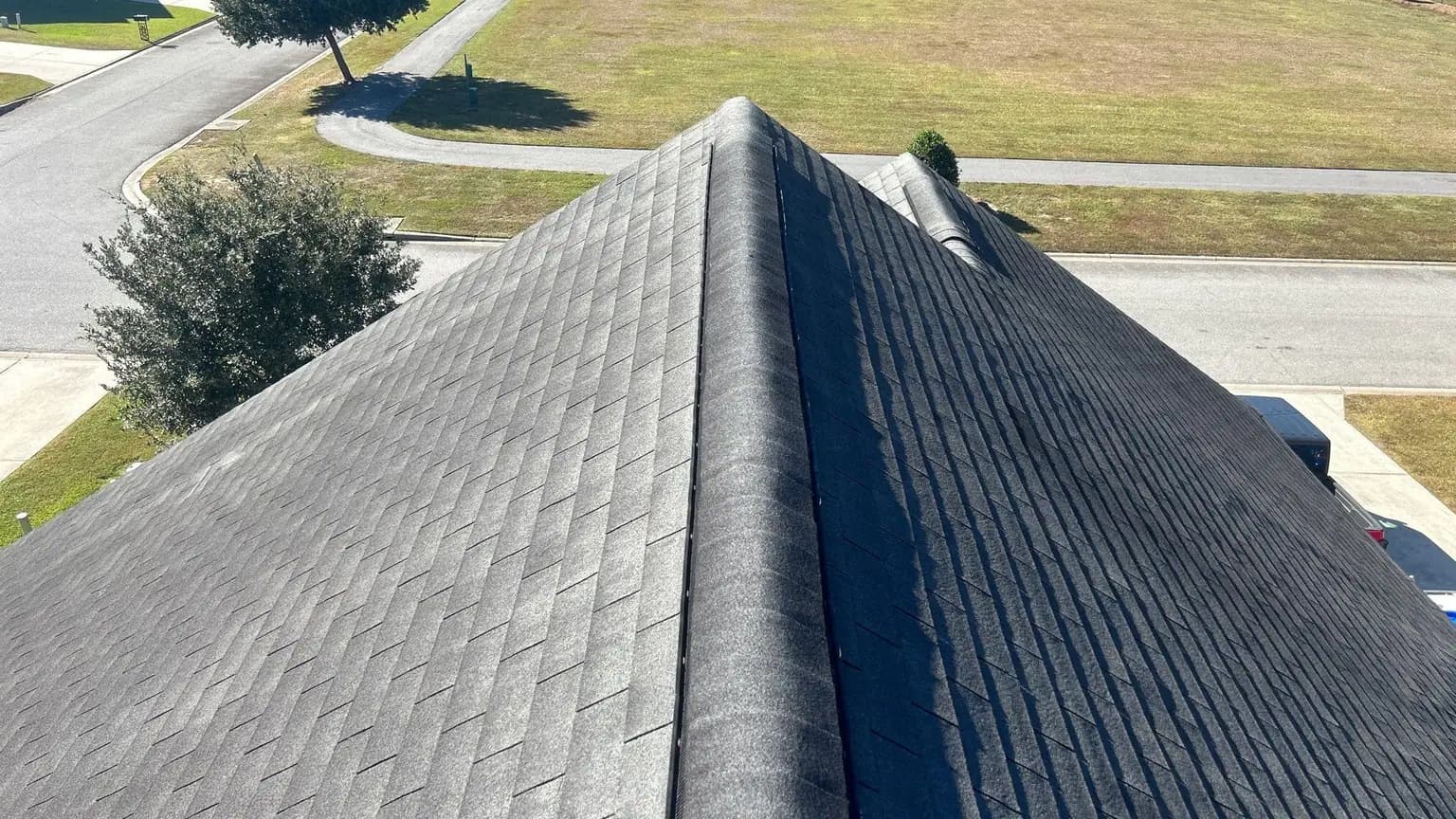
Cosmetically on shingles, and as a membrane-selection input on flat roofs. Diesel particulate from container traffic settles on roofs across the corridor, which is why we spec dark-profile Scotchgard-protected shingles that mask the buildup. On membranes we treat diesel particulate and chemical fallout from neighbouring industrial tenants as a specification input, so downwind parcels get chemical-resistant membrane grades.
On the residential side this is mostly an appearance and maintenance question. We use Scotchgard-protected dark-profile shingles on residential work in 31407 for the same reason. On the commercial side it is a materials-engineering question with real consequences. Where a building sits directly downwind of fueling, paint or solvent operations, we specify chemical-resistant TPO grades rather than the standard formulation, and we flag any rooftop HVAC condensate runoff during inspections. One honest boundary: we are describing membrane compatibility and shingle appearance, both of which we manage through product selection. We are not making a public-health claim about air quality in Port Wentworth, and nothing here should be read that way.
TPO membrane or silicone coating on a Hwy 21 warehouse?
New 60-mil TPO is the default on a clean deck; silicone restoration is the answer on a sound-but-weathered roof. Mechanically attached TPO over new polyiso runs $7-$10 per square foot installed in Port Wentworth. A silicone restoration coating runs $2-$5 per square foot and avoids the disposal cost and downtime of a tear-off.
On a clean deck with good slope, mechanically attached 60-mil TPO is our default in 31407. The white reflective surface pushes back against the urban heat island coming off the concrete terminal yards, and heat-welded seams hold against river sheer winds. A silicone restoration coating enters the conversation when the existing roof is structurally sound but weathered — it seals seams and aging surfaces, restores reflectivity, and extends service life for a fraction of a tear-off. A recover sits between the two: new membrane over a separator sheet on top of a single existing layer, typically 30-40% less per square than tearing off. The gate on every recover is a core sample. Recovering over saturated polyiso traps moisture and voids most manufacturer warranties, so we core first and go to tear-off when the samples show more than 25% wet insulation or the roof already carries two layers. Tapered polyiso goes in wherever positive slope to drains and scuppers is missing. For the membrane-versus-membrane engineering behind that choice, our breakdown of how TPO stacks up against EPDM on Coastal Georgia flat roofs goes deeper, and our silicone restoration coating service covers the coating path. On flat and commercial work our systems are TPO single-ply membrane and silicone restoration coatings, plus standing seam metal. EPDM, PVC, modified bitumen and built-up roofing sit outside that scope entirely, so if one of those is the right answer for your building we will tell you rather than sell around it.
| Approach | Installed cost (Port Wentworth) | When it is the right call | Disqualifier |
|---|---|---|---|
| New mechanically attached 60-mil TPO over polyiso | $7-$10 / sq ft | Clean deck, good slope, or an assembly already at two layers | Nothing — this is the fallback when the others are ruled out |
| TPO recover over a separator sheet | Roughly 30-40% less than tear-off | Dry deck, one existing layer, sound parapet flashings | Cores showing >25% wet insulation, or two existing layers |
| Silicone restoration coating | $2-$5 / sq ft | Structurally sound but weathered roof; parapet-bound roofs that cannot accept membrane termination upgrades | Failing substrate or trapped moisture in the assembly |
Do Port Wentworth warehouses need drains, scuppers, or both?
Both, on most Hwy 21 warehouses. Primary internal roof drains carry the design rainfall load — sized to the code's peak design rainfall rate for the jurisdiction, not to Port Wentworth's 48-inch annual total — and parapet scuppers act as overflow to prevent pond depth from exceeding deflection limits during a tropical-system rain event.
During membrane work we re-set drain bowls with new clamping rings rather than reusing tired hardware, and we add scuppers wherever the existing relief is undersized against the overflow provisions in the building code. Hurricane Irma made the case in 2017: tropical-storm-force winds and heavy rain stressed drainage across the Hwy 21 industrial corridor, and several warehouses ponded past deflection limits specifically where scuppers were undersized. That is why code-sized overflow scuppers are non-negotiable in our Port Wentworth flat-roof retrofit spec, regardless of how tidy the primary drain layout looks on paper. Parapet detailing runs alongside it — on older 31407 warehouses we strip failing through-wall counter-flashing back to sound substrate, install new through-wall reglet or surface-mounted termination bar with sealant tape, and run membrane up and over the parapet cap with prefabricated corners at every change of direction.
What should Rice Hope and Newport homeowners check on a builder roof?
Check the nailing pattern before your one-year builder warranty closes. The issues we routinely find on fast-built 31407 subdivision roofs are 4-nail patterns where the shingle manufacturer's high-wind spec calls for 6, misaligned starter strips at the eaves, exposed field nails, and thin flashing around pipe boots.
Port Wentworth has grown quickly, and that growth has a roofing consequence: much of it is new subdivision construction in Rice Hope, Newport and Rice Creek along the Hwy 21 and Hwy 30 corridors, and a lot of those roofs go on fast, with builder-grade fastening. Catching a 4-nail pattern inside the warranty window gives you dated photo documentation to take back to the builder; after the window closes you usually pay out of pocket for the same fix. Open-field exposure across the corridor means windward eaves and ridge caps take the brunt of summer downdrafts, so the high-wind fastening pattern matters here. On our own residential replacements in 31407 we run 6-nail ring-shank patterns, double-bead ridge cap sealing, and dark-profile shingles that mask corridor soot, and most jobs close in two to three days with off-peak material staging so neighbourhood streets stay clear. A documented pre-warranty roof inspection is how you get that dated photo record before the window closes.
Do I need a permit to replace a roof in Port Wentworth, GA?
Yes for a full replacement — and which office you deal with depends on your parcel. Inside city limits, the City of Port Wentworth Planning & Development department handles permitting and inspection. Parcels just outside city limits route through Chatham County instead, so we confirm the jurisdiction off the parcel record before quoting.
Port Wentworth is a Chatham County coastal jurisdiction, so reroofs are specified to the design wind speed on the permit under Georgia's adoption of the International codes. We verify the permit requirement before any work begins on a 31407 home, pull the permit, schedule any required closeout inspection, and hand you the permit copy for your resale and insurance file. Repair-only work can fall below the permit threshold depending on scope, which is why we check first rather than assume. If you want the code background rather than the paperwork, our explainer on coastal building codes and wind ratings in Chatham County covers where design wind speeds come from and how they translate into a fastening schedule. We are City of Savannah business licensed and insured, and we coordinate the required Port Wentworth and 31407 permits per project.
Permit office: City of Port Wentworth — Permits & Licenses
What have hurricanes actually done to Port Wentworth roofs?
Four storms since 2016 wrote the local spec. Matthew lifted shingles along Hwy 21; Irma exposed undersized scuppers on the industrial corridor; Idalia exposed aged TPO near end-of-life; Helene brought oak strikes into Rice Hope and rooftop equipment damage on warehouses.
Each storm points to something concrete in how we specify roofs here. Mechanically attached membrane with reinforced parapet termination bars is our standard on Port Wentworth commercial bids, and 6-nail patterns are our residential standard in 31407, because older 4-nail installs in Rice Hope lost ridge caps and starter strips to Matthew's gusts off the Savannah River. Code-sized overflow scuppers are non-negotiable in that spec; Irma is the storm that exposed undersized ones. Idalia demonstrated that aged single-ply membranes near end-of-life are the most exposed roofs in a tropical system, and that pre-storm inspection photos give you a useful baseline for comparing conditions afterwards. Helene reinforced that ring-shank nailing and reinforced rooftop equipment curbs pay for themselves the first time a 60-foot pine or oak comes down across the deck.
| Storm | Date | Local roofing effect | Report |
|---|---|---|---|
| Matthew | Oct 7-8, 2016 | Shingle uplift along Hwy 21 and torn membrane terminations on terminal-adjacent warehouses | NHC |
| Irma | Sep 11, 2017 | Flat-roof drainage stressed corridor-wide; several warehouses ponded past deflection limits where scuppers were undersized | NHC |
| Idalia | Aug 30, 2023 | Aged TPO along Hwy 21 flagged for repair-versus-recover assessments after the storm | NHC |
| Helene | Sep 26-27, 2024 | Oak strikes on Rice Hope homes; rooftop equipment damage from airborne debris on Hwy 21 warehouses | NHC |
How often should a Port Wentworth commercial roof be inspected?
Annually at minimum, on a documented 5-year cycle for any roof carrying a manufacturer NDL warranty. We walk the roof in spring before hurricane season and again in late fall, photo-document seams, terminations, drains and rooftop equipment penetrations, and submit a written report with prioritized repairs.
The economics are simple and unforgiving. Catching a failed pitch pan or split seam at year four is a $400 fix; missing it through year seven is a deck rebuild. That is the entire argument for a documented cycle, and it is why we quote 5-year inspection cycles by the square so facilities managers can budget recoats before tear-offs become unavoidable. The corridor adds two wrinkles worth planning for. First, work has to fit around live operations: we schedule material deliveries and crane setups outside peak container-traffic windows on Hwy 21, position roll-offs to keep loading docks clear, and run hot-work permits, fire-watch protocols and odor-control planning as standard on any commercial mobilization in 31407. Second, timing on any storm response depends on crew availability, travel conditions and safe weather — we do not promise arrival windows. If you want the numbers behind preventive spending, our write-up on what commercial roof maintenance actually returns lays out the math, and our commercial roofing program and TPO membrane systems pages cover scope.
Where in Port Wentworth has Talya actually worked?
Our documented work in 31407 concentrates in three residential pockets. Repeat work along the Springwater Drive corridor, with multiple homes on the same street inspected and serviced; inspections and projects across the Miller Pond and Miller Park subdivision area off Hwy 21; and inspections in the Fall Lake and Burnt Oak sections, with full photo documentation per job.
Repeat work on the same street is the part that matters — it means neighbours saw the job and called us next. Our Port Wentworth work to date is residential. We install TPO membrane and silicone restoration coatings on flat and low-slope roofs and will quote a Hwy 21 building on that basis, but we are not going to claim a warehouse track record in 31407 that we have not built yet. We work throughout the corridor, including neighbouring Garden City, and the full local scope lives on our Port Wentworth service page.
What can Talya do after a storm in Port Wentworth?
Stabilize first, document second, quote the permanent repair third. We offer fast emergency and storm response in a corridor that has taken hits from Matthew, Irma, Idalia and Helene — tarping torn shingle fields, sealing failed membrane terminations, clearing tree-strike debris before water tracks deeper into the deck.
Once the building is dry we photograph visible conditions at seams, terminations, drains and shingle fields, take measurements, and provide an itemized construction estimate quoted against the design wind speed on the permit. When requested, we can attend an on-site adjuster meeting to explain our construction scope. To be clear about the boundaries: we do not file or negotiate an insurance claim and we do not promise a recovery. The policyholder or an appropriately licensed representative handles submissions and advocacy, and the carrier and the policy decide coverage and payment. Response timing depends on crew availability, travel conditions and safe weather.
Sources
- Hurricane Matthew (Oct 7-8, 2016) — NOAA National Hurricane Center Tropical Cyclone Report
- Hurricane Irma (Sep 11, 2017) — NOAA National Hurricane Center Tropical Cyclone Report
- Hurricane Idalia (Aug 30, 2023) — NOAA National Hurricane Center Tropical Cyclone Report
- Hurricane Helene (Sep 26-27, 2024) — NOAA National Hurricane Center Tropical Cyclone Report
- Scotchgard™ Protector algae resistance on Atlas shingles — Atlas Roofing: Benefits of Scotchgard Protector
- Permitting — City of Port Wentworth, Permits & Licenses
- Local pricing, weather profile, neighbourhood detail and documented job locations — Talya Roofing's Port Wentworth service record for ZIP 31407
Roof on the Hwy 21 corridor or in Rice Hope? Get a free estimate.
Warehouse membrane, silicone restoration, or a 31407 shingle replacement — call (912) 999-7989 or see our Port Wentworth roofing coverage.