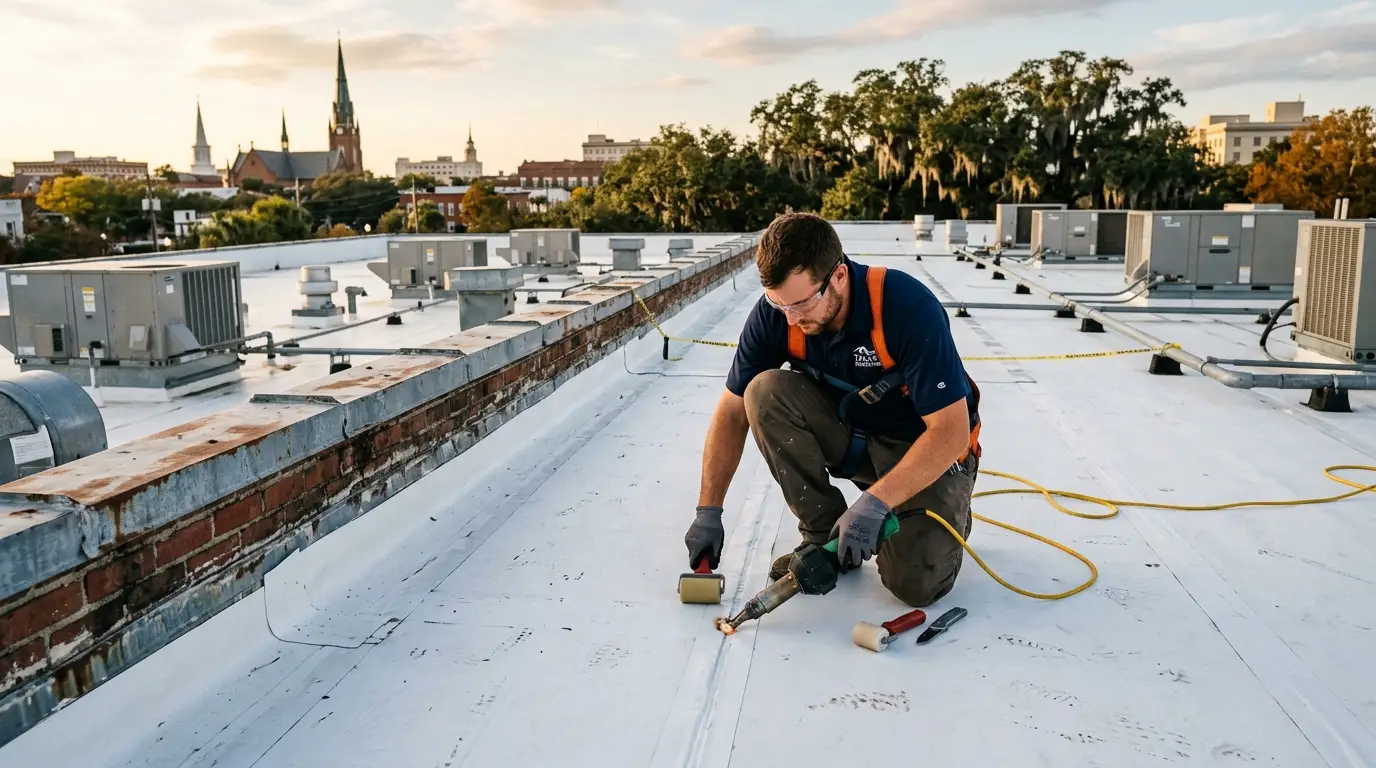

If you're a Savannah commercial property owner evaluating a flat-roof replacement, TPO vs EPDM is the question you'll spend the most time on — and the one most contractors over-simplify. The honest answer in Coastal Georgia is: both can work, both can fail, and the difference between a 28-year roof and a 12-year roof has more to do with install quality and detail work at penetrations than with which membrane you picked.
This guide walks through the mechanical differences, the real 2026 installed cost for Savannah buildings, the hurricane wind-rating reality under Chatham County's high-wind design requirements, the common failure modes we've seen across both systems on Coastal Georgia roofs, and a decision framework that aligns membrane choice to building use. Numbers and recommendations are pulled from Talya Roofing's commercial flat-roof project log for Savannah, Pooler, Garden City, Port Wentworth, and Brunswick — what these systems actually cost and how they actually behave, not the manufacturer-marketing version.
Key Takeaways
- ✓ TPO usually wins on UV reflectivity (white surface, 80%+ solar reflectance → 10-30% cooling-bill reduction); EPDM usually wins on tear-resistance, weld-free seams, and tolerance for amateur install/foot traffic.
- ✓ 2026 Savannah installed cost: TPO $7.50–$11.50/sq ft; EPDM $6.00–$9.50/sq ft. On a 10,000 sq ft warehouse that's a $15K–$20K total-project delta.
- ✓ Hurricane rating: TPO mechanically-fastened to 130 mph (150+ at tightened-perimeter); EPDM fully-adhered to 130 mph. Ballasted EPDM is a non-starter for Chatham County wind code.
- ✓ Real Savannah lifespans: TPO 22-30 years (depends heavily on seam-weld quality); EPDM 25-30 years (depends on adhesive cure-condition). Both shortened ~5-10% vs inland GA by salt-air + UV intensity.
- ✓ The actual decision rule: TPO for restaurants/schools/healthcare (HVAC load matters); EPDM for manufacturing/retail/retrofits/budget projects. Neither is universally better — match the membrane to building use.
Why This Comparison Matters Specifically in Coastal Georgia
A flat-roof membrane decision in Atlanta is not the same decision in Savannah. Three Coastal-Georgia-specific factors shift the math:
- UV intensity. Coastal Georgia gets more direct annual solar load than inland Georgia (less cloud cover, more reflective water proximity). White TPO's 80%+ solar reflectance pays back faster on Savannah cooling bills than on Atlanta cooling bills — a real annual energy-cost differential of 10-30% on rooftop-heat-driven HVAC zones.
- Humidity + salt-air. Average summer dew points 72-78°F mean adhesives cure slower (and sometimes incorrectly) without proper installer attention. Salt deposits accelerate UV-driven plasticizer migration in both TPO and EPDM — roughly 5-10% lifespan reduction vs inland installations.
- Hurricane wind-uplift. Chatham County's ASCE 7 wind design governs the uplift spec here. Mechanically-fastened TPO and fully-adhered EPDM both clear this — but the fastener density (TPO) and adhesive coverage (EPDM) get tightened from inland specs. A contractor without Coastal Georgia wind-uplift experience often files the wrong calc.
Translation: a generic "TPO is better than EPDM" claim from a contractor who doesn't live and work in Coastal Georgia is not a Coastal Georgia answer. The right answer depends on YOUR building's geometry, occupancy use, and rooftop traffic profile — none of which the membrane-marketing pitch covers.
TPO Mechanics — What It Is, How It Installs, Where It Wins
TPO (thermoplastic polyolefin) is a single-ply white-or-light-gray membrane in 45-, 60-, and 80-mil thicknesses. Standard install methods on Coastal Georgia commercial:
- Mechanically fastened. Most common method for 5,000–50,000 sq ft warehouses, retail, light-industrial. Plates and fasteners at the membrane laps, hot-air-welded seam closure. Cheapest install method, slightly noisier under high wind (membrane "flap" sound), 130 mph standard rating with tightened-corner-perimeter detail.
- Fully adhered. Used on higher-wind-rated jobs (Tybee, Wilmington coastal commercial), schools, healthcare. Adhesive bonded to insulation board across the full field. More expensive (~20-30% labor premium), no wind-flap sound, 150+ mph rating typical.
- Ballasted. Aggregate or paver loaded over loose-laid membrane. Mostly NOT used in Coastal Georgia — the structural deck load + wind-uplift behavior of ballast doesn't work well in hurricane zones.
Where TPO wins in Savannah:
- Buildings where rooftop temperature drives HVAC load. Restaurants, schools, churches, healthcare facilities, office buildings with rooftop chiller units. The 80%+ solar reflectance translates directly to lower cooling bills.
- New construction where seam-welding equipment access is easy (open field, no overhead obstructions).
- Buildings pursuing LEED or other green-build credits — TPO white roofs earn cool-roof credits in most rating systems.
EPDM Mechanics — What It Is, How It Installs, Where It Wins
EPDM (ethylene propylene diene monomer — a synthetic rubber) is a single-ply black membrane in 45-, 60-, and 90-mil thicknesses. Standard install methods on Coastal Georgia commercial:
- Fully adhered. Most common method for commercial Coastal Georgia. Adhesive bonded across the full field. 130 mph wind rating, no fastener penetrations through the membrane. The Talya default for retail / restaurant / municipal.
- Mechanically fastened. Less common than adhered for new commercial because EPDM seams are taped (cured tape applied at seams) rather than welded — the mechanical-fastener layout interferes with seam-tape integrity if not laid out carefully.
- Ballasted. Same as TPO — mostly not used in Coastal Georgia for the same wind-uplift reasons.
Where EPDM wins in Savannah:
- Retrofits over existing failing membrane. EPDM's flexibility tolerates substrate movement and pre-existing low spots better than TPO.
- Manufacturing facilities and warehouses with heavy rooftop foot traffic for HVAC/equipment maintenance. EPDM's tear-resistance handles boot traffic and dragged tool boxes better than TPO.
- Budget-driven retail and light-industrial where the $1.50–$2.00/sq ft savings vs TPO is the deciding factor and rooftop temperature isn't operationally critical.
- Buildings where seam quality matters more than membrane field strength — EPDM's adhesive-bonded or tape-sealed seams are more forgiving of installer technique than TPO's hot-welded seams.
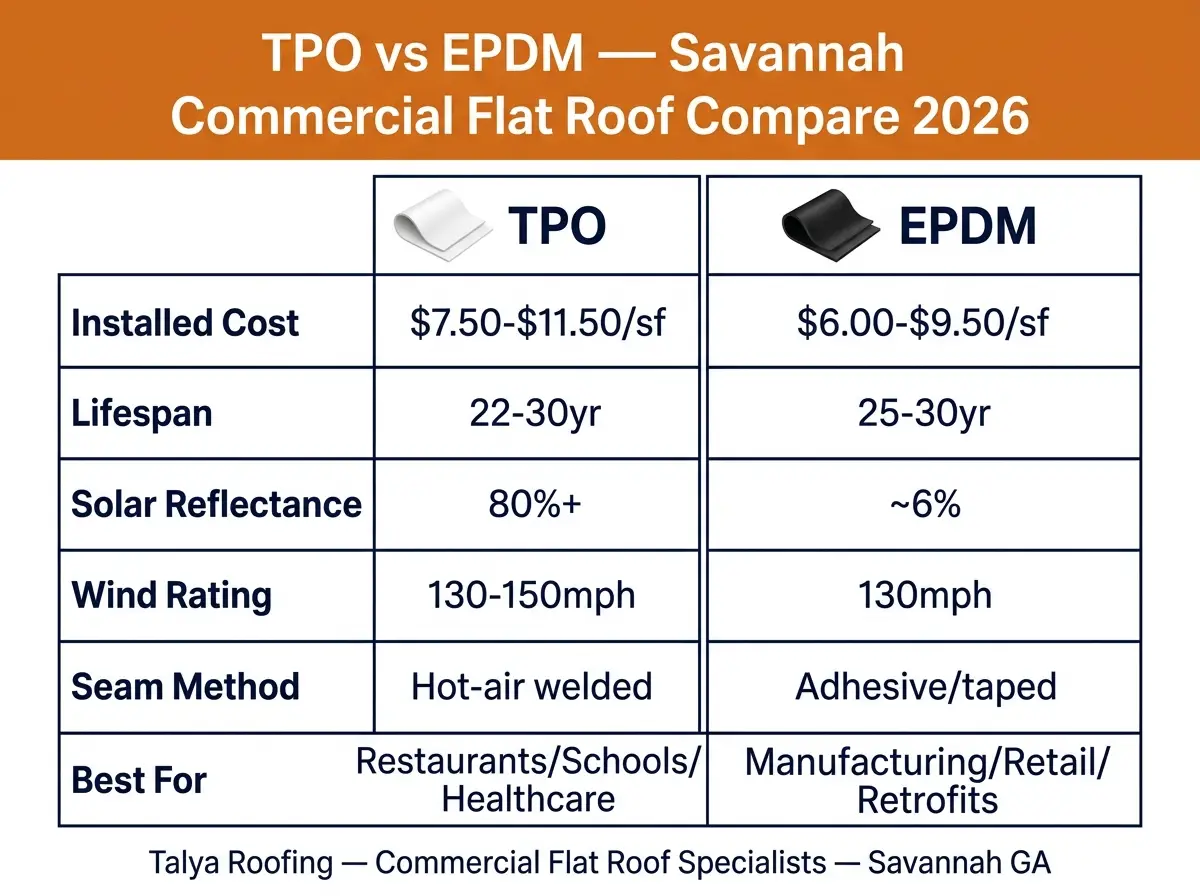
Side-by-Side Comparison: Cost, Lifespan, Wind Rating, Energy
| Factor | TPO (Savannah 2026) | EPDM (Savannah 2026) |
|---|---|---|
| Installed cost per sq ft | $7.50–$11.50 | $6.00–$9.50 |
| 10,000 sq ft project total | $75K–$115K | $60K–$95K |
| Spec lifespan (manufacturer) | 25-35 years | 25-30 years |
| Observed Coastal Georgia lifespan | 22-30 years | 25-30 years |
| Solar reflectance | 80%+ (white) | ~6% (black) |
| Cooling-bill impact vs dark roof | 10-30% reduction | baseline |
| Wind rating (mech-fast / adhered) | 130 / 150+ mph | N/A / 130 mph |
| Seam method | Hot-air welded | Adhesive bonded or taped |
| Tear resistance | Moderate | High |
| Tolerance for amateur install | Low (weld skill required) | Higher |
| Best fit | Restaurants, schools, healthcare | Manufacturing, retail, retrofits |
Common Failure Modes in the Savannah Climate
From Talya Roofing's commercial repair-and-replace log over the last 36 months, the failure modes we see at the inspection stage:
- TPO seam weld failures (year 10-15). Cause: installer used a lower-temp weld setting than spec (common with crews new to the membrane), or welded during high-humidity conditions (typical Savannah summer afternoons). Symptom: seams pop open along long runs, water enters underneath. Prevention: hire a manufacturer-certified TPO installer; demand seam-probe QC verification.
- EPDM adhesive degradation (year 12-18). Cause: adhesive cured under high-humidity Coastal Georgia conditions where it didn't fully evaporate volatile solvents. Symptom: membrane begins detaching from the substrate in waves, becoming a wind-uplift hazard. Prevention: schedule adhesive applications in low-humidity windows (mornings, post-cold-front) or use water-based adhesives spec'd for high-humidity.
- Flashing failures at penetrations (BOTH membranes, year 8-15). Cause: detail work shortcuts at pipe boots, HVAC curbs, scuppers. Symptom: water enters at the penetration before any membrane field issue. Prevention: this is where contractor experience matters most — same membrane, different installer, dramatically different outcome.
- Wind-uplift at building corners (BOTH, post-named-storm). Cause: fastener spacing or adhesive coverage spec'd for field zones used at corners. Symptom: membrane peels back from the corner inward. Prevention: corner-zone uplift calcs must be on the permit submission; check before signing.
All four of these failures are install-quality problems, not membrane-choice problems. Across 20+ Savannah commercial roofs Talya has inspected for catastrophic leak issues since 2023, NONE were caused by the membrane being the "wrong" type. Every single one traced back to a detail-work or fastener-spacing failure that would have happened regardless of which membrane was selected.
The Decision Tree — Picking the Right Membrane for Your Building Type
A practical decision framework for Savannah commercial property owners:
- Restaurant, school, healthcare, office with rooftop chillers? → TPO. Cooling-bill savings repay the cost premium inside 5-8 years on most Coastal Georgia operational profiles.
- Warehouse, manufacturing, retail with heavy rooftop foot traffic? → EPDM. Tear-resistance and forgiveness of repeat trade access matter more than reflectivity.
- Retrofit over existing failing membrane? → EPDM. Tolerance of substrate movement and pre-existing low spots is higher than TPO.
- Tight-budget project with rooftop temperature not operationally critical? → EPDM. The $1.50-$2.00/sq ft savings is real and the lifespan parity is real.
- LEED / Green Globes certification pursuit? → TPO. White-roof cool-roof credits available under most rating systems.
- Tybee / Wilmington / Skidaway coastal commercial? → Either, but specify fully adhered (TPO 80-mil or EPDM 90-mil) for the higher wind exposure. Skip the mechanically-fastened spec.
If your project doesn't fit cleanly into one of these buckets, we'll walk through the decision with you in a free commercial roof consultation. Most Savannah commercial owners we talk to end up with a clear answer within a 30-minute conversation once we understand the building's use, traffic, and operational priorities.
Why the Contractor Matters More Than the Membrane Choice
The single highest-impact decision on a Savannah commercial flat-roof project isn't TPO vs EPDM — it's whether the contractor is a flat-roof specialist with manufacturer certification and Coastal Georgia experience, or a residential roofer bidding flat as a side business.
Specialist commercial flat-roof contractors carry:
- Manufacturer certification on the specific system (GAF Master Select, Carlisle Authorized Applicator, Firestone Building Products Red Shield, Mule-Hide Warranty Eligible).
- The right tooling: hot-air welders, seam probes, tapered-insulation cutting templates, vacuum lifting for membrane rolls, access equipment for building height.
- Commercial GL $1M+ with you named as additional insured.
- 20+ completed Coastal Georgia flat-roof jobs in the last 24 months — specifically Coastal Georgia, not inland-Georgia work mistaken for coastal.
- Wind-uplift calculation experience for Chatham County's high-wind design requirements, including the V-zone / AE-overlay add-ons for waterfront properties.
For a deeper vetting checklist see our 2026 Savannah Flat Roof Contractor Vetting Guide — it covers the 6 questions every commercial property owner should ask before signing.
Evaluating a flat-roof replacement in Coastal Georgia?
Talya Roofing provides free commercial flat-roof consultations across Chatham, Bryan, Effingham, and Liberty counties. Bring your building specs and operational priorities; we'll walk you through your options for YOUR specific situation — and where TPO membrane or a restoration coating is the right call — with honest cost ranges and lifespan estimates.
Call (912) 999-7989 or request a commercial consultation — turnaround typically same week.