Garden City GA Commercial Roofing
Flat-roof TPO membrane and silicone restoration coatings for the Hwy 21 truck corridor and Garden City Terminal warehouses, plus residential shingle work in 31408. 130 mph wind code, per-square pricing.
Garden City Roofing Services
Complete roofing solutions tailored for Garden City's unique conditions and requirements.
Commercial TPO Flat Roofs
Available in Garden City →
TPO Tear-Off & Recover
Available in Garden City →
Warehouse Roof Coating Programs
Available in Garden City →
Residential Shingle Replacements
Available in Garden City →
Why Choose Us in Garden City
Garden City Roofing Challenges
Weather Factors
Garden City Terminal & Hwy 21 Warehouse Work
Garden City sits on top of the largest single container terminal in Georgia, and the Hwy 21 truck corridor moves that freight day and night. The commercial market in 31408 is dominated by tilt-up and pre-engineered metal warehouses on 40,000 to 150,000 sq ft footprints — single-ply membranes, coated assemblies, and aged built-up roofs. Our commercial spec is mechanically attached 60-mil TPO over polyiso on new builds and recovers, and document scope per square so facilities managers can budget against next fiscal year.
Recover vs. Tear-Off — How We Decide in 31408
On a Garden City warehouse with one existing membrane layer, dry polyiso cores, and sound parapet flashings, a TPO recover over a separator sheet runs roughly 30-40% less per square than a full tear-off. We core-sample for moisture before bidding — recovering over saturated insulation traps water, voids most manufacturer NDL warranties, and cuts the new system's life. Tear-off becomes the right call when cores show >25% wet insulation, the roof carries two layers already, or the deck shows fastener pullout from years of truck-corridor vibration.
- Mechanically attached 60-mil TPO with heat-welded seams
- Chemical-resistant TPO grades for parapet-heavy retrofits and high-exposure parcels
- Tapered polyiso for positive slope to drains and overflow scuppers
- Per-square line-item pricing on every commercial proposal
Hwy 21 Logistics — Working Around Container Traffic
Hwy 21 doesn't slow down for a roof job. We schedule material deliveries, crane setups, and roll-off swaps outside peak container-traffic windows, stage tear-off debris to keep loading docks clear, and coordinate with facilities managers on tenant occupancy. Hot-work permits, fire-watch protocols, and odor-control planning for occupied warehouse spaces are standard practice on a commercial mobilization. Residential work in the 31408 neighborhoods runs in parallel — 6-nail patterns with ring-shank fasteners on shingle replacements to resist the constant truck vibration.
Residential Roofs in the Established Garden City Neighborhoods
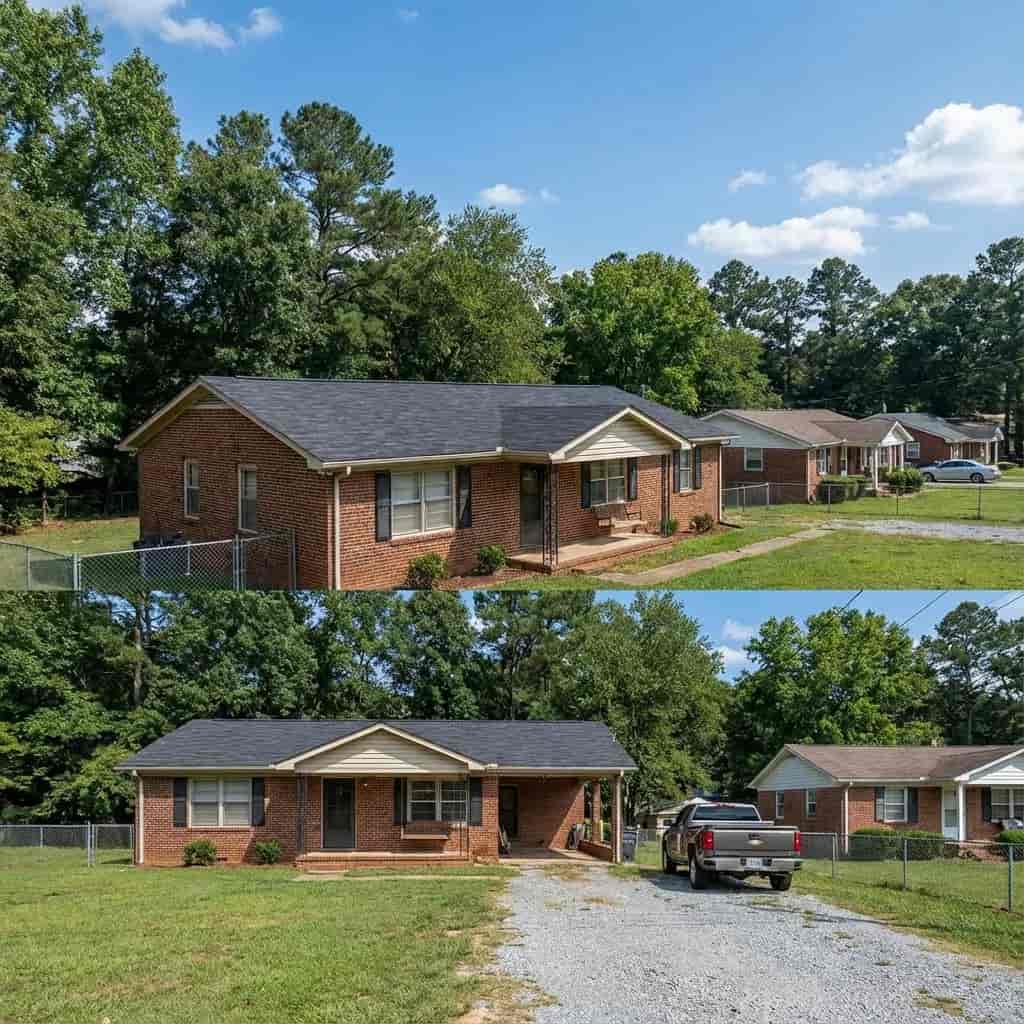
Garden City started in 1939 as Industrial City Gardens — a community built to house workers for the factories and plants west of Savannah — and the residential heart of town still sits in the older triangle around Main Street (Hwy 25) and the Augusta Road (Hwy 21) corridor. Neighborhoods like Rossignol Hill, Chatham Villa, and Chatham City are largely single-family homes from the 1940s through the 1990s, which means a lot of these roofs are well past their first or even second covering. On homes that close to the port and the truck corridor, two things age a roof faster than the calendar alone: airborne diesel soot and industrial particulate that streak and darken shingle surfaces, and the steady, low-grade vibration of heavy freight traffic that works fasteners loose over decades. Architectural asphalt shingles typically carry a 20-25 year service life in this climate, but a soot-exposed roof near Hwy 21 often shows surface staining and granule loss earlier, even when the underlying deck is sound. When we reroof in these neighborhoods we lean on algae- and stain-resistant granule lines in darker profiles that hide buildup between rain washes, and we fasten to a 6-nail ring-shank pattern so the install holds against both coastal wind and corridor vibration. Because Garden City falls inside Chatham County's coastal wind-borne-debris region, every residential reroof is specified to the area's roughly 130 mph design wind speed, with reinforced starter strips and sealed eaves rather than the thinner builder-grade fastening many of these older homes were originally finished with.
- Algae- and stain-resistant granules in darker profiles to mask soot near the port and Hwy 21
- 6-nail ring-shank fastening to resist both coastal wind and freight-corridor vibration
- Reinforced starter and sealed eaves specified to Chatham County's ~130 mph coastal wind design
- Honest tear-off vs. overlay assessment on multi-decade roofs in Rossignol Hill, Chatham Villa, and Chatham City
Garden City Coastal Weather Impact
Our Service Area in Garden City
Click to load map of Garden City, GA
Garden City Neighborhoods We Serve
Click a neighborhood to see our dedicated roofing services in your area of Garden City.
Weather Events That Shaped Garden City Roofing
Real storms, real roof damage, what we learned.
- Event 1 of 3.Hurricane MatthewWind
Sustained winds near 50 mph (gusting past 70 mph) at the Savannah stations stressed flat-roof terminations on Hwy 21 warehouses adjacent to Garden City Terminal, with torn membrane edge metal and lifted parapet copings on aged single-ply assemblies in 31408. Mechanically attached membranes generally held; older fully adhered systems past 15 years saw the most edge-detail failures, and residential shingle uplift hit the older 4-nail installs in the surrounding neighborhoods.
Source:www.nhc.noaa.gov/data/tcr/AL142016_Matthe…— Takeaway: Matthew pushed every Garden City commercial bid into mechanically attached membrane with reinforced parapet termination bars, and 6-nail patterns became the residential standard in 31408.
- Event 2 of 3.Hurricane IdaliaWind
Tracked across south Georgia after a Category 3 Florida Big Bend landfall. NWS Charleston logged a 40 mph gust at the I-95 Chatham weigh station and 52 mph at Savannah/Hilton Head International, with the county peak at 66 mph in Savannah and shingle uplift on newer Pooler-corridor subdivisions just west of Garden City; no hail was reported anywhere in Georgia on August 30-31, 2023 (SPC storm reports). For the Hwy 21 logistics corridor the exposure in a storm like this is wind at membrane edges and ponding during the rainbands rather than impact, so the post-storm checks on aged single-ply are edge-metal terminations, parapet copings and scupper or drain capacity.
Source:www.weather.gov/chs/IdaliaGusts— Takeaway: Idalia was a wind-and-rain event here, not a hail event: on aged single-ply the details that decide how a near-end-of-life membrane fares are edge terminations and drainage, not impact, and documented pre-storm inspection photos provide a useful baseline for comparing post-storm roof conditions.
- Event 3 of 3.Hurricane HeleneTree Strike
Category 4 Florida Big Bend landfall sent damaging winds inland to Statesboro and Augusta. In the Garden City industrial corridor, airborne debris struck rooftop HVAC and process equipment on several Hwy 21 warehouses, and a few aged modified-bitumen roofs in 31408 took blow-offs at unreinforced parapet corners where prior repairs had skipped membrane re-termination.
Source:www.nhc.noaa.gov/data/tcr/AL092024_Helene…— Takeaway: Helene reinforced that reinforced rooftop equipment curbs and full parapet re-termination during recovers pay for themselves the first time a debris-loaded gust hits the deck.
Garden City Roofing FAQ
Common questions about roofing services in Garden City.
TPO recover or full tear-off on our Garden City warehouse?+
Depends on the existing system, deck condition, and insulation moisture. If the deck is dry, the existing membrane has one layer, and parapet flashings are sound, a TPO recover over a separator sheet runs roughly 30-40% less per square than a tear-off. We core-sample for wet insulation first — recovering over saturated polyiso traps moisture and voids most manufacturer NDL warranties. Tear-off is the right call when cores show >25% wet insulation or you're already at two layers.
What does commercial flat-roof work cost per square in 31408?+
Mechanically attached 60-mil TPO over new polyiso typically runs $7-$10 per sq ft installed, depending on insulation thickness, deck condition, and parapet complexity. A silicone restoration coating runs $2-$5 per sq ft over a structurally sound existing roof. Recovers run 30-40% less than a full tear-off when the existing assembly qualifies. Every estimate breaks out membrane, insulation, accessories, and labor by the square so facilities managers can compare line-by-line against competing bids.
Can you work around active warehouse operations and Hwy 21 truck traffic?+
Yes. We schedule material deliveries and crane setups outside peak container-traffic windows on Hwy 21, stage tear-off debris in roll-offs positioned to keep loading docks clear, and coordinate with facilities managers on tenant occupancy and shift change. Hot-work permits, fire-watch protocols, and odor-control planning for occupied spaces are standard practice on a commercial mobilization. We've sequenced phased installs across multiple roof sections so dock doors never stop cycling.
Does the heat island and diesel soot off Hwy 21 shorten roof life?+
Yes. Garden City's vast concrete and asphalt yards run 5-8°F hotter than surrounding residential areas, accelerating thermal cycling and shingle aging. Diesel particulate from container traffic and chemical fallout from neighboring industrial tenants can soften standard TPO formulations over time. We spec chemical-resistant TPO grades on parcels directly downwind of fueling, paint, or solvent operations, and Scotchgard-protected dark-profile shingles on residential work to mask soot between rain washes.
How often should a Garden City Terminal-corridor warehouse roof be inspected?+
Annually at minimum, with a documented 5-year cycle for any roof carrying a manufacturer NDL warranty. We walk the deck in spring before hurricane season and again in late fall, photo-document seams, terminations, drains, and rooftop equipment penetrations, and submit a written report with prioritized repairs and budget tiers. Catching a failed pitch pan or split seam at year four is a $400 fix; missing it through year seven on a 100,000 sq ft footprint becomes a deck rebuild.
My Garden City house is close to the port and Hwy 21 — why does my roof look so dirty and age faster?+
Two things work against a home roof in the older Garden City neighborhoods near the port and the Augusta Road (Hwy 21) corridor. The first is airborne diesel soot and industrial particulate from constant container-truck and terminal traffic, which settles on shingles and leaves dark streaking and surface staining that can make a roof look failed years before it actually is. The second is the steady low-frequency vibration of heavy freight moving day and night, which over many years can work fasteners loose on roofs that were originally finished with thin builder-grade nailing. Many homes in Rossignol Hill, Chatham Villa, and Chatham City date from the mid-1900s through the 1990s, so a lot of these roofs are already at or past the 20-25 year service life typical of architectural asphalt shingles in this climate. When we reroof near the corridor we specify algae- and stain-resistant granule lines in darker profiles to mask soot between rain washes, and we refasten to a 6-nail ring-shank pattern so the new roof holds against both coastal wind and freight vibration. If the staining is only cosmetic and the deck and flashings are sound, we will tell you that too rather than push an unnecessary replacement.
What wind code applies to a residential roof in Garden City, GA, and do I need a permit?+
Garden City sits in Chatham County, which the state classifies as a coastal county inside the wind-borne-debris region, so residential roofs here are designed to a roughly 130 mph basic wind speed under Georgia's adoption of the International Building Code and ASCE wind-load standards. In practice that means we install to a 6-nail high-wind fastening pattern with ring-shank nails, reinforced starter strips at the eaves, and sealed perimeter details rather than the lighter builder-grade nailing common on older homes in the area. For a full roof replacement you will generally need a permit, and the jurisdiction depends on where the parcel sits: homes inside Garden City limits go through the City of Garden City's permitting process, while any unincorporated parcels are handled by Chatham County. We verify the correct jurisdiction before we quote, handle the permit paperwork, and schedule the closeout inspection when one is required, then provide the permit copy for your resale and insurance records. Repair-only work may fall below the permit threshold depending on scope, which is another reason we confirm requirements before starting any job in 31408.
Do you offer emergency roof help and insurance-related documentation after a storm in Garden City?+
Yes. Emergency and storm-damage response depends on weather, safe access, storm volume, materials, and crew availability. We can temporarily stabilize open shingle uplift, lifted parapet copings, torn membrane edge metal, split seams, and debris-struck rooftop equipment. We photograph visible roof conditions, take measurements, and provide an itemized construction estimate. When requested, we can attend an on-site adjuster meeting to explain the construction scope. We do not file or negotiate the claim; the policyholder or an appropriately licensed representative handles submissions and advocacy, and the carrier and policy decide coverage and payment.
Do you install metal roofs in Garden City, GA?+
Yes. Garden City's pre-engineered metal warehouses along the Hwy 21 corridor and its older homes in Rossignol Hill, Chatham Villa, and Chatham City both suit metal roofing. For commercial and industrial buildings we install and re-screw standing-seam and exposed-fastener metal systems; for homes we offer standing seam and stone-coated steel rated to the area's 130 mph coastal wind code. Metal shrugs off the heat-island temperatures and freight-corridor vibration that age asphalt faster near the port, and every estimate specifies panel gauge, fastener type, and finish in writing.
What makes Talya the roofing company to call in Garden City, GA?+
Talya Roofing holds a current City of Savannah Business License, carries documented insurance, and is an Atlas PRO+ Silver Member. Our live Google rating and review count are shown through the site’s current Google Places data. We serve commercial properties near the Hwy 21 corridor and residential neighborhoods including Rossignol Hill, Chatham Villa, and Chatham City. Call (912) 999-7989 to discuss the property and written scope.
Green Savannah Initiative
A solar exhaust vent is included with full roof replacements when your roof and attic intake can support it. Your written proposal lists the unit and terms.
Learn moreReferral Program
Refer a neighbor and earn $250 on your 1st referral, $350 on your 2nd. Cash paid on completion.
Start referringRoofing guides for Garden City & nearby areas
Garden City GA Roofing: Warehouse & Home
Garden City GA roofing guide for warehouses and homes: 130 mph wind code, $7-$10/sq ft TPO, and why Hwy 21 soot ages 31408 roofs faster than the calendar.
Read articleRoofing GuideChatham County Roofing Permits Guide 2026
Do you need a permit to replace your roof in Chatham County? What it costs, how long it takes, and how Savannah's 130 mph wind code affects your project.
Read articleMaintenanceFlat Roof Maintenance & Repair Savannah
Expert guide to flat roof maintenance and repair in Savannah GA and Coastal Georgia. TPO roofing, EPDM maintenance, common problems, and repair best practices.
Read articleRoofing MaterialsMetal Roofing Savannah 2026 Guide
Everything Savannah homeowners need to know about metal roofing in 2026: standing seam vs exposed fastener, Galvalume vs aluminum, coastal salt-air ratings,…
Read articleNearby service areas
Explore roofing in communities near Garden City. Project teams follow the written scope and current manufacturer instructions; Talya Roofing is an Atlas PRO+ Silver Member.
Port Wentworth
Metal roof installation, TPO membrane & silicone coatings in Port Wentworth GA — Hwy 21 warehouses near Garden City Terminal plus Rice Hope homes. ZIP 31407.
View area~3.8 miPooler
Pooler GA roof repair and replacement for 31322 homes. Fully insured Atlas PRO+ Silver Member. Request a project estimate or $250 homeowner inspection.
View area~4.0 miNorth Savannah
North Savannah flat-roof specialists: TPO membrane, silicone coatings & standing-seam metal for Hwy 21 port warehouses. ZIP 31407, 31408.
View area~4.1 miBerwick Plantation
Berwick Plantation roofing in West Chatham off Hwy 80 — slate, copper, and standing-seam on 2010s-built luxury homes. HOA packages handled for you.
View areaFlat-roof leak in Garden City? Call for availability.
TPO membrane, silicone coatings, parapet flashing — properly.
Fast Emergency & Storm Response • Business Licensed & Insured