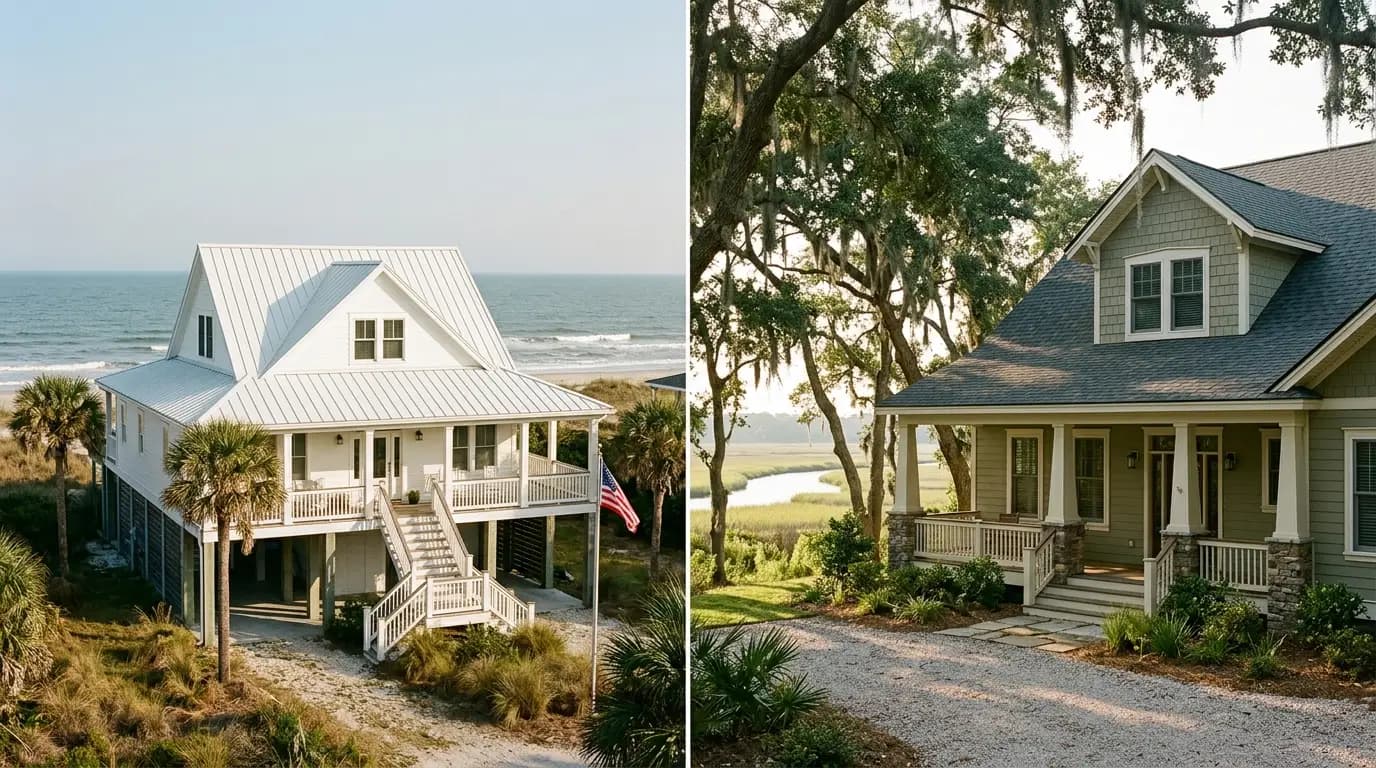

From the outside, Tybee Island and Wilmington Island look like two similar Coastal Georgia residential islands — same general weather, same Chatham County jurisdiction, same general home styles. The roofing decisions for each are surprisingly different. Tybee sits directly on the Atlantic with continuous salt-spray exposure and a FEMA V-zone classification that requires engineered wind-uplift plans on most reroofs. Wilmington Island is one bridge inland, surrounded by marsh and river rather than open ocean, sits in the milder AE flood overlay, and gets meaningfully less salt deposition.
High-wind design requirements apply to both — but the material lifespan math and the permit-engineering burden differ enough that the right roof for one island is sometimes the wrong roof for the other. This guide walks through the salt-air spectrum, FEMA flood-zone implications for your roof permit, material recommendation differences (with real observed lifespan data from Talya Roofing's Coastal Georgia project log), the 2026 cost differential for the same 2,500 sq ft home built on each island, the most common decision-making errors we see island homeowners make, and how the V-zone vs AE-overlay permit process works in practice.
Key Takeaways
- ✓ Tybee = FEMA V-zone (wave-action) + high-wind design + extreme salt-spray. Most Tybee reroofs need sealed engineering plans.
- ✓ Wilmington Island = FEMA AE-overlay (flood-but-no-wave) + high-wind design + moderate salt. Engineering letters less common.
- ✓ Material lifespan delta on Tybee vs Wilmington: Galvalume metal 12-15yr vs 25-30yr; aluminum metal 40-50yr both; premium architectural asphalt 18-22yr vs 25-30yr.
- ✓ 2026 cost delta for a 2,500 sq ft island reroof: Tybee $14K-$32K vs Wilmington $11K-$24K — $3K-$8K Tybee premium baked in.
- ✓ Single biggest mistake: choosing Galvalume on Tybee to save money. You save $4-7K on install, replace 15 years sooner. Wrong TCO math.
Why Tybee Island and Wilmington Island Need Different Roofing Decisions
Three Coastal-Georgia-specific factors differentiate the two islands materially:
- Atlantic exposure. Tybee sits directly on the Atlantic with prevailing winds carrying sea-salt spray and aerosolized salt mist year-round. Wilmington Island is buffered by Tybee + the Savannah River + the surrounding marsh, getting roughly 30-40% of Tybee's salt deposition.
- FEMA flood zone. Most of Tybee Island is mapped V-zone (high-velocity wave-action) or AE (1% annual flood + base flood elevation). Most of Wilmington Island is AE overlay only — no V-zone. V-zone triggers building-code requirements that AE doesn't.
- Causeway access. Tybee is bridge-only (Highway 80) and material delivery + crew transit are causeway-dependent. Wilmington has two bridges (Islands Expressway + the south access) and roads are inland-style. Tybee logistics cost more on larger projects.
All three factors push the right Tybee roofing decision toward higher-grade material + sealed engineering + more contingency on schedule. None of those apply to Wilmington at the same magnitude.
The Salt-Air Spectrum — Tybee Extreme vs Wilmington Moderate
Salt-air corrosion is the silent material-life killer on Coastal Georgia island roofs. The mechanism: chloride ions in airborne salt deposits onto roof fasteners, flashings, and metal panels, then react with moisture to form corrosive cells that eat through galvanized steel, untreated aluminum, and even some stainless grades over time.
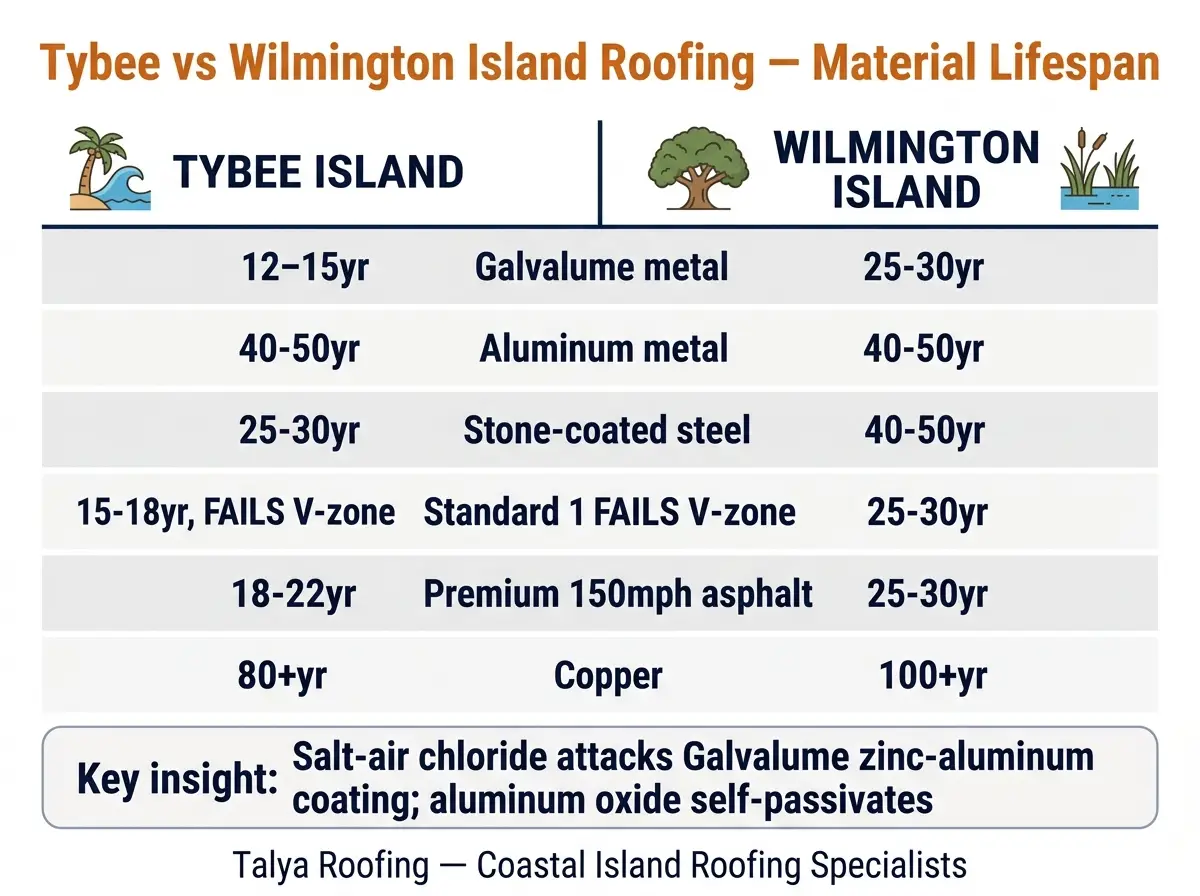
From Talya Roofing's island-roof inspection log, observed material lifespans:
| Material | Tybee (extreme salt) | Wilmington (moderate salt) |
|---|---|---|
| Galvalume standing-seam metal | 12-15 years (corrosion through) | 25-30 years |
| Aluminum standing-seam metal | 40-50 years | 40-50 years |
| Stone-coated steel | 25-30 years | 40-50 years |
| Standard architectural asphalt (130 mph) | 15-18 years (fails V-zone spec anyway) | 25-30 years |
| Premium architectural asphalt (150+ mph, Class H) | 18-22 years | 25-30 years |
| Copper standing-seam | 80+ years | 100+ years |
The headline takeaway: Galvalume's lifespan halves between Wilmington and Tybee because Galvalume's protective zinc-aluminum coating reacts with salt-air chloride. Aluminum lifespan is unchanged because aluminum's oxide layer self-passivates against chloride attack. Most Coastal Georgia roofers either don't know this distinction or don't communicate it clearly — Talya leads with it on every Tybee material conversation.
FEMA Flood Zones and What V-zone vs AE-Overlay Means for Your Roof
FEMA's Flood Insurance Rate Map (FIRM) classifies Coastal Georgia properties into flood zones that determine both insurance premiums AND building-code requirements:
- V-zone (Velocity Hazard). Coastal areas subject to base flood plus wave action greater than 3 feet. Roof requirements: sealed wind-uplift plan from a Georgia-licensed structural engineer required for any new or replacement roof system. The engineer calculates uplift loads at the building corners, perimeters, and field for the specific building geometry and the design wind speed on the permit, then issues a stamped letter. Most of Tybee's residential parcels are V-zone.
- AE (1% annual flood). Areas subject to base flood (the standard 100-year flood) but no wave action. Roof requirements: standard Chatham County permit applies; no sealed wind-uplift plan typically required. Most of Wilmington Island is AE overlay.
- X-zone (minimal flood hazard). Outside the 0.2% annual chance flood. Roof requirements: standard permit only. Some interior portions of Wilmington Island fall here; almost none of Tybee.
Check your specific address at FEMA's Map Service Center (msc.fema.gov) before assuming. We've seen Tybee parcels at the back side of the island that are AE rather than V-zone (saving the homeowner $150-$400 on engineering) and Wilmington parcels that — surprisingly — fall in the V-zone due to specific waterfront geometry. Address-level lookup matters.
Material Recommendations by Island (With Material Lifespan Reality)
Based on the lifespan data above and total-cost-of-ownership math over 30 years:
For Tybee Island:
- Best choice (TCO winner): Aluminum standing-seam metal with 316 marine-grade stainless fasteners + Kynar 500 paint. 40-50 year lifespan, single replacement event over a typical home-ownership horizon.
- Best mid-range: Premium architectural asphalt rated to 150+ mph (Atlas Pinnacle Pristine Class H, GAF Timberline AS II) with 6-nail pattern + self-adhered ice-and-water full-coverage. 18-22 year lifespan, cheaper upfront ($16K-$22K vs $24K-$32K for aluminum).
- Premium for historic Tybee homes: Copper standing-seam — 80+ year lifespan, $45K-$80K for a 2,500 sq ft home. Not for everyone, but the "buy it once" choice if the budget allows.
- Wrong choice (DO NOT use on Tybee): Galvalume metal (12-15 year corrosion-through), standard 130 mph architectural asphalt (fails V-zone material spec on most parcels).
For Wilmington Island:
- Best long-term value: Aluminum standing-seam metal — same 40-50 year lifespan as on Tybee, $5K-$8K cheaper to install because no V-zone engineering.
- Best mid-range: Standard 130 mph architectural asphalt (Atlas Pinnacle Pristine, GAF Timberline HDZ, Owens Corning Duration) — 25-30 year lifespan; confirm the rating against the design wind speed on your permit.
- Reasonable budget choice: Galvalume metal — 25-30 year lifespan on Wilmington (vs the 12-15 disaster on Tybee), cheaper than aluminum, real choice for budget-conscious Wilmington homeowners.
- Stone-coated steel for HOA shingle-look requirements: 40-50 year lifespan on Wilmington, more aesthetic flexibility for HOAs that mandate "shingle appearance".
Real 2026 Cost Comparison for a 2,500 sq ft Island Reroof
| Material spec | Tybee 2026 | Wilmington 2026 |
|---|---|---|
| Architectural asphalt (premium, 150+ mph) | $16,000–$22,000 | $11,000–$15,000 (130 mph spec) |
| Galvalume standing-seam | Not recommended | $15,000–$22,000 |
| Aluminum standing-seam | $24,000–$32,000 | $19,000–$27,000 |
| Stone-coated steel | $22,000–$28,000 | $18,000–$24,000 |
| Copper standing-seam | $48,000–$80,000 | $40,000–$68,000 |
| V-zone engineering letter | +$150–$400 (typically required) | N/A on most parcels |
| Causeway delivery surcharge | +$300–$900 | $0 |
Same home, $3K-$8K Tybee premium baked into the project regardless of material — engineering plus delivery plus the material upgrade required by Tybee's V-zone spec.
Common Mistakes Island Homeowners Make
- Choosing Galvalume on Tybee to save money. Most common error. Galvalume corrodes through in 12-15 years on Tybee's direct salt exposure. The $4K-$7K savings vs aluminum becomes a $20K-$28K replacement 15 years sooner. Total-cost-of-ownership over 30 years: Galvalume installed twice costs more than aluminum installed once.
- Skipping the FEMA flood-zone lookup. Assuming "I'm on Tybee, I must be V-zone" or "I'm on Wilmington, I must be AE" — both wrong some of the time. Always check msc.fema.gov for the specific address.
- Using a non-coastal contractor on either island. Inland-Georgia roofers don't know the coastal wind-uplift calc, the V-zone permit packet, or the marine-grade fastener spec. We've inspected Tybee roofs installed by Atlanta crews where the standard galvanized fasteners failed in 4 years.
- Choosing 130 mph standard asphalt on Tybee. Most Tybee V-zone parcels require materials rated to the full system uplift load — 130 mph rated shingles may pass the wind test but fail the system-level rating when the engineering review checks the full assembly.
- Not insuring for replacement value. Same-island roof replacement insurance settlements lag actual replacement cost by 30-50% if the policy is on ACV (actual cash value) basis rather than RCV (replacement cost value). On a 15-year-old roof on Tybee, the ACV check might be $4,000 — the actual replacement cost is $24,000. Verify your policy before you need to file.
How Talya Roofing Handles V-zone vs AE-Overlay Permit Work
For every Tybee project we run through our V-zone workflow:
- FEMA flood-zone lookup on the specific address (we do this before quoting).
- If V-zone: coordinate with our Georgia-licensed structural engineer partner for the sealed wind-uplift plan. Pass-through cost at the engineer's published rate; no Talya markup.
- Material spec to the engineered uplift loads — not just the 130 mph nominal rating.
- Chatham County permit submission with the engineered plan + manufacturer cut-sheets + contractor COI + scope-of-work narrative + sealed plan.
- Coordinated inspection sequencing (dry-in + final) timed to minimize the homeowner's wait between tear-off and shingle install.
For Wilmington Island projects, the workflow is simpler (standard Chatham County permit, no sealed plan in most cases) but the same Coastal Georgia material expertise applies — same marine-grade fasteners, same high-wind fastening details, same understanding that salt-air exposure (even at moderate levels) shapes the material decision.
Need a Tybee or Wilmington Island roof replacement?
Talya Roofing handles the FEMA flood-zone lookup, V-zone engineering coordination (when required), and Chatham County permit submission as part of every coastal island project. Free estimates include the engineering and permit costs itemized at pass-through rate.
Call (912) 999-7989 or request an island roof consultation — turnaround typically same week.