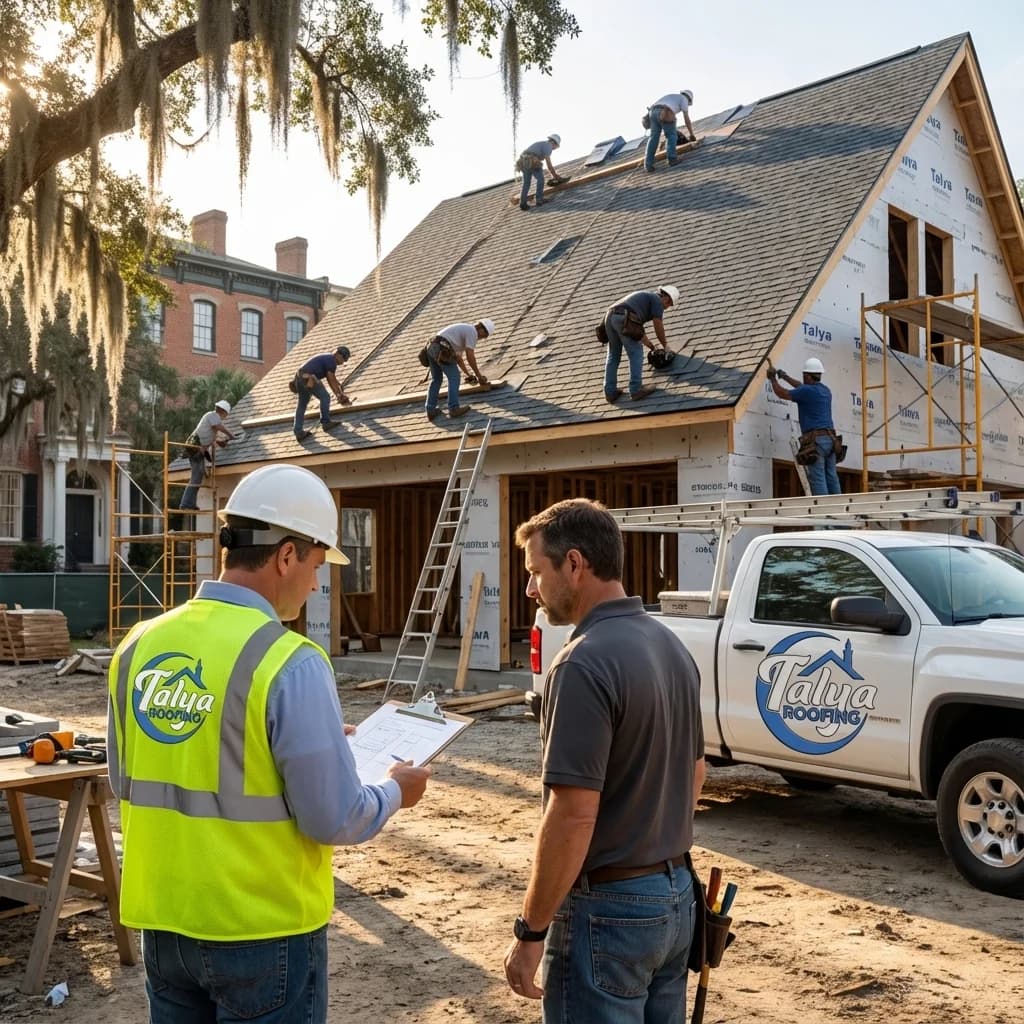

Most Savannah homeowners have never heard of FORTIFIED certification — but their insurance company definitely has. A Georgia law now requires every admitted insurer in the state to offer a premium discount when your roof meets the FORTIFIED standard. If your next re-roof doesn't include this upgrade, you're leaving money on the table every single year.
FORTIFIED is a voluntary above-code construction standard created by the Insurance Institute for Business & Home Safety (IBHS). It was built specifically to close the gap between minimum building codes and the construction quality actually needed to survive hurricane-force winds. On the Savannah coast, where roofs are built to high-wind design requirements, that gap is significant and costly.
Key Takeaways
- ✓ Georgia Act 476 requires all insurers to offer FORTIFIED discounts — effective March 2025
- ✓ Savannah homeowners can typically save 5–20% on annual premiums with a certified FORTIFIED roof — the exact credit is carrier-set
- ✓ Upgrades add only $1,000–$3,000 to a typical re-roof — payback in 3–7 years
- ✓ Five core requirements: sealed deck, drip edge, ice/water barrier, ring-shank nails, Class H shingles
- ✓ An independent FORTIFIED Evaluator (not your contractor) must inspect and certify the work
What Is FORTIFIED Roof Certification?
FORTIFIED is a voluntary construction program developed by IBHS — the research and testing arm of the property insurance industry. Unlike building codes, which set the minimum legal standard, FORTIFIED sets a performance standard: your roof must actually be able to withstand the wind and water events common in your region.
The program has three tiers. FORTIFIED Roof is the entry level, focused entirely on the roof system itself — sealed deck, enhanced edges, wind-rated shingles. FORTIFIED Silver adds requirements for windows, doors, and garage doors. FORTIFIED Gold addresses the entire building envelope. Most homeowners pursuing insurance discounts start with FORTIFIED Roof, and that's where the strongest cost-to-benefit ratio lives.
Once your roof passes inspection, IBHS awards a designation that lasts 5 years. After 5 years, a renewal inspection is required. You can look up any certified address in the IBHS FORTIFIED database — insurers use this to verify your discount eligibility.
Why Georgia Homeowners Should Act Now — Georgia Act 476
Georgia Act 476, passed during the 2023–2024 legislative session, is the reason FORTIFIED went from a niche program to something every Savannah homeowner replacing their roof should understand. The law requires all admitted insurance carriers in Georgia to offer premium discounts for FORTIFIED-certified properties, with a compliance deadline of March 1, 2025.
Before this law, getting a FORTIFIED discount in Georgia depended entirely on whether your specific carrier chose to participate. Many didn't. Act 476 removed that optionality — if an insurer is admitted in Georgia, they must offer the discount.
What Georgia Act 476 Means for You
- Effective: March 1, 2025 — all admitted Georgia insurers must offer the discount
- Georgia Underwriting Association: 5–10% discount for FORTIFIED-certified properties
- Private market carriers: 10–20% in wind-exposed coastal areas like Savannah
- No income limit: Any homeowner who certifies qualifies, regardless of income
- Renewable: Discount continues as long as you maintain an active designation
For context: the average homeowner insurance premium in Chatham County runs approximately $2,000–$3,500 per year depending on home value, location, and carrier. A 15% discount saves $300–$525 annually. Over a 10-year period, that's $3,000–$5,250 in savings — significantly more than the upgrade cost.
The 5 Core FORTIFIED Requirements Explained
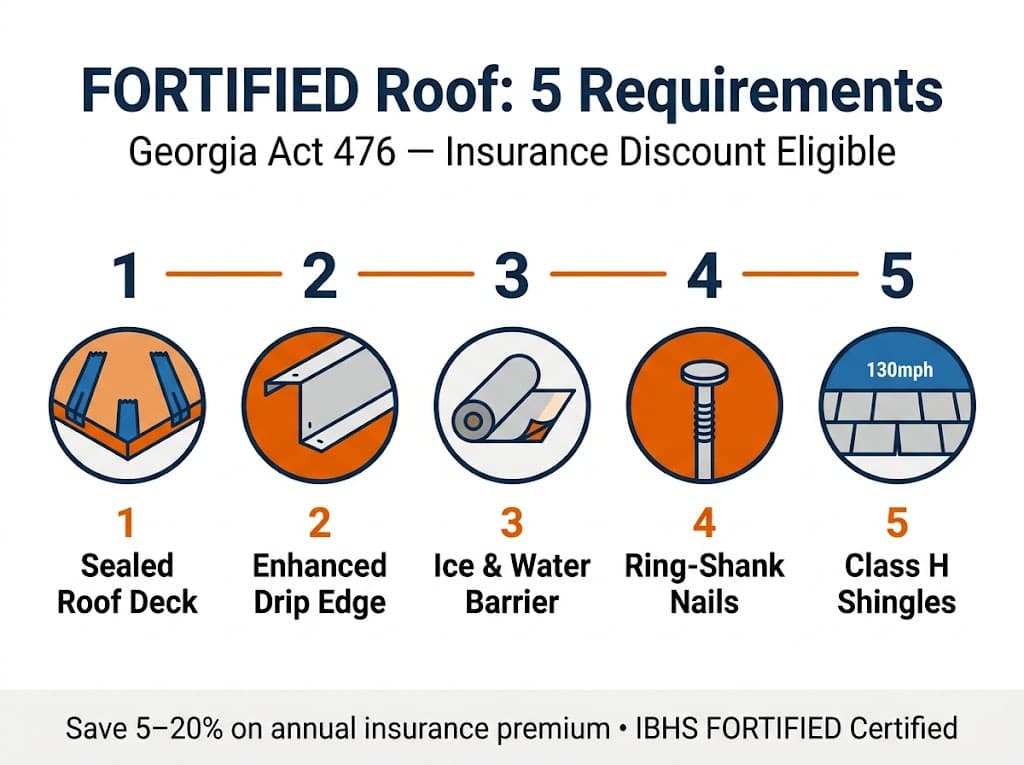
FORTIFIED Roof certification requires five specific construction upgrades. None of them are exotic or experimental — they're systematic improvements that any licensed roofing contractor can execute on a standard re-roof. Here's exactly what each requirement involves and why it matters in Coastal Georgia.
Sealed Roof Deck
Every joint, seam, and nail penetration in the OSB or plywood sheathing must be sealed with IBHS-approved self-adhering tape or membrane. This is FORTIFIED's single most impactful requirement. When a hurricane strips shingles off a standard roof, nothing prevents rain from pouring directly into the home through the exposed deck. A sealed deck stays watertight even after total shingle loss. IBHS research shows this single requirement prevents the majority of interior water damage in major storms — the damage that causes total losses on homeowner claims.
Enhanced Drip Edge
Standard drip edge is thin aluminum that provides minimal structural contribution. FORTIFIED requires at minimum 26-gauge steel drip edge that extends at least 2 inches onto the roof deck, fastened with 8d ring-shank nails at the specified spacing. Combined with a fully adhered starter strip, this creates a reinforced edge system that dramatically improves resistance to wind uplift at the roof's most vulnerable point — the eave. In Savannah's hurricane exposure, wind gets under the edge first; this requirement addresses exactly that failure mode.
Ice and Water Barrier Placement
Self-adhering ice and water barrier must be installed in all roof valleys, along eave edges, and around every penetration — chimneys, pipes, skylights, HVAC curbs. In Coastal Georgia we don't worry much about ice dams, but this requirement matters enormously for wind-driven rain. During a hurricane, rain is horizontal, not vertical, and it finds every seam and edge. The self-adhering barrier creates a watertight secondary defense in the locations where water almost always intrudes first.
Ring-Shank Nail Pattern
Standard smooth-shank nails are required by Georgia building code, but they have a known failure mode under sustained wind load: they back out. Ring-shank nails, by contrast, grip the wood fibers along their entire shank, making them dramatically harder to withdraw. FORTIFIED requires ring-shank nails with a specific spacing pattern — 6 inches on center at panel edges, 12 inches in the field. This reduces potential nail penetrations that could become leak points while increasing holding power. IBHS testing shows ring-shank patterns can double deck withdrawal resistance compared to smooth-shank installations.
Wind-Rated Shingles (Class H)
FORTIFIED requires shingles meeting ASTM D7158 Class H — rated for wind speeds of 110 mph and above, with a minimum ultimate design wind speed of 130 mph when the full FORTIFIED system is installed. Most quality architectural shingles from Atlas, GAF, CertainTeed, and Owens Corning already meet this standard. Class H shingles use a reinforced mat, stronger adhesive strips, and more robust sealing technology than entry-level products. If you're already planning on mid-grade or premium shingles, you may already be within reach of this requirement at no additional material cost.
FORTIFIED vs. Standard Georgia Building Code
| Feature | Georgia Building Code | FORTIFIED Roof |
|---|---|---|
| Roof deck sealing | Not required | Required — all joints, seams, nails |
| Drip edge | Basic aluminum acceptable | 26-ga steel, 2" overlap, ring-shank nails |
| Underlayment | Felt paper acceptable | Self-adhering in valleys, eaves, penetrations |
| Nail type | Smooth-shank acceptable | Ring-shank required |
| Nail spacing | Standard pattern | 6" edge / 12" field |
| Shingle wind rating | 90–110 mph common | Class H (130 mph minimum) |
| Independent inspection | None required | FORTIFIED Evaluator required |
| Insurance discount | None | Typically 5–20% annually, carrier-set (Act 476 requires the credit) |
Cost and ROI for a FORTIFIED Roof in Savannah
The most common question we get: how much extra does it cost? According to IBHS estimates, FORTIFIED upgrades typically add $1,000–$3,000 to the cost of a standard re-roof on a 2,000 square-foot home. The range depends on your existing deck condition, the shingle grade you were already planning to use, and how much of the deck needs sealing work.
On a standard Savannah roof replacement running $10,000–$16,000, the FORTIFIED upgrade represents a 7–20% premium. Here's the ROI math:
Sample ROI: Savannah Home, $14,000 Re-Roof
Figures are illustrative. Actual discounts vary by carrier. Private market carriers in coastal areas often offer higher discounts (10–20%).
One factor that's harder to quantify but very real: reduced out-of-pocket exposure after a storm. Savannah averages one significant named-storm threat per hurricane season. A FORTIFIED roof that survives a storm that damages or destroys a standard roof eliminates your deductible, eliminates claim-related premium increases, and eliminates months of contractor scheduling in a post-storm market where labor costs spike 30–50%.
Step-by-Step: How to Get Your FORTIFIED Designation
Find a contractor familiar with FORTIFIED requirements. Not all contractors know the specific materials and installation methods required. Ask explicitly: "Can you install to FORTIFIED Roof specifications and document each stage with photographs?" The contractor doesn't need to be officially FORTIFIED-certified, but they must know the standards. As a licensed Savannah roofing contractor, we install to FORTIFIED spec on request.
Select FORTIFIED-compliant materials. Your contractor specifies Class H wind-rated shingles, 26-gauge steel drip edge, ring-shank nails, IBHS-approved deck sealing tape, and self-adhering underlayment for critical areas. Most of these materials are standard stock — the difference is in the selection and installation method.
Installation — staged photography required. Your contractor must photograph each stage as they go: bare deck, sealed deck joints and nails, underlayment placement, drip edge installation, and finished shingles. These photos become the primary compliance record submitted to IBHS. A complete photo set is non-negotiable — without it, the evaluator cannot verify compliance on stages that are no longer visible.
Hire an independent FORTIFIED Evaluator. This is a critical point: the evaluator is hired by you, the homeowner — not by your contractor. This independence is intentional. The evaluator is IBHS-trained and certified, reviews the photo documentation, and conducts a physical inspection of accessible roof areas. You can find evaluators through the FORTIFIED homeowner resources page. Evaluation typically costs $200–$400.
⚠️ Most Common Mistake: Don't Let Your Contractor Be the Evaluator
Some contractors claim they can handle both installation and evaluation. They cannot — IBHS requires the evaluator to be completely independent of the installing contractor. If the same person installs the roof and signs off on the certification, IBHS will not issue the designation. Always hire your evaluator separately. Find an IBHS-certified evaluator at fortifiedhome.org/homeowner-resources. Evaluations typically cost $200–$400.
Evaluator submits to IBHS. If the inspection passes, the evaluator submits the application and photo documentation to IBHS. IBHS reviews and awards the FORTIFIED Roof designation, issuing you a digital certificate with your unique designation number and a 5-year expiration date.
Submit to your insurer for the discount. Contact your insurance agent with your FORTIFIED designation number. They verify it in the IBHS database and apply the discount. Most carriers apply it at your next policy renewal; some apply it immediately. Keep your certificate on file and set a reminder to schedule a renewal inspection before the 5-year expiration.
FORTIFIED Levels: Roof vs. Silver vs. Gold
| Level | What It Covers | Typical Insurance Discount | Best For |
|---|---|---|---|
| FORTIFIED Roof | Roof system only — deck, edges, fasteners, shingles | 5–15% | Homeowners replacing their roof; best cost/benefit ratio |
| FORTIFIED Silver | Roof + windows, doors, garage doors | 15–30% | Coastal exposure areas; homes doing major renovation |
| FORTIFIED Gold | Entire building envelope — roof, openings, walls | 25–55% | Maximum protection; new construction; barrier island homes |
For most existing Savannah homes doing a standard re-roof, FORTIFIED Roof is the right starting point. Silver and Gold involve upgrades to windows, doors, and structural elements that typically require broader renovation. But if you're building new or doing a substantial renovation, going straight to Gold may make financial sense given the dramatically higher insurance discounts available in Alabama and other hurricane-corridor states — discounts that Georgia carriers are beginning to approach as coastal insurance markets tighten.
What FORTIFIED Protects Against (and What It Doesn't)
FORTIFIED Roof focuses on wind and rain intrusion. It's engineered around the failure modes that cause the most insurance losses: roof edge uplift, deck exposure after shingle loss, and water intrusion at unsealed penetrations. If a Category 3 hurricane hits Savannah, a FORTIFIED roof is significantly more likely to stay intact than a code-minimum roof.
What FORTIFIED Roof Does NOT Cover
- • Flood damage — FORTIFIED addresses wind and rain, not rising water. Separate flood insurance (NFIP or private) is required for flood coverage in Savannah's flood zones.
- • Hail damage to shingles — FORTIFIED Roof uses wind-rated shingles, not necessarily impact-rated. For hail-specific discounts, ask about Class 3 or Class 4 impact-resistant shingles (separate program).
- • Tree falls or debris — structural damage from fallen trees is a separate coverage issue regardless of FORTIFIED status.
- • Foundation or structural issues — FORTIFIED addresses the building envelope, not the foundation or framing.
A complete Savannah resilience strategy typically pairs FORTIFIED Roof with flood insurance (especially for homes in AE or VE flood zones), proper attic ventilation to prevent heat and moisture damage, and a pre-season roof inspection checklist. See also our complete guide to Coastal Georgia building codes for context on local wind zone requirements.
Talya Roofing's Take for Savannah Homeowners
We see a lot of homeowners replace roofs with code-minimum installations and then wonder why their insurance premium doesn't budge. With Georgia Act 476 now in force, you have a clear path to annual savings — but only if you build to FORTIFIED specifications from the start. Retrofitting a sealed deck or upgraded drip edge after the roof is finished isn't practical; it has to be done during installation.
Our recommendation: if you're planning a roof replacement in Savannah, get a separate FORTIFIED line item in your estimate. Ask your contractor what it costs to upgrade from their standard spec to full FORTIFIED Roof compliance. For most homes, that number is $1,500–$2,500. Compare that to 7–10 years of 10–15% insurance discounts. The math is straightforward.
Talya Roofing is an Atlas PRO+ Silver Member and holds a City of Savannah business license. For a FORTIFIED project, the roof scope and staged documentation must follow the evaluator-approved requirements, and the independent FORTIFIED Evaluator—not the roofing contractor—reviews the work and submits the designation package.
Get a FORTIFIED Roof Estimate — Free
We'll quote your re-roof with and without FORTIFIED upgrades so you can see the exact cost difference.
Sources: IBHS FORTIFIED Roof Program · FORTIFIED Financial Incentives · Smart Home America — Georgia · IBHS 2025 Updated Standards