
Key Takeaways
- Savannah's Historic District is protected by strict preservation ordinances enforced by the Historic District Board of Review (HDBR) — any visible exterior change, including roofing, requires a Certificate of Appropriateness (COA).
- Approved roofing materials in the Historic District include natural slate, standing seam metal, and specific architectural shingles that replicate historic profiles — standard 3-tab shingles and modern metal panels are typically prohibited on contributing structures.
- The permit process requires architectural review, and rushing or skipping it can result in stop-work orders, fines, and mandatory removal of non-compliant materials at the property owner's expense.
- Working with a contractor experienced in historic Savannah properties saves months of frustration — Talya Roofing understands the HDBR process and specifies compliant materials from the start.
- Emergency repairs after storm damage have a streamlined approval path, but permanent replacement still requires full HDBR review.
Roofing in Savannah's Historic District: A Different World
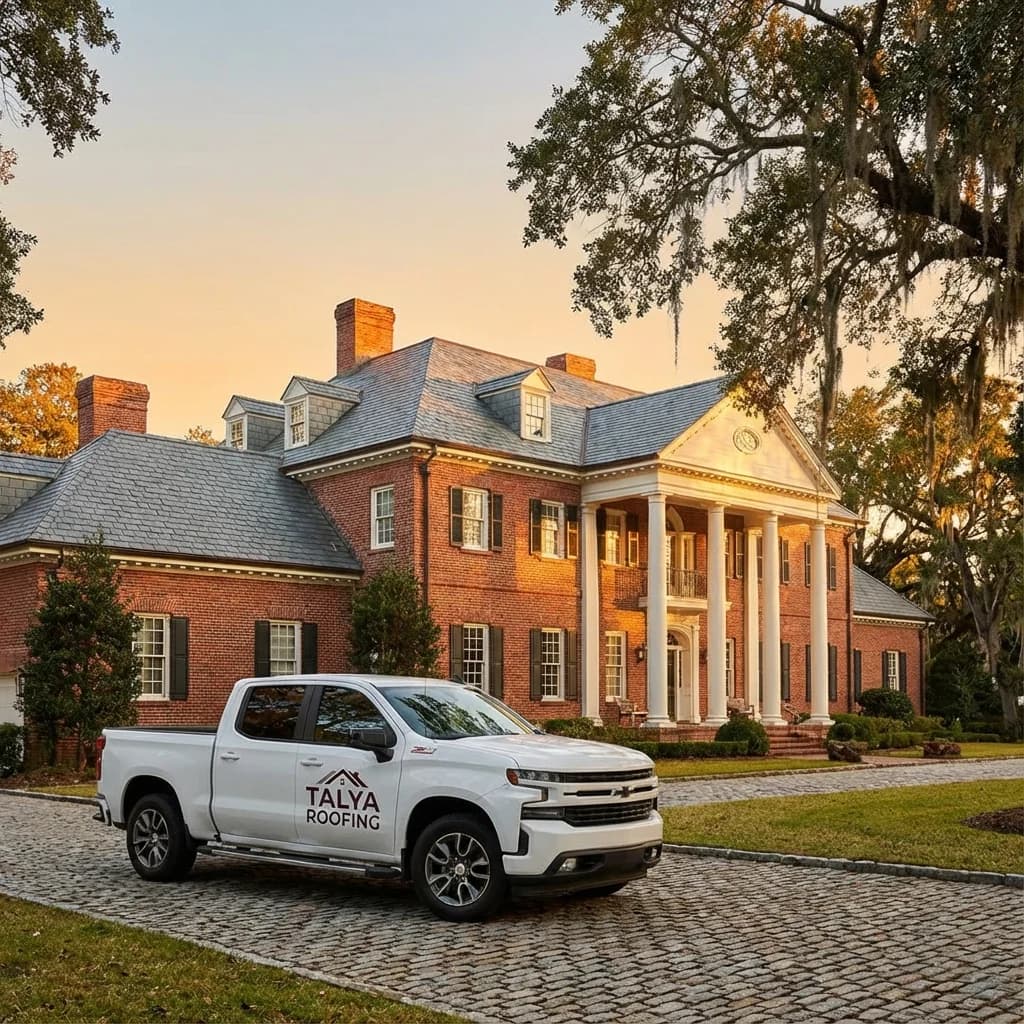
Savannah's Landmark Historic District encompasses 2.5 square miles of some of the most architecturally significant urban landscape in America. The district's 22 original squares, antebellum townhouses, Victorian mansions, and early 20th-century commercial buildings draw millions of tourists annually and sustain property values that rank among the highest in Georgia. Protecting this irreplaceable architectural heritage is the mission of the Historic District Board of Review (HDBR), and their authority extends directly to your roof.
If you own property in the Historic District — or in the adjacent Victorian District, Thomas Square Streetcar Historic District, or other locally designated historic zones — replacing or repairing your roof involves a regulatory process that doesn't exist in standard Savannah neighborhoods. Understanding this process before you start is essential to avoiding costly mistakes, delays, and conflicts with the city. Talya Roofing has navigated the HDBR process for numerous historic property owners across Chatham County.
Understanding the Historic District Board of Review
The HDBR is a city-appointed board that reviews all exterior changes to properties within Savannah's historic districts. Their authority comes from the Savannah Zoning Ordinance (Chapter 8, Article K) and is backed by state enabling legislation. The board meets regularly, and decisions are based on the Secretary of the Interior's Standards for Rehabilitation and local design standards documented in the Historic District ordinance.
What Requires HDBR Approval
- Any change to a roof that is visible from a public right-of-way (street, lane, or square)
- Change of roofing material type (e.g., replacing slate with shingles)
- Change of roof color if the new color differs significantly from existing
- Adding, removing, or altering dormers, skylights, or roof penetrations
- Structural changes to the roofline profile (pitch, height, shape)
- Installation of solar panels, satellite dishes, or other rooftop equipment visible from public view
What May Not Require Full Review
- In-kind replacement with identical materials (same type, profile, and color) — may qualify for staff-level approval rather than full board review
- Repairs using matching materials that don't change the roof's appearance
- Work on non-visible roof areas (rear slopes not visible from any public right-of-way) — though this determination must be confirmed with HDBR staff
- Emergency temporary repairs (tarps, temporary patches) after storm damage — though permanent repair still requires review
The Certificate of Appropriateness (COA) Process
A COA is the formal approval you need before beginning any regulated roofing work. Here's the process:
Step 1: Pre-Application Consultation
Before submitting a formal application, schedule a meeting with HDBR staff at the Metropolitan Planning Commission (MPC) offices. Bring photographs of your existing roof, information about the original materials (if known), and the materials you'd like to use. Staff can tell you whether your project will qualify for staff-level approval or require full board review, and they'll flag any likely issues with your proposed materials.
Step 2: Application Submission
The COA application requires detailed documentation including property photographs from all public-view angles, a description of existing and proposed materials with manufacturer specifications, color samples, and a contractor statement. Applications must be submitted by the posted deadline to be heard at the next scheduled board meeting — missing the deadline pushes you to the following month's agenda.
Step 3: Board Review and Decision
At the board meeting, your application is presented and discussed. The board may approve, approve with conditions, deny, or continue (defer) the application for more information. You or your representative should attend to answer questions and address concerns. Denial can be appealed to the Zoning Board of Appeals, but this adds months to the timeline.
Step 4: Building Permit
An approved COA does not replace the standard Chatham County building permit. After COA approval, you still need to obtain a building permit through the normal process. Talya Roofing handles both the COA application support and building permit filing so our clients have a single point of contact for all regulatory requirements.
Approved Roofing Materials for Historic Properties
Material approval depends on your property's classification (contributing, non-contributing, or new construction) and the original roofing material. Here are the general guidelines:
| Material | Typically Approved For | Notes |
|---|---|---|
| Natural Slate | Contributing structures originally roofed in slate | In-kind replacement is preferred; requires skilled installation |
| Synthetic Slate | Contributing structures where natural slate is impractical | Must closely replicate natural slate appearance; board reviews specific products |
| Standing Seam Metal | Properties originally roofed in metal; many commercial buildings | Must match historic seam profiles; Galvalume or terne-coated acceptable |
| Architectural Shingles | Non-contributing structures; some contributing structures with shingle history | Must have dimensional, shadow-line profile; flat 3-tab typically prohibited |
| Cedar Shake/Shingle | Historically appropriate for certain property types | Fire-treated required; high maintenance in Savannah's humidity |
Materials Almost Always Prohibited
- Standard 3-tab asphalt shingles on contributing structures (insufficient historic character)
- Corrugated metal panels or exposed-fastener metal roofing
- Concrete or clay tile (unless historically documented on the specific property)
- Rubber membrane or roll roofing on visible slopes
- Any roofing material in non-traditional colors (blue, green, red) unless historically documented
Special Considerations for Historic Roof Structures
Structural Load
Historic timber roof framing may not support the weight of heavy materials like natural slate without reinforcement. When a 150-year-old building needs a new roof, we conduct a structural assessment of the existing framing before recommending materials. Synthetic slate (at approximately 1/4 the weight of natural slate) is often the solution when the framing can't support the original material without modification — and modifying original framing requires its own HDBR review.
Flashing and Detail Work
Historic Savannah buildings often feature complex rooflines with dormers, parapets, cupolas, widow's walks, and decorative cornices. Each element requires precise flashing and waterproofing that matches the building's character while providing modern weather protection. This is craftsmanship work that requires experienced roofers — it cannot be rushed or handled by crews unfamiliar with historic construction.
Gutters and Drainage
Many historic Savannah buildings use half-round copper gutters and round downspouts. Replacing these with modern K-style aluminum gutters would violate district standards. When roof replacement includes gutter work, the replacement system must match the historic profile. Copper is the preferred material for longevity and appearance, though painted aluminum half-round systems may be acceptable for some properties.
Emergency Storm Damage in the Historic District
When a storm damages your historic roof, the HDBR understands that emergency action is needed. The city's emergency provisions allow temporary protective measures (tarping, emergency patching) without prior COA approval. However, permanent repairs or replacement still require the standard review process. Important steps after storm damage:
- Document all damage with photographs before any temporary repairs
- Make emergency temporary repairs to prevent further water damage — this is allowed and expected
- Contact the MPC/HDBR staff promptly to discuss the damage and begin the COA process for permanent repairs
- File your insurance claim with detailed documentation — historic material replacement costs are significantly higher than standard materials, and your policy should reflect this
- Call Talya Roofing at (912) 999-7989 for emergency assessment and temporary protection while the permanent repair plan is developed
Tax Benefits for Historic Preservation
Georgia offers significant tax incentives for preservation work on historic properties. The Georgia State Income Tax Credit for Rehabilitated Historic Property provides a tax credit equal to 25% of qualified rehabilitation expenses for properties listed on the Georgia Register of Historic Places. Roof replacement using appropriate historic materials typically qualifies as a rehabilitation expense. The federal Historic Tax Credit (20%) is available for income-producing properties. Talya Roofing can provide the documentation needed for tax credit applications as part of our project records.
Working with Talya Roofing on Historic Properties
Historic roofing is a specialty within a specialty. It requires not just roofing expertise but knowledge of preservation standards, experience with the HDBR process, and craftsmanship skills that many modern roofing companies simply don't possess. Talya Roofing brings all three to every historic project in Savannah, whether it's a Jones Street townhouse, a Bull Street commercial building, or a Victorian District residence.
- Pre-application consultation and material research to identify the right approach before engaging the HDBR
- Complete COA application preparation including specifications, photographs, and material samples
- Coordination with structural engineers when needed for load analysis
- Expert installation of slate, metal, and specialty materials by trained craftsmen
- Post-installation documentation for tax credit applications and property records
Historic Savannah Property? We Speak Your Language.
Navigating the HDBR process, selecting period-appropriate materials, and executing the meticulous installation that historic buildings demand — Talya Roofing handles it all. Protect your historic investment with a roofing partner who understands preservation as well as performance.
Historic Home Roofing Compliance: A Practical Guide
Navigating Savannah's historic district roofing requirements can feel overwhelming, but understanding the process protects both your investment and the neighborhood's architectural heritage. Here's what every homeowner in the Landmark or Victorian districts needs to know before starting a roofing project.
The Certificate of Appropriateness (COA) Process
The COA application requires detailed project plans including material specifications, color samples, and photos of the existing roof. The Review Board meets twice monthly, and applications must be submitted at least 10 business days before the meeting. Approvals typically take 2-4 weeks, though complex projects may require revisions.
Approved Materials by Home Style
| Home Style | Preferred Material | Acceptable Alternatives | Notes |
|---|---|---|---|
| Federal/Georgian | Natural slate, standing seam metal | Synthetic slate, architectural shingles | Must match original profile |
| Victorian/Queen Anne | Patterned slate, metal shingles | Architectural shingles in dark tones | Decorative ridge caps required |
| Colonial Revival | Wood shake, architectural shingle | Composite shake, metal | Earth tones preferred |
| Italianate | Low-profile metal, flat tile | Architectural shingles | Maintain low-slope appearance |
Working with a Savannah roofer experienced in historic district projects — like Talya Roofing — streamlines the COA process significantly. We prepare the application package, attend Review Board meetings on your behalf, and ensure all work meets both preservation standards and modern building codes.