
Key Takeaways
- HOA and apartment complex roofing programs save 15–25% versus individual replacements through bulk material purchasing, consolidated labor mobilization, and reduced per-unit overhead.
- Phased replacement programs allow communities to spread capital expenditure over 2–5 years while maintaining architectural uniformity and compliance.
- Talya Roofing navigates HOA architectural review requirements, coordinates multi-building schedules, and provides dedicated project management for community-wide roofing projects.
- Common Savannah-area HOA requirements include material type mandates, color restrictions, timeline stipulations, and contractor insurance minimums that Talya Roofing fully meets.
- Contact us at (912) 999-7989 for a community roofing program proposal tailored to your HOA or property management needs.
Why HOAs and Apartment Complexes Need Dedicated Roofing Programs
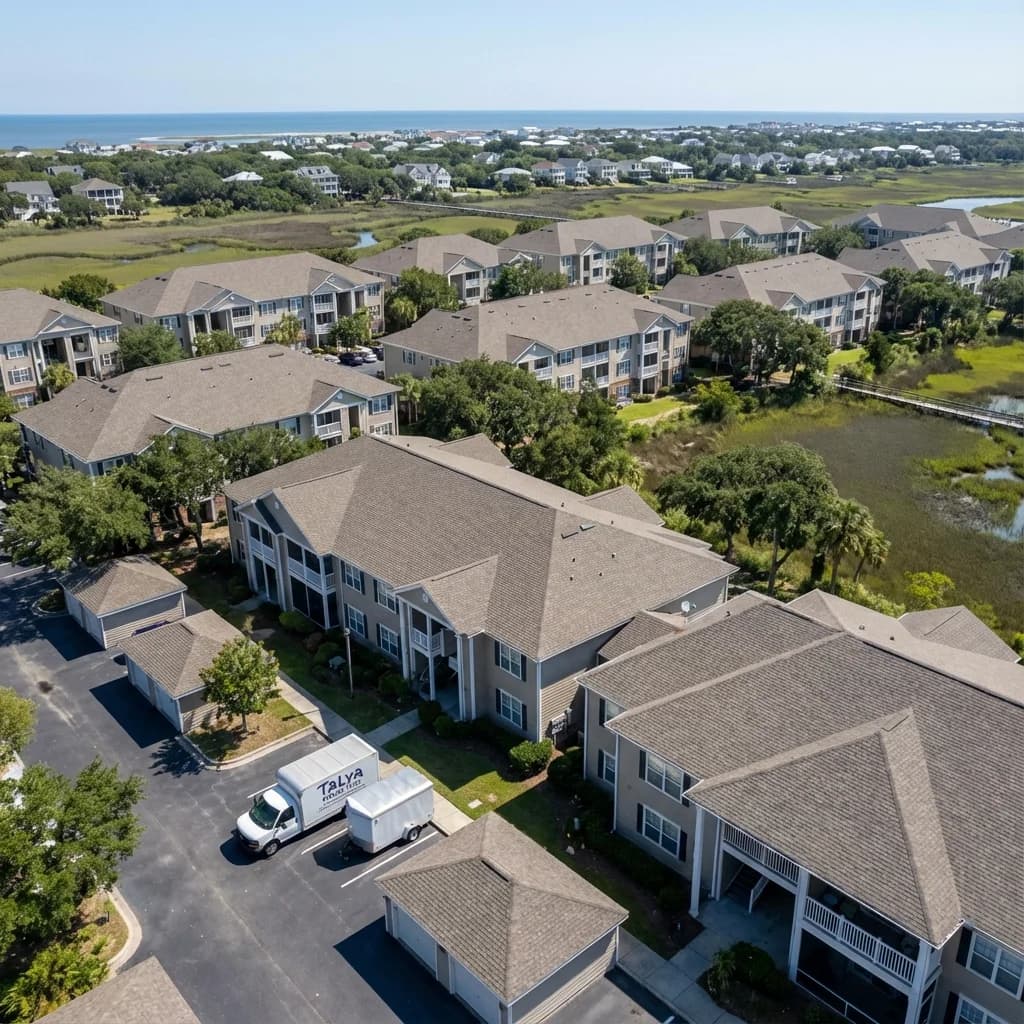
Managing roofing across a multi-building community — whether it's a 50-home HOA subdivision in Pooler, a 200-unit apartment complex in Savannah, or a luxury condominium development in Richmond Hill — is fundamentally different from managing a single residential roof. The stakes are higher, the logistics are more complex, the approval processes are multi-layered, and the financial decisions affect dozens or hundreds of property owners simultaneously.
Without a structured roofing program, communities face a common pattern: individual homeowners or buildings replace roofs piecemeal over years, creating a patchwork of different materials, colors, and conditions that drags down property values, complicates insurance, and makes future planning nearly impossible. A unified roofing program solves this by providing consistent material and color specifications across all units, bulk pricing that significantly reduces per-unit cost, coordinated scheduling that minimizes community disruption, centralized warranty management, and a single point of accountability for the entire project.
The Economics of Community Roofing Programs
Bulk Pricing Advantages
When an HOA or property management company contracts 20, 50, or 100+ roofing replacements as a single program, the per-unit economics shift dramatically compared to individual homeowner contracts:
| Cost Component | Individual Replacement | Community Program (25+ units) | Savings |
|---|---|---|---|
| Materials (per square) | Retail pricing | Volume discount (8–15% off) | 8–15% |
| Labor mobilization | Individual setup per job | Consolidated — one mobilization | 5–10% |
| Waste disposal | Individual dumpster per job | Shared dumpsters, efficient rotation | 3–5% |
| Project management | Full overhead per project | Shared across program | 2–5% |
| Total Program Savings | — | — | 15–25% |
For a 40-unit townhome community in Pooler where individual roof replacements average $12,000 each, a community program pricing of $9,500–$10,200 per unit saves the HOA $72,000–$100,000 collectively. That's money that stays in the community's reserve fund or reduces special assessment burdens on individual homeowners.
Phased Replacement Programs
Not every community can or should replace all roofs simultaneously. Capital reserve limitations, varying roof conditions across the community, and the desire to minimize simultaneous construction disruption often make a phased approach more practical. Talya Roofing designs phased programs based on the community's specific situation:
- Condition-based phasing: The most common approach. We inspect every roof in the community and prioritize replacement based on condition. Phase 1 addresses the most deteriorated roofs (typically 20–30% of units), Phase 2 tackles the next tier, and so on. This ensures the community's highest-risk roofs are addressed first.
- Geographic phasing: Replacing roofs by neighborhood section or building cluster. This minimizes the duration of construction activity in any one area and simplifies staging logistics.
- Budget-based phasing: Aligned with the HOA's annual capital budget. We design a 3–5 year program where each phase's scope matches the community's annual roofing allocation.
- Insurance-driven phasing: Review the association's actual policy and carrier notices when planning roof work. Georgia Act 277 concerns nonrenewal notice for policies covered by the amended statute; it does not impose roof-age premium penalties or guarantee insurance savings from phased replacement.
All phased programs lock in material specifications and pricing for the program duration, ensuring Phase 3 roofs match Phase 1 exactly — maintaining the architectural uniformity that protects property values.
Common HOA Roofing Requirements in the Savannah Area
Savannah-area HOAs vary widely in their architectural guidelines, but common roofing requirements we encounter include:
- Material restrictions: Many communities mandate specific material types (e.g., architectural shingles only, no metal, no 3-tab) or approved manufacturer/product lists.
- Color palettes: Roof color is almost universally restricted. Most Savannah-area HOAs approve 3–6 color options, typically earth tones, weathered wood, and charcoal/slate ranges. Talya Roofing maintains sample boards for all major manufacturer colors and can present options that meet community standards.
- Contractor qualifications: Each HOA sets its own insurance, documentation and credential requirements. Talya Roofing is an Atlas PRO+ Silver Member. Confirm the community's written requirements and the contractor's current documentation before approval; do not assume membership in one manufacturer's program satisfies another program's requirements.
- Approval timelines: Most HOAs require architectural review board approval before any roofing work begins. Review cycles can take 2–6 weeks. For community programs, we work directly with the HOA board to pre-approve materials and specifications for the entire program, eliminating the per-unit approval delay.
- Work hour restrictions: Many communities limit construction hours to weekdays (typically 7:30 AM–6:00 PM) with no weekend work. Our scheduling accommodates all community-specific restrictions.
Apartment Complex Roofing Programs
Property Management Partnership
Apartment complex roofing presents unique challenges beyond HOA residential work. Tenant notification and coordination is essential — residents need advance notice for noise, debris, and potential water shutoffs during tie-in work. Occupied-unit safety protocols must be maintained throughout the project. Complex financial structures (owner, management company, investors) require clear communication of scope, cost, and timeline.
Talya Roofing works closely with property management companies across the Savannah metro area, providing the documentation, reporting, and communication structure that professional management requires. Our project managers serve as the single point of contact between the management company, onsite maintenance staff, and our installation crews.
Multi-Building Coordination
A typical Savannah apartment complex may have 8–20+ buildings requiring roofing work. Efficient sequencing matters enormously for cost control and tenant experience. Our approach includes completing a comprehensive inspection of every building to establish condition baselines, prioritizing buildings with active leaks or imminent failure risk, scheduling material deliveries to minimize staging footprint and parking disruption, rotating crews through buildings in sequence to maintain continuous progress, and conducting quality checks at each building completion before moving to the next.
The Community Program Process with Talya Roofing
Our community roofing program follows a structured process designed for HOA boards, property managers, and community stakeholders:
- Step 1 — Community Assessment: We inspect every roof in the community, documenting condition with photographs, measurements, and remaining-life estimates. This assessment is provided to the HOA board at no cost and becomes the foundation for program planning.
- Step 2 — Program Design: Based on the assessment, we present phasing options, material recommendations that meet architectural requirements, and detailed pricing for each phase.
- Step 3 — Board Presentation: We attend HOA board meetings to present the program, answer homeowner questions, and address concerns. Our experience with community presentations helps boards build consensus and move forward confidently.
- Step 4 — Architectural Approval: We handle the architectural review process, submitting pre-approved materials and specifications that cover the entire program.
- Step 5 — Execution: Dedicated project management, daily progress updates to the board liaison, and strict adherence to community protocols from start to finish.
- Step 6 — Documentation: Each completed unit receives a warranty package, and the HOA receives a master documentation binder with warranties, material certifications, and maintenance recommendations for the entire program.
Savannah Communities We've Served
Talya Roofing has completed community roofing programs for HOA subdivisions, townhome communities, and apartment complexes across Chatham County, including neighborhoods in Savannah, Pooler, Richmond Hill, and the islands. Our project portfolio includes communities ranging from 15-unit townhome associations to 100+ unit apartment complexes. We understand the specific demands of Coastal Georgia community roofing — from hurricane-rated installations to HOA compliance — and deliver consistent results building after building.
If your community has aging roofs, rising insurance costs due to roof condition, or a patchwork of individual replacements that need to be unified, a structured roofing program from Talya Roofing is the most cost-effective and architecturally consistent path forward.
Ready to Explore a Community Roofing Program?
Talya Roofing provides complimentary community-wide roof assessments for HOAs and property management companies across Savannah, Pooler, Richmond Hill, and Chatham County. Let us show your board how a structured program saves money, protects property values, and eliminates the headaches of piecemeal roofing management.
Request a Community AssessmentOr call us directly: (912) 999-7989