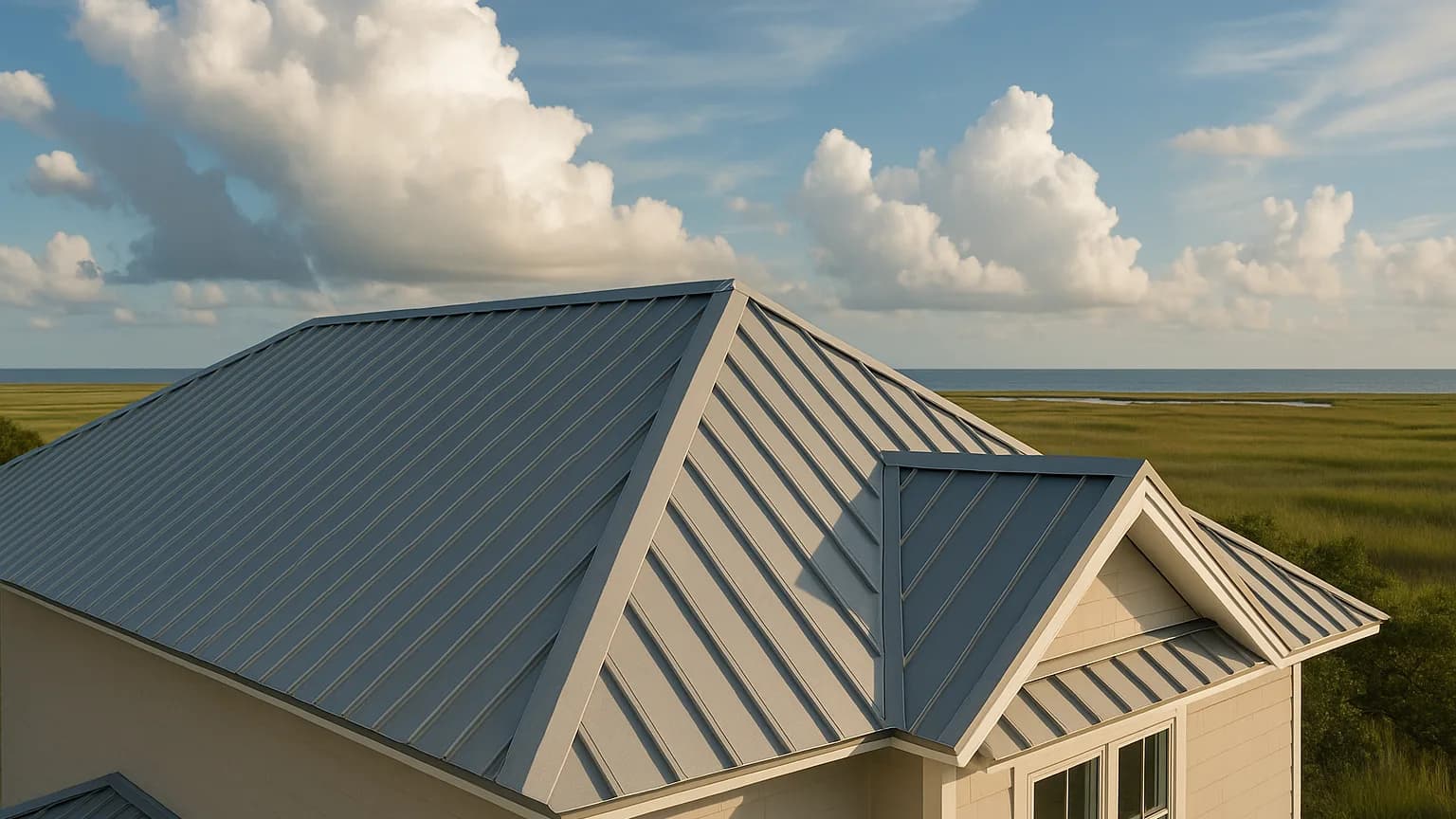

Metal roofing is one of the most durable, energy-smart options for a Coastal Georgia home — yet a handful of stubborn myths keep Savannah-area homeowners hesitating. Out here, salt air, blistering summer heat, and hurricane season make worries about rust, noise, and storm performance feel especially urgent. Below, we tackle the most common objections one by one, using only verified facts from sources like the Metal Construction Association, the Metal Roofing Alliance, the U.S. EPA, and the U.S. Department of Energy. If you are comparing options for your home, our metal roofing service page covers the systems we install across Chatham County.
Key Takeaways
- Lightning: A metal roof is no more likely to be struck than any other material, and because metal is noncombustible it will not ignite if struck (Metal Construction Association / Metal Roofing Alliance).
- Noise: Rain measures ~52 dBA on metal vs ~46 dBA on asphalt over a solid deck — below the ~8 dB humans can distinguish (Lulea study via industry sources).
- Heat: A cool roof can cut peak cooling demand 11-27% in A/C homes and stay 50F+ cooler than a conventional roof (U.S. EPA / U.S. DOE).
- Rust: Aluminum does not red-rust and is the preferred metal within ~1 mile of the coast (Metal Construction News) — the Tybee and Wilmington Island zone.
- Lifespan: A properly installed metal roof lasts ~40-70 years vs ~15-30 for asphalt (Metal Roofing Alliance).
Do metal roofs attract lightning?
No. A metal roof is no more or less likely to be struck by lightning than any other roofing material, according to the Metal Construction Association. As the Metal Roofing Alliance explains, lightning risk is driven by a structure's location, height, and surrounding topography — not by what the roof is made of. This is the single most persistent metal-roof myth, and it falls apart quickly under the data. The Metal Roofing Alliance adds the point that actually matters in a strike: metal is noncombustible and will not ignite if hit. Compare that to a wood or asphalt assembly, where a strike can spark a fire. A properly grounded metal roof installed per NFPA 780 conducts strike energy over a broad surface area, and as a noncombustible conductor it may be a more desirable option in a strike (MCA, via ATAS). For a coastal home that catches frequent summer thunderstorms rolling in off the Atlantic, a roof that resists ignition is a feature, not a flaw.
Source: Metal Construction Association
Source: Metal Roofing Alliance
Are metal roofs loud when it rains?
Not when they are installed properly. Over a solid deck with underlayment, rain measures about 52 dBA on a metal roof versus 46 dBA on asphalt. That 6 dBA difference sits below the roughly 8 dB gap humans can reliably distinguish, so most people cannot tell the difference from inside. The "tin roof in a thunderstorm" image comes from old barns and sheds, where bare panels were fastened directly to open purlins with nothing underneath. A modern residential metal roof is a layered assembly: a solid sheathing deck, underlayment, and often an attic with insulation beneath it. As McElroy explains, the assembly underneath the panel — not the metal itself — governs how much sound transfers indoors. The 52/46 dBA figures trace to a Lulea University study cited across industry sources such as S-5! and McElroy. In a well-built Savannah home, a hard summer downpour on metal sounds much like rain on any other roof. If anything, many homeowners describe it as a pleasant, muffled patter rather than a roar.
Source: McElroy Metal (Lulea study via industry sources)
Do metal roofs make your house hotter in the Georgia sun?
No — a reflective metal "cool roof" does the opposite. The U.S. EPA reports a cool roof can cut peak cooling demand 11 to 27 percent in air-conditioned homes and lower maximum indoor temperatures 2.2 to 5.9F in homes without A/C. That is real relief during a Coastal Georgia July. The myth assumes metal "attracts" heat because it gets hot to the touch, but what matters is reflectivity. The U.S. DOE Energy Saver program notes a reflective roof can stay more than 50F cooler than a conventional roof, which can hit 150F or higher in direct sun; white surfaces reflect roughly 60 to 90 percent of sunlight, while cool-colored finishes reflect about 30 to 60 percent. The DOE Federal Energy Management Program adds that cool roofs stay up to 60F cooler than black roofs in summer. The Lawrence Berkeley National Laboratory (LBNL) Heat Island Group found a white roof reflecting 80 percent of sunlight stays about 50F cooler than a grey roof reflecting 20 percent. One important note: the ENERGY STAR roofing-products designation was retired on June 1, 2022, so look for Cool Roof Rating Council (CRRC) ratings instead — there is no such thing as an "ENERGY STAR metal roof" anymore. To see how these savings stack up locally, read our metal roofing cost guide for Savannah.
Source: U.S. EPA — Cool Roofs
Source: U.S. DOE Energy Saver
Source: LBNL Heat Island Group
Do metal roofs rust in Savannah's salt air?
Not if you choose the right metal. Aluminum roofing does not red-rust — it forms a self-healing aluminum-oxide layer — and Metal Construction News identifies aluminum as the preferred metal within about one mile of the coast. For Tybee Island, Wilmington Island, and other waterfront homes, that makes aluminum the standout choice. This is the myth that deserves the most nuance in our market, because the answer genuinely depends on the alloy. Galvalume steel (about 55% aluminum, 43.4% zinc, 1.6% silicon) outlasts older galvanized steel, but Englert notes that salt and chlorides accelerate bare-steel corrosion — which is precisely why the industry recommends aluminum in the immediate coastal zone. The salt-laden air that defines life near the Savannah River and the barrier islands is hard on the wrong materials and easy on the right ones. A roofer who installs the same panel a mile inland and a block from the beach is not protecting your investment. If your home sits in the splash zone, see our Tybee Island roofing page, and for the broader metal picture our Savannah metal roofing guide walks through finishes and warranties.
Source: Metal Construction News
Source: Englert
Do metal roofs dent and lose hail protection?
Severe hail can dent metal cosmetically, but a UL 2218 Class 4 roof — the highest impact class — is built to keep its waterproof barrier intact. Class 4 is tested by dropping a 2-inch steel ball from 20 feet, and a denting panel can still shed water without leaking. The distinction that gets lost is the difference between a cosmetic dent and a functional breach. A dent is a surface mark; a breach is a hole that lets water into your home. A Class 4 impact rating speaks to the latter — the assembly's ability to protect against penetration. Coastal Georgia sees fewer destructive hailstorms than the Plains, but our severe summer storms can still drop large stones, so impact rating is worth weighing. There is a financial upside too: many insurers offer discounts for Class 4 impact-rated roofs. We say "many," not "all" — discounts and amounts vary by carrier and policy, so always confirm directly with your own insurer before counting on the savings. To compare impact and storm performance against shingles, see our best shingles for Coastal Georgia breakdown.
Do metal roofs block WiFi and cell signal?
Almost never. Metal Roofing Alliance executive director Renee Ramey has stated that any interference caused by metal roofing is negligible. Weak signal almost always traces to router placement, router age, interior obstructions, and the distance to your provider's towers — not the roof. It is an understandable worry, since metal can shield electronics in the abstract. But in a real home, your WiFi and cellular signals are shaped overwhelmingly by what is inside and around the house, plus your carrier's network. The MRA's October 27, 2025 guidance is clear that the roof is rarely the culprit. If you do notice spotty coverage after a re-roof, the fix is usually mundane: move the router toward the center of the house, upgrade an aging unit, add a mesh node or extender, or check coverage maps for your carrier. None of those point back to the metal overhead. For a deeper system comparison, our standing seam vs. screw-down guide covers panel types side by side.
Source: Metal Roofing Alliance (Oct 27, 2025)
Are metal roofs worth the cost on the coast?
For most Coastal Georgia homes, yes — the value case rests on lifespan. The Metal Roofing Alliance reports a properly installed metal roof lasts about 40 to 70 years, versus roughly 15 to 30 years for asphalt. That is potentially two to three asphalt replacements avoided over the same period. Metal does carry a higher upfront price than asphalt, and we will never pretend otherwise. But in a salt-air, high-humidity, hurricane-exposed environment, a roof that endures for decades changes the math. When you spread the cost across that 40-to-70-year service life and factor in the cooling savings discussed above, the per-year picture often favors metal — especially for homeowners planning to stay put. Choosing the correct alloy for your distance from the water (aluminum near the beach, Galvalume further inland) is what protects that long lifespan. To run the numbers for your situation, our metal roofing team can give you a clear, itemized estimate.
Source: Metal Roofing Alliance
Metal roof myths vs. facts: quick comparison
Here is the whole picture at a glance. Each row pairs a common myth with the verified fact and its source, so you can scan the truth in seconds before talking to any roofer. Use it as a checklist when you compare quotes — a contractor who cannot speak to alloy selection, deck and underlayment, or impact ratings is leaving value on the table for a coastal home.
| The Myth | The Verified Fact | Source |
|---|---|---|
| Metal attracts lightning | No more likely to be struck than any material; noncombustible, will not ignite | MCA / MRA |
| Metal roofs are loud in rain | ~52 dBA vs ~46 dBA on asphalt — below the ~8 dB humans can distinguish | Lulea study via industry sources |
| Metal makes a house hotter | Cool roof cuts peak cooling demand 11-27%; stays 50F+ cooler than conventional | U.S. EPA / U.S. DOE |
| All metal rusts at the coast | Aluminum does not red-rust; preferred metal within ~1 mile of the coast | Metal Construction News |
| Hail destroys metal roofs | Class 4 (UL 2218) can dent cosmetically without breaching the barrier; many insurers discount | UL 2218 |
| Metal blocks WiFi/cell | Any interference is negligible; signal issues trace to router/towers | MRA (Renee Ramey) |
| Metal is not worth the cost | Lasts ~40-70 years vs ~15-30 for asphalt | Metal Roofing Alliance |
Get the facts for your roof, not the myths
Wondering whether aluminum or Galvalume is right for your distance from the water? Request a complimentary Coastal Georgia project assessment and estimate to compare suitable systems for the salt-air exposure at your property.