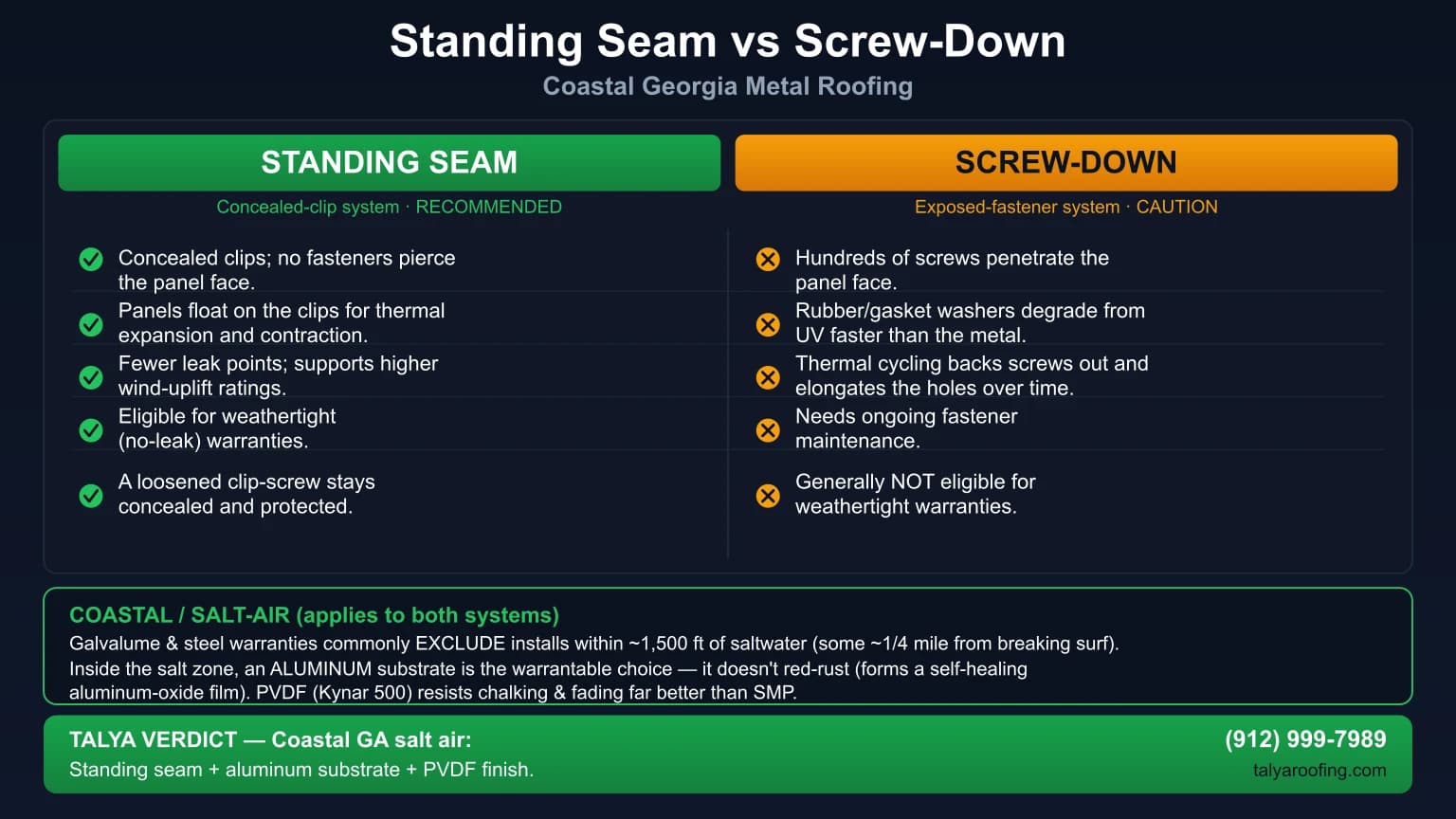

You have already decided on metal. Good choice for the Georgia coast. But "metal roof" is not one product, and the decision that actually matters once you are inside the metal category is this: standing seam or screw-down (exposed-fastener)? On Tybee Island and Wilmington Island, where homes sit within sight of the surf and take the harshest salt load on the coast, that decision plus your substrate choice determines whether the roof is even warrantable. This guide breaks down the real differences so you can specify the right system the first time.
If you are still weighing metal against asphalt, that is a different question. We cover it in depth in our standing seam metal vs shingles guide and the 2026 metal roofing cost breakdown for Savannah. This post stays inside the metal lane.
Key Takeaways
- Standing seam uses concealed clips and never pierces the panel; screw-down relies on exposed gasketed fasteners.
- Most Galvalume and steel warranties exclude installs within roughly 1,500 feet of saltwater (some use about a quarter mile from breaking surf).
- Inside the salt zone, an aluminum substrate with a coastal-rated paint warranty is the warrantable choice.
- Standing seam is eligible for weathertight (no-leak) warranties; exposed-fastener systems generally are not.
- A PVDF (Kynar 500) finish resists chalking and fading far better than SMP.
- On Tybee and Wilmington Island, fastener and substrate choices matter most for homes near the surf.
What is the real difference between standing seam and screw-down metal?
The difference is how the panel attaches. Standing seam uses hidden clips so the panel face is never pierced, while screw-down panels are held by visible screws driven straight through the metal into the deck. That single distinction drives nearly every coastal performance and warranty difference between the two systems.
With standing seam, the panels lock together at raised vertical seams and ride on concealed clips fastened to the roof deck. Because there are no surface fasteners and the panels are not pierced, the clips can let each panel expand and contract with temperature swings without being double-pinned. If a clip-screw ever loosens, it stays concealed and protected under the seam rather than opening a hole in your weather surface.
Screw-down, also called exposed-fastener or through-fastened panels, takes the opposite approach. Each panel is held down by many screws driven directly through the face of the metal, each one sealed by a small rubber or neoprene gasket washer. It is a simpler, faster system to install, and it has its place on barns, outbuildings, and budget projects. But every one of those screws is a penetration through the part of the roof that is supposed to keep water out, and that is the crux of the coastal conversation.
Which metal roof is actually warrantable near saltwater?
Warrantability is decided before performance. Most Galvalume and steel roofing warranties exclude installs within roughly 1,500 feet of saltwater, with some written to about a quarter mile from breaking surf. Inside that band, the warrantable path is an aluminum substrate with a coastal-rated paint warranty.
This is the single most overlooked factor in coastal metal roofing, and it catches homeowners off guard. The exclusion distance of about 1,500 feet from saltwater is the most common one in the industry, though it is not an absolute line and varies by manufacturer. Some warranties are instead written to roughly a quarter mile, or about 1,320 feet, from breaking surf. Either way, a standard Galvalume or steel roof installed inside that zone may carry no meaningful finish or substrate warranty at all.
How close is too close is not guesswork. One coastal-rated Galvalume product, made with U.S. Steel and a DuPont finish and marketed as the first Galvalume warrantied for coastal use, covers installs up to 300 feet from breaking surf, with warranty terms up to 50 years on the finish and up to 25 years on the substrate. The very existence of that product proves that standard Galvalume is not warrantied that close to saltwater. For oceanfront and near-surf homes, this is why the substrate and warranty conversation has to come before the standing-seam-versus-screw-down conversation.
For a full coastal-roofing primer specific to the islands, see our salt air roofing guide for Tybee Island, and when you are ready to spec a system, our metal roofing service page walks through the options we install on the coast.
Why does standing seam hold up better in salt air and high wind?
Standing seam keeps the fasteners concealed and lets the panels float, which removes the most common leak points and supports higher wind-uplift ratings. Because no holes are punched through the weather surface, the system stays watertight even as it expands and contracts in coastal heat.
Salt air is relentless. It works into every seam, gasket, and exposed metal edge it can reach, and the closer you are to breaking surf, the more aggressive it gets. A standing seam roof gives that salt far fewer entry points to attack. The fasteners that hold the system down sit under the panels, shielded from both UV and direct salt spray, so they are not the part of the roof that ages first.
Wind matters just as much here. Coastal Georgia sees tropical systems and sustained high winds, and concealed-fastener attachment is often preferred for coastal and high-wind work precisely because it allows higher wind-uplift ratings. That combination of fewer leak points and stronger uplift performance is why standing seam is the system most often specified for serious near-coast roofing. It is also the system eligible for weathertight, or no-leak, warranties, which is a level of coverage that exposed-fastener roofs generally cannot reach.
What goes wrong with screw-down (exposed-fastener) roofs on the coast?
Exposed-fastener panels depend on hundreds of rubber-gasketed screws. The gaskets degrade from UV faster than the metal, and thermal cycling slowly backs screws out and elongates the holes, so the roof needs ongoing fastener maintenance to stay sealed.
The weak point of a screw-down roof is almost never the metal panel itself; it is the seal around each fastener. Those rubber or neoprene washers sit fully exposed to the sun, and they break down from UV well before the painted metal does. As they harden and crack, the watertight seal they were providing fails one screw at a time.
Then there is movement. Metal expands in the coastal heat and contracts at night, and through-fastened panels cannot float the way clip-mounted panels do. That constant thermal cycling gradually backs the screws out and elongates the holes they sit in, so even tight fasteners loosen over the years. The result is a roof that needs a real maintenance program: periodic inspections, re-torquing, and eventually replacing washers and screws to keep it sealed. For a primary residence near the water, that ongoing obligation is a meaningful downside, and it is a big part of why exposed-fastener systems generally are not eligible for weathertight warranties.
Aluminum or Galvalume substrate for an oceanfront Georgia home?
Near the ocean, the substrate matters more than the profile. Aluminum does not red-rust because it forms a self-healing aluminum-oxide film, which is why coastal paint warranties require an aluminum substrate inside the salt zone rather than standard Galvalume.
This is where a lot of well-meaning advice goes wrong. The point is not that "Galvalume fails on the coast." Galvalume is 55% aluminum and is an excellent product across most of Coastal Georgia. The nuance is about warrantability inside the salt zone. When a coastal paint warranty is on the line, manufacturers require an aluminum substrate, because aluminum reacts differently to salt than steel-based products do.
Aluminum does not red-rust. When its surface is exposed, it forms a thin aluminum-oxide film that seals itself and resists further corrosion. That self-healing characteristic is what makes aluminum the warrantable substrate to specify when your home sits within the salt zone. It is important to frame this correctly: aluminum is not categorically superior in every situation, and it does not "make the roof stronger" or automatically prolong its life. It is simply the corrosion-resistant, warrantable choice for the harshest near-surf locations. Outside that band, coastal-rated Galvalume products are often a perfectly sound and warrantied option.
| Factor | Standing Seam | Screw-Down (Exposed Fastener) |
|---|---|---|
| Fasteners | Concealed clips; panel never pierced | Visible screws through the panel face |
| Leak points | Minimal; no surface penetrations | Many; one at every fastener |
| Thermal movement | Panels float on clips | Pinned; screws back out over time |
| Maintenance | Low; clip-screws stay protected | Ongoing fastener and gasket upkeep |
| Weathertight (no-leak) warranty | Eligible | Generally not eligible |
| Wind-uplift performance | Higher ratings available | Lower; depends on fastener hold |
Does the paint finish matter as much as the panel type?
The finish protects the metal from sun and salt-laden air. A PVDF (Kynar 500) coating resists chalking, fading, acids, and pollutants far better than SMP, making it the right choice for any panel facing Georgia's coastal climate.
A PVDF finish, commonly sold under the Kynar 500 name, is built from roughly 70% PVDF and 30% acrylic. Its carbon-fluorine bonds make the coating virtually immune to sun, moisture, acids, and pollutants, and they are why a PVDF finish resists chalking and fading so much better than an SMP finish over time. On the coast, where intense sun and salt air both attack the surface, that durability keeps the panel looking right and keeps its protective layer intact for decades.
This is why the strongest coastal specification stacks all three decisions together: a standing seam profile, an aluminum substrate inside the salt zone, and a PVDF finish. Coastal-rated PVDF products carry their own coastal warranty as well, which is one more reason to confirm the full warranty package in writing for your exact product. To compare full systems and pricing, our complete Savannah metal roofing guide lays out the options side by side.
Standing seam vs screw-down: which should Tybee and Wilmington Island homeowners choose?
For homes within sight of the surf on Tybee or Wilmington Island, standing seam on an aluminum substrate with a PVDF finish is the safest combination. It maximizes warrantability, removes leak points, and stands up to the harshest salt load on the islands.
The further a home sits from breaking surf, the more options open up, including coastal-rated Galvalume in a screw-down profile for outbuildings or budget-sensitive projects. But for a primary residence on Tybee Island or Wilmington Island that catches direct salt exposure, the math is clear: concealed fasteners protect the seal, aluminum protects against corrosion, and a PVDF finish protects the surface. Each layer addresses a different way salt air attacks a roof.
The most expensive mistake we see is a homeowner installing a beautiful metal roof that turns out to be unwarrantable for its location, because the substrate and distance-to-saltwater details were never checked. Before any near-coast metal install, the warranty language has to be confirmed for your specific address and product. That is exactly the kind of detail our team verifies on every coastal estimate through our metal roofing service, and you can start that conversation any time through our contact page.
Source: Western States Metal Roofing
Source: McElroy Metal
Source: Roofing Contractor (2023-10-17)
Source: Sheffield Metals
Source: S-5!
Spec the right coastal metal roof the first time
Not sure if your home is inside the salt zone, or which substrate and warranty may apply to your address? For each coastal estimate, we identify the quoted product and system and review the available written manufacturer information. Warranty eligibility and coverage depend on the product and system, required components, project eligibility, installation, registration or application, and current written terms. Request a complimentary project assessment and estimate from a local team that roofs the islands.