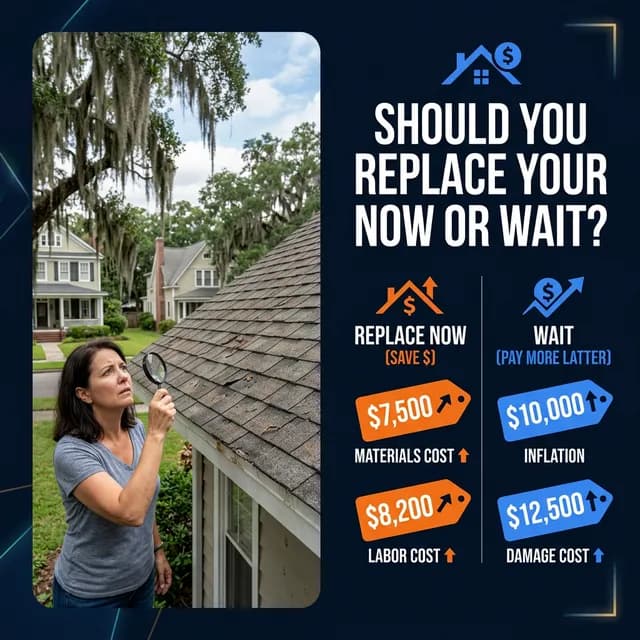

⏰ Should You Replace Now or Wait?
- ✓ Material costs have risen 8-12% annually since 2022 — waiting costs more
- ✓ Delaying past storm season risks uninsurable damage on an aging roof
- ✓ Interest-free financing makes "now" affordable without a lump sum
- ✓ A failing roof reduces your home's resale value by $10,000-$20,000
- ✓ Spring and fall offer the best scheduling availability and weather windows
Your roof is 18 years old. Maybe 22. The shingles are showing their age — some granule loss, a few curling edges, maybe a minor leak you caught early. You know replacement is coming. The question is: do you do it now, or do you wait?
This is a financial decision as much as a roofing decision. Both options have real costs, and the right answer depends on your roof's current condition, your financial situation, and your risk tolerance. This guide breaks down both sides with real Savannah-area numbers.
The Case for Replacing Now
Material Costs Keep Climbing
Roofing material costs have increased 8-12% annually since 2022, driven by raw material prices, supply chain adjustments, and increased demand. A roof replacement that costs $12,000 today will likely cost $13,500-$14,000 next year. Every year you wait, the same job costs more.
Storm Season Risk
Savannah sits in a hurricane-prone zone. An aging roof with compromised shingles is far more vulnerable to storm damage. If a storm hits before you replace, you are dealing with emergency repairs, water damage, insurance claims, and the stress of an unplanned project on top of the planned replacement you were already going to need.
Insurance Complications
Some Georgia insurance carriers are now declining to renew policies on homes with roofs older than 20 years, or they are switching those policies to ACV (Actual Cash Value) coverage, which pays dramatically less on claims. Replacing proactively keeps you insurable at RCV (Replacement Cost Value) rates.
Home Value
If there is any chance you will sell your home in the next 3-5 years, a new roof adds significant value. Buyers and their inspectors can spot an aging roof immediately, and it becomes a negotiation point that typically costs sellers $10,000-$20,000 in concessions.
The Case for Waiting
The Roof Is Still Functional
If your roof has no active leaks, the shingles are intact, the attic is dry, and a professional inspection confirms the roof has 3-5 more years of reliable service, waiting can make financial sense — especially if you are saving for the project or expecting insurance circumstances to change.
Budget Constraints
A full roof replacement is a significant investment. If the timing is not right financially, targeted repairs can extend the roof's lifespan by 2-5 years while you prepare. However, factor in the cost of those repairs — multiple $500-$1,000 repairs add up and do not get credited toward the eventual replacement.
The Smart Middle Ground: Financing
For many Savannah homeowners, the answer is not "now vs. wait" — it is "now, with financing." Through our Enhancify financing partnership, we offer 12-18 month interest-free financing that lets you replace today at today's prices, spread over manageable monthly payments.
This eliminates the two biggest reasons to wait (cash flow and material cost increases) while capturing the benefits of acting now (insurance protection, home value, peace of mind).
Not Sure If It Is Time? Get a Free Assessment.
We will inspect your roof and give you an honest timeline — replace now, or how long you can safely wait.
Should You Replace Your Savannah Roof Now or Wait?
This is the most common question we hear from Savannah homeowners with aging roofs. The answer depends on several factors specific to your situation, the current market conditions in 2026, and the real risks of delaying. Here's a decision framework to help you choose.
Decision Matrix: Replace Now vs. Wait
| Factor | Replace Now | Can Wait 1-2 Years |
|---|---|---|
| Active leaks | Yes — even small leaks cause exponential damage | No active leaks |
| Roof age | Past expected Savannah lifespan (see below) | Within expected lifespan |
| Shingle condition | Curling, cracking, granule loss >30% | Cosmetic wear only |
| Insurance status | Carrier threatening non-renewal | Coverage stable |
| Selling home | Within 2 years — buyers negotiate $10K-$20K for old roofs | Staying long-term |
| Storm season | Pre-hurricane season (best May timing) | Just missed season (Nov-Feb) |
| Material costs | Current 2026 prices (rising 8-12% annually) | Expecting prices to stabilize |
The Hidden Cost of Waiting
Many homeowners assume waiting saves money, but in Savannah's climate, delaying often costs more:
- Material price inflation: Roofing materials have increased 8-12% year-over-year since 2023. A $12,000 job today could cost $13,500 next year.
- Secondary damage: A failing roof allows moisture into your attic, causing wood rot, mold growth, and insulation degradation. These repairs (often $3,000-$8,000) add to the eventual replacement cost.
- Insurance complications: Georgia insurers are increasingly non-renewing policies on homes with roofs older than 20 years. Losing coverage or being forced into a surplus-lines policy costs $1,000-$3,000 more annually.
- Emergency pricing: If your roof fails during hurricane season, emergency repairs and replacements cost 30-50% more than planned projects due to demand surge.
- Energy waste: A deteriorating roof loses thermal efficiency. In Savannah's 7-month cooling season, this can add $50-$100/month to energy bills.
2026 Market Conditions in Savannah
The current roofing market in Savannah favors acting sooner rather than later:
- Material availability: Supply chain disruptions from 2023-2024 have largely resolved, and most materials are in stock with 1-2 week lead times.
- Contractor availability: January through April is the least busy season for Savannah roofers, meaning you get faster scheduling, better crew availability, and sometimes competitive pricing.
- Financing: 0% APR promotional periods are still widely available from major roofing finance partners. Rising interest rates may reduce these offers in the coming months.
- Tax incentives: Energy-efficient roofing materials (cool metal roofs, ENERGY STAR shingles) qualify for federal tax credits up to $1,500 through 2026.
Our recommendation: If your roof shows multiple warning signs and is well into its expected service life, request a property-specific repair-or-replacement assessment instead of relying on age alone. Talya Roofing offers a complimentary project assessment and estimate for proposed work; the separate $250 documented homeowner inspection provides a written condition record.