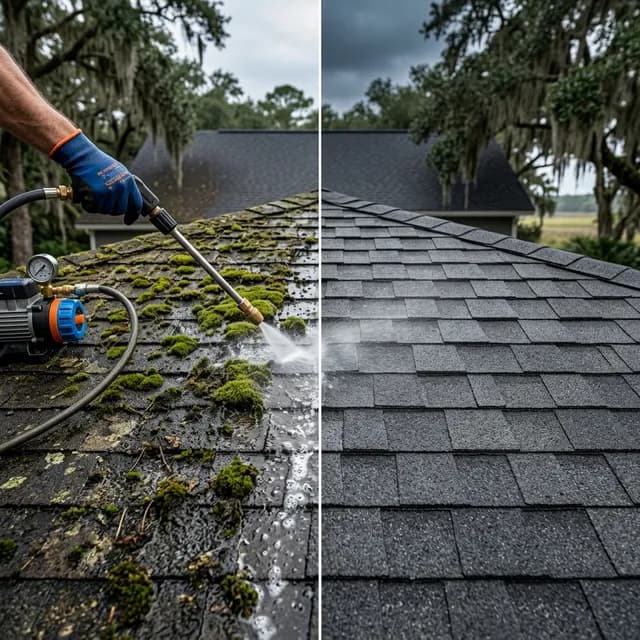

Coastal Georgia's climate is iconic: Spanish moss hanging from ancient live oaks, tidal creeks, and thick, relentless humidity. While beautiful, this environment creates a hyperactive breeding ground for roof destroying organisms: namely Gloeocapsa Magma (blue-green algae), lichen, and thick green moss.
Those ugly black streaks running down the north-facing slopes of roofs in Pooler, Rincon, and Wilmington Island aren't "dirt." They are colonies of cyanobacteria literally eating the limestone filler out of your asphalt shingles. If moss or algae establish a permanent foothold, they trap moisture against the roof deck and dramatically shorten your roof's lifespan.
🚫 NEVER PRESSURE WASH A ROOF
Do not let a "handyman" or driveway pressure-washing company use high-psi equipment on your roof. Blasting water at asphalt shingles rips away the protective ceramic granules, exposing the asphalt directly to UV rays. Pressure washing a roof will permanently destroy it and instantly void your manufacturer warranty. You must use a chemical "soft wash" technique.
The Difference Between Algae, Lichen, and Moss
To effectively clean your Savannah roof, you must understand what you are fighting:
1. Gloeocapsa Magma (Black Algae)
Appears as long, dark, sooty black streaks, largely on the north or shaded side of the roof where the sun cannot burn off the morning dew. This algae feeds on limestone dust. It drastically reduces your home's curb appeal and lowers energy efficiency by absorbing heat instead of reflecting it.
2. Lichen
Looks like light green, crusty, disc-like spots. It is a symbiotic combination of algae and fungus. Lichen is aggressive; it shoots fine root-like structures into the shingle granules to anchor itself, accelerating granule loss.
3. Green Moss
Moss is thick, fuzzy, and green. It acts exactly like a sponge, absorbing and holding rainwater directly against the shingles long after the sun comes out. In extreme cases, moss roots will lift the edges of the shingles, allowing water to sneak underneath into the underlying decking.
The Soft-Wash Solution (The Professional Standard)
Because aggressive scrubbing and high pressure destroy shingles, the roofing industry standard is the "soft-washing" method. This involves spraying a customized chemical solution at the pressure of a standard garden hose to kill the organic growth at its root.
How Soft Washing Works:
- Application: A mixture of Sodium Hypochlorite (specialized bleach) and eco-friendly surfactants (soaps) is formulated. The soap allows the bleach to cling to the steep slope without running off immediately.
- Dwell Time: The solution sits on the roof for 15-30 minutes. You essentially watch the black streaks turn yellow, then brown, then disappear as the algae is neutralized at the cellular level.
- Rinsing: The roof is gently rinsed with low-pressure water. Dead moss may require a few weeks of natural rain to completely detach from the roof without ripping granules off with it.
| Organism | Primary Danger | Removal Difficulty |
|---|---|---|
| Black Algae | Eats limestone / ruins curb appeal | Easy (Soft Wash instantly clears) |
| Lichen | Embeds roots into granules | Medium (Takes a few days to detach) |
| Thick Moss | Traps water / lifts shingles causing rot | Hard (Requires careful brushing after chemical death) |
Preventative Solutions for Coastal Homes
If you are tired of paying for roof cleanings every three years, consider long-term structural solutions:
- Zinc or Copper Strips: Installing specific metal flashing strips near the roof ridge. When it rains, metallic ions wash down the slope, acting as a mild poison to algae.
- Tree Trimming: Trim back oak canopies at least 10 feet from the roofline to allow direct sunlight and wind to dry the roof quickly.
- Modern Shingle Upgrades: If your roof is approaching the end of its life, a roof replacement using premium algae-resistant shingles (like Atlas Pinnacle Pristine featuring 3M Scotchgard™) guarantees lifetime protection against black streaks.
Frequently Asked Questions
Will the soft wash chemicals kill my landscaping?
It can, if not handled professionally. Reputable soft-washing companies vigorously water all surrounding plants before, during, and after the process to dilute any runoff, and often collect the chemical run-off at the gutter downspouts to protect your grass.
My HOA is demanding I clean my roof. Can I just use Dawn dish soap?
No. Dish soap alone will not kill cyanobacteria or moss at the root level. While it may wash away superficial surface dirt, the black streaks will return within weeks.
Safe Roof Cleaning Methods for Savannah Homes
Pressure washing a roof is the most common — and most damaging — mistake Savannah homeowners make when trying to remove algae and moss. High-pressure water strips granules from shingles, voiding manufacturer warranties and accelerating the very deterioration you're trying to prevent.
Recommended Cleaning Methods
| Method | Best For | Cost | Safe for Shingles? |
|---|---|---|---|
| Soft wash (low pressure + solution) | Algae (black streaks) | $300-$600 | Yes — manufacturer approved |
| Zinc strip installation | Prevention (after cleaning) | $200-$400 | Yes — passive protection |
| Manual removal + treatment | Moss and lichen | $400-$800 | Yes if done carefully |
| Pressure washing | Nothing — avoid this | $200-$400 | NO — strips granules, voids warranty |
Long-Term Prevention Strategy
After professional cleaning, preventing regrowth is far more cost-effective than repeated cleaning cycles. The most effective long-term prevention for Savannah homes is installing zinc or copper strips along the ridge line. When rainwater washes over these metal strips, it carries microscopic metal particles down the roof surface that inhibit algae, moss, and lichen growth. A single installation of zinc strips ($200-$400) provides 15-20 years of passive protection, eliminating the need for $300-$600 cleaning sessions every 2-3 years.
Prevention Is Better Than Cure
Rather than repeatedly paying for cleaning cycles every 2–3 years, invest in prevention strategies that address the root causes of biological growth on Savannah roofs:
- Zinc or copper strips: These thin metal strips are installed along the ridge line, just below the ridge cap shingles. Every time it rains, water washes microscopic metallic ions down the roof slope, creating an environment hostile to algae, moss, and lichen. Zinc strips cost $200–$400 to install and provide 15–20 years of passive protection. Copper strips are more effective but cost roughly twice as much. For Savannah homes with persistent north-facing algae problems, zinc strips pay for themselves after a single avoided cleaning cycle.
- Tree trimming: Shade and debris are the two biggest contributors to biological growth on coastal Georgia roofs. Trees that overhang the roof block sunlight that would otherwise dry morning dew and kill algae colonies. Overhanging branches also deposit leaves, pine needles, and pollen that trap moisture and provide organic nutrients for moss. Maintain a minimum 6–10 foot clearance between tree canopy and the roof surface. An annual trimming service ($200–$500 per visit) dramatically reduces biological growth pressure.
- Proper attic ventilation: Poor ventilation traps moisture in the roof system, creating persistently damp conditions on the underside of the decking that promote moss growth from below and condensation that feeds biological activity on the exterior. Ensure soffit vents are clear, ridge vents are unobstructed, and total ventilation meets the 1:150 rule (1 sq ft of net free ventilation per 150 sq ft of attic floor). In Savannah's humidity, ventilation is not optional — it is the foundation of roof health.
- Algae-resistant shingles: When it is time for a roof replacement, specify shingles with copper-infused granules (such as Atlas Pinnacle Pristine with Scotchgard or GAF StainGuard Plus). These shingles release copper ions that inhibit algae colonization for the life of the roof. The premium over standard shingles is minimal — typically $200–$500 for a whole-roof upgrade — and eliminates the need for separate cleaning or zinc strip installation.
Cleaning Methods Compared
Not all roof cleaning methods are equal — and the wrong approach can cause more damage than the biological growth itself. Here is how the common methods compare for Savannah homes:
Pressure Washing (AVOID)
High-pressure water (2,000+ PSI) strips granules from asphalt shingles on contact, exposing the asphalt layer to UV degradation and immediately voiding the manufacturer's warranty. A pressure-washed roof may look clean for a few months, but the granule damage shortens the roof's remaining lifespan by 5–10 years. Despite being cheap ($150–$300), pressure washing is the most expensive "cleaning" method when you factor in the accelerated replacement timeline it causes. No reputable roofing company recommends or performs high-pressure roof washing.
Soft Wash (Recommended)
The industry-standard method uses a customized sodium hypochlorite solution (specialized bleach formulated for roofing applications) applied at garden-hose pressure. The chemical kills algae, lichen, and moss at the cellular level without disturbing the shingle granules. The solution is applied, allowed to dwell for 15–30 minutes, and gently rinsed. Results are visible immediately for algae; moss and lichen may take 2–4 weeks of natural rainfall to fully detach after the organisms die. Cost: $300–$600 for a typical Savannah home. Professional soft-wash companies pre-wet and protect landscaping to prevent chemical runoff damage to plants.
Chemical Treatment (DIY Option)
For homeowners comfortable working from a ladder, commercially available roof cleaning solutions (such as Wet & Forget or Spray & Forget) offer a lower-cost alternative to professional soft washing. These products are sprayed on from a garden sprayer and work gradually over several weeks of natural rain exposure. They are effective against algae and light moss but less effective against established lichen or heavy moss mats. Cost: $25–$50 per application. The trade-off is slower results and the need for reapplication every 6–12 months. For heavy growth, professional soft washing is more effective for the initial cleaning, followed by DIY maintenance treatments to prevent regrowth between professional visits.