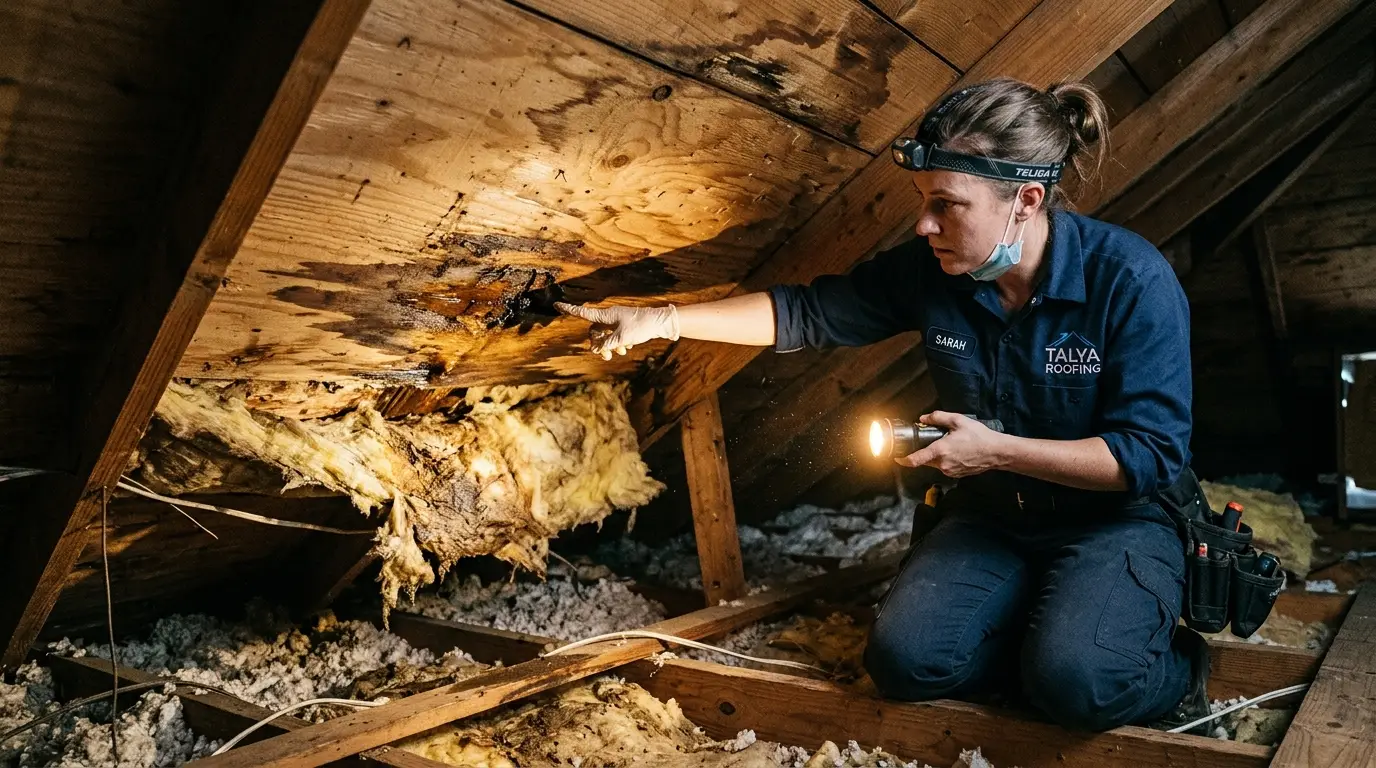

When a brown stain appears on your Savannah ceiling, your first instinct is to look directly above it on the roof. That's the wrong starting point about 70% of the time. Water enters the roof system at one point, then travels along the underside of the deck — sometimes 6 to 12 feet — before dripping into the insulation, soaking through the drywall, and finally showing on your ceiling. By the time you see the stain, the actual leak source is usually a few feet uphill from where you're looking.
This guide gives you the 7-step diagnostic flowchart we use on every Talya Roofing leak investigation, the 8 most common Coastal Georgia leak sources in priority order, how to distinguish a real leak from the attic-condensation problem that Savannah humidity makes especially common, and the honest cost math on early vs late leak repair. You can do the inside-the-attic diagnosis safely yourself; the on-the-roof part is where DIY gets dangerous.
Key Takeaways
- ✓ Diagnose from the SOURCE down, not the stain up — water travels 3-12 ft along the deck before dripping. Most Savannah leaks originate 3-6 ft uphill of the ceiling stain.
- ✓ Top-3 Savannah leak sources: flashing around plumbing/exhaust penetrations (40% of calls), chimney/sidewall step flashing (~20%), roof-to-wall intersections on additions (~12%).
- ✓ Active leak = water within 4-8 hours of rain start. Condensation = widespread fine dew across the deck, peaks October-March. Don't confuse the two.
- ✓ Early-catch leak repair: $150-$650. Late-catch (6+ months ignored): $2,500-$8,000 (drywall + insulation + deck + sometimes mold remediation).
- ✓ DIY safely from inside the attic; do NOT DIY from the roof — Savannah's 6/12 to 9/12 pitches are steep enough to make one slip a 12-25 ft fall.
Why Most Savannah Roof Leaks Don't Show Up Where You Think They Do
A typical asphalt-shingle roof system has three water-management layers: the shingles (primary barrier), the underlayment (secondary barrier), and the deck (the substrate). When water defeats the shingle layer at one specific entry point — a cracked vent boot, a lifted shingle tab, a failed sealant on a flashing seam — it doesn't drip straight down. It runs down the slope along the top of the underlayment, or along the underside of the deck if the underlayment also failed, until it finds gravity's path of least resistance.
In Savannah's typical roof geometry, that path is rarely straight down. Common detours we see weekly:
- Down a rafter — water hits a rafter and travels horizontally 4-8 feet before dripping at a joint.
- Across an insulation batt — fiberglass insulation wicks water laterally before saturating enough to drip.
- Along a ductwork run — HVAC ducts in the attic become a slip-and-slide surface that can move water 12+ feet from the entry point.
- Down a wire bundle — electrical wiring routed through the attic creates a perfect drainage path that dumps water at the next penetration through the ceiling.
Add Coastal Georgia's near-100% summer humidity and the fact that wet insulation looks identical to dry insulation through fiberglass-pink coloring, and the "obvious" leak location is almost always misleading. Diagnose by following the water uphill from the wet zone, not by looking up at the ceiling stain.
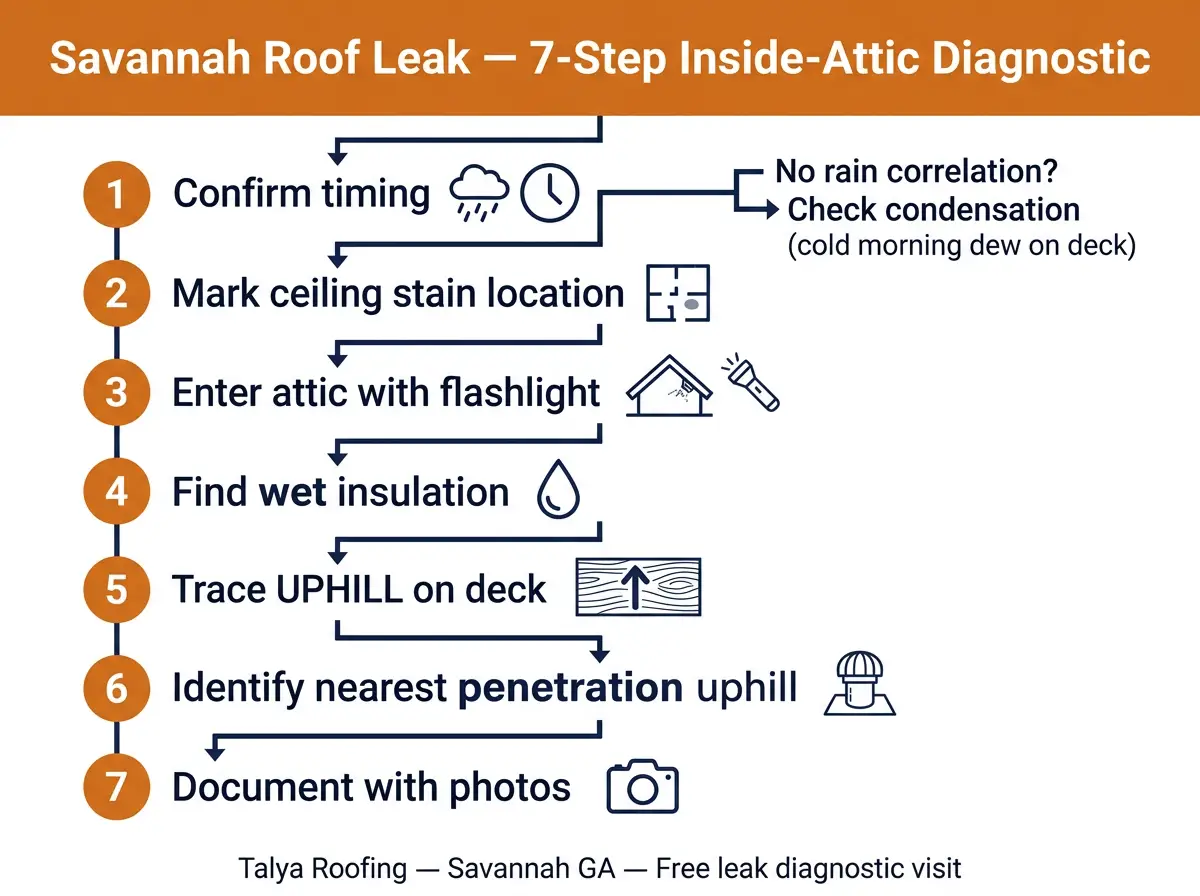
The 7-Step Diagnostic Flowchart — From Ceiling Stain to Root Cause
Run these steps in order. Stop at the step where you find the answer; you don't need to do all 7 on every leak.
- Confirm timing. Did the stain appear within 4-8 hours of a recent rain? YES → real leak, continue to step 2. NO (gradual growth over weeks) → likely condensation, jump to step 7.
- Note the ceiling-stain location on a floor plan. Mark the room, the wall it's nearest to, distance to nearest wall in inches. This becomes your reference for the attic search.
- Go into the attic during a dry day after rain. Bring a flashlight and protective gloves. Locate the wet insulation directly above the ceiling stain — it'll be darker, heavier, sometimes visibly damp on top.
- Trace UPHILL along the underside of the roof deck. Follow the slope away from the wet area. Look for: dark water tracks on the wood, rust stains around nail heads (water drips down a nail), daylight visible through the deck, or sagging/discolored sheathing.
- Identify the nearest penetration UPHILL. The most common entry point will be a plumbing vent pipe (cast-iron or PVC sticking up through the roof), a bathroom exhaust vent, an attic fan, a chimney, or a roof-to-wall transition. Almost every Savannah leak we find ties back to one of these.
- Document with photos. Take 4-6 photos of the wet area and the suspected entry point. You'll need these for the contractor (and for insurance if the damage is storm-related).
- If timing was gradual (step 1 = NO) — check for condensation. Inspect for: widespread "frost-like" dew on the underside of the deck (cold morning), no concentrated drip point, insulation evenly damp rather than wet in one spot, the issue worsens in October-March (cold humid season). If yes to these, you have a ventilation problem, not a roof leak.
The 8 Most Common Leak Sources on Savannah Roofs (In Priority Order)
From Talya Roofing's leak-investigation log over the last 24 months across Chatham, Bryan, Effingham, and Liberty counties:
| # | Source | % of leaks | Typical repair cost | Coastal Georgia note |
|---|---|---|---|---|
| 1 | Cracked plumbing-vent boot | Common source | Quoted after assessment | Scope depends on access, flashing, surrounding shingles, material match, and supported damage |
| 2 | Chimney step flashing failure | ~15% | $650–$1,800 | 1960-1990 Savannah homes used lapped (not stepped) flashing — common failure mode |
| 3 | Bathroom/kitchen exhaust vent flashing | ~12% | $150–$400 | Humidity-driven condensation BACK into the duct mimics a leak |
| 4 | Roof-to-wall (addition junction) | ~12% | $450–$1,400 | Common on Savannah addition projects from 1980-2010 |
| 5 | Ridge vent end-cap failure | ~10% | $200–$500 | Hurricane wind-driven rain enters through the end caps in any storm 60mph+ |
| 6 | Valley underlayment failure | ~8% | $800–$2,500 | High-volume water-channel area; failures common at 15+ years old |
| 7 | Lifted/missing shingles after wind | ~10% | $200–$600 | Standard issue post-named-storm in Chatham/Bryan/Liberty |
| 8 | Gutter back-flow under drip edge | ~5% | $0–$300 (cleaning) up to $1,200 (re-edge) | Live-oak debris is Savannah's #1 gutter-clog cause |
| — | Attic condensation (NOT a leak) | ~3% | $400–$1,800 (ventilation upgrade) | Mistaken for leak; ventilation fix not shingle work |
If your stain timing matches a wind-event from last week or last month — items #5, #6, #7 jump to the top. If it's gradual with no storm correlation — items #1, #2, #4 are most likely.
How to Tell an Active Leak From Attic Condensation in Coastal Georgia
Savannah's humidity makes condensation a real and frequently misdiagnosed problem. The pattern:
- Cold morning (especially November-February). Warm humid air rises from the heated living space into a cold attic. The deck (which is at outdoor temperature) acts as a condenser.
- Moisture condenses on the underside of the deck like dew on grass.
- If severe, the condensation runs down the slope and drips off the lowest sheathing points or off ductwork — looks exactly like a roof leak.
The diagnostic test: does the "leak" happen on a clear cold morning with no rain in the last 48 hours? If yes, it's condensation — fix the ventilation, not the roof. Ventilation fixes range from adding soffit vents ($400-$800) to retrofitting a continuous ridge vent ($800-$1,800) to installing a powered attic fan ($600-$1,400). A real Savannah roofer should be willing to diagnose this difference for you for free — be skeptical of any contractor who immediately proposes a re-roof after seeing condensation patterns.
What You Can Safely Diagnose Yourself vs When to Call a Pro
Safe DIY:
- Looking in the attic with a flashlight (use a board across rafters to walk on — don't step on insulation alone).
- Photographing the wet area and visible damage from inside.
- Documenting the stain location with measurements.
- Using a sky-light or roof-vent opening to look at the exterior surface from inside.
- Checking gutters for clogs from the ground or a short ladder (no higher than gutter line).
NOT DIY:
- Walking on the roof to inspect from above.
- Resealing a vent boot, flashing, or shingle from on the roof.
- Replacing damaged shingles from on the roof.
- Anything on a metal roof — slipperier than asphalt by an order of magnitude.
- Anything on a wet roof, in wind 15mph+, or in the first 4 hours after rainfall.
Roof-related falls are the second leading cause of construction fatalities in Georgia (after electrocutions). Homeowners doing DIY roof work account for a real share of those statistics. The savings from doing it yourself are not worth the medical bill if you slip — let alone the worse outcomes. A licensed Savannah roofer carries workers' comp specifically because this work is dangerous.
Cost of a Savannah Roof Leak Repair Caught Early vs Caught Late
The compounding cost of an ignored leak in Coastal Georgia (humidity accelerates secondary damage):
| Time leak has been active | Typical Savannah repair scope | Cost range |
|---|---|---|
| Week 1 (caught immediately) | Vent boot or flashing work, no supported interior damage | Quoted after assessment |
| Month 1-3 | Same exterior fix + insulation replacement (1-2 batts) + 1 small drywall patch | $450–$950 |
| Month 4-6 | Exterior fix + insulation R&R + drywall ceiling patch + paint touch-up | $950–$2,200 |
| Month 6-12 | Above + plywood deck replacement (1-2 sheets) + possible joist treatment | $2,200–$4,800 |
| Year 1+ | All of above + mold remediation (Coastal Georgia humidity ensures this) + sometimes HVAC duct cleaning | $4,800–$8,000+ |
The practical lesson is to investigate a suspected leak promptly. A localized exterior repair can grow into insulation, drywall, deck, framing, or moisture-remediation work when water entry continues. The actual repair scope and price are confirmed after assessment.
Talya Roofing's Complimentary Leak-Repair Project Assessment
Across Chatham, Bryan, Effingham, and Liberty counties, a complimentary leak-repair project assessment supports a proposed repair estimate. It is not the separate paid homeowner inspection report. The estimate visit may include:
- Interior visual of the ceiling stain and attic above (when accessible).
- Exterior visual of the suspect entry zone using safe access methods appropriate to the property and conditions.
- Project findings used to develop a proposed repair scope; concealed conditions and exact leak paths cannot be guaranteed from a visual assessment.
- Written project estimate — if the supported scope is localized penetration work, we quote the property-specific repair rather than assuming a full re-roof.
- If you want a quick patch-and-monitor approach instead of permanent repair, we'll quote that separately.
- If the diagnosis is condensation (not a leak), we'll tell you and refer you to a ventilation specialist — we don't accept work we shouldn't.
Call (912) 999-7989 or request a leak-repair project assessment online. Appointment timing depends on weather, safe access, location, storm volume, and current availability.
Got a leak you can't pin down?
Use the inside-the-attic flowchart above to get oriented, then request a complimentary leak-repair project assessment and estimate. A written homeowner condition report is available through the separate $250 documented inspection.
Call (912) 999-7989 or book online; timing and diagnostic limitations are confirmed for the property.