
Key Takeaways
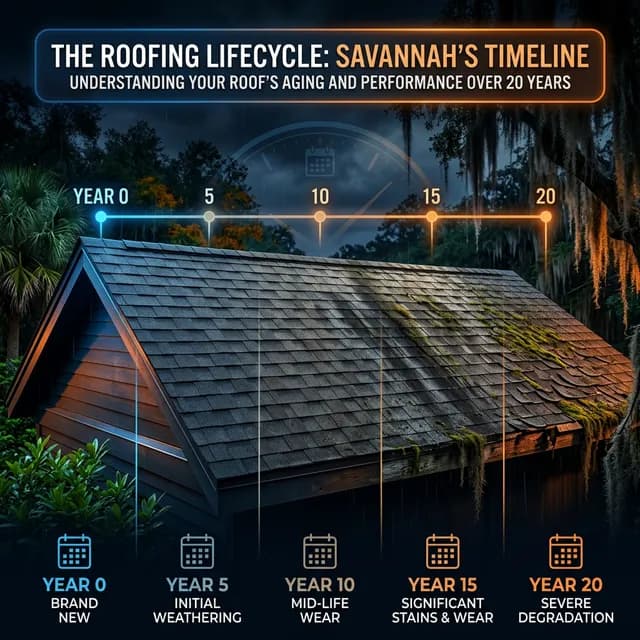
- Savannah's subtropical climate — heat, humidity, UV, storms, and salt air — reduces roof lifespan by 15–25% compared to manufacturer estimates
- Three-tab asphalt shingles last 12–18 years in Savannah vs. the rated 20–25; architectural shingles last 18–25 years vs. rated 30
- Metal roofing delivers the best longevity ROI in coastal Georgia, lasting 35–50+ years with minimal maintenance
- Proper ventilation, quality installation, and regular maintenance are the three controllable factors that most affect roof life
- Annual roof inspections catch problems early and can extend effective lifespan by 3–5 years
Why Roofs Don't Last As Long in Savannah
When a shingle manufacturer stamps "30-year warranty" on their product, that figure is based on standardized testing conditions that bear little resemblance to what roofing materials endure in Savannah, Georgia. Our roofs face a relentless combination of environmental stressors that accelerate aging beyond what homeowners — and even some contractors — expect.
Understanding these factors helps Savannah, Pooler, Richmond Hill, and Tybee Island homeowners set realistic expectations for roof lifespan and plan replacement budgets accordingly.
Savannah's Climate Stressors on Roofing Materials
UV Radiation
Savannah receives approximately 217 sunny days annually and sits at 32° north latitude, meaning UV intensity is significantly higher than in the northern states where many roofing materials are tested. UV radiation breaks down the chemical bonds in asphalt, causing it to become brittle, lose flexibility, and shed protective granules. A roof in Savannah accumulates roughly 30% more UV exposure over its lifetime than the same roof in Philadelphia or Chicago.
Thermal Cycling
Savannah's daily temperature swings — roof surfaces can reach 160–170°F in summer afternoon sun and drop to 70–80°F overnight — create constant expansion and contraction stress. Over years, this cycling fatigues shingle adhesive bonds, works fasteners loose, and cracks rigid sealants. The cumulative effect is equivalent to thousands of tiny stress tests on every joint and connection in your roofing system.
Humidity and Moisture
At 74% average annual relative humidity, Savannah's atmosphere keeps roofing materials perpetually moist. Organic components absorb this moisture, expanding and contracting with every humidity change. Trapped moisture promotes biological growth (algae, moss, mold) that further degrades materials. In poorly ventilated attics, condensation on the underside of roof decking adds moisture damage from below.
Storm Exposure
Savannah sits within the Atlantic hurricane basin's reach, experiencing tropical weather threats from June through November. Even storms that don't make direct landfall subject our roofs to sustained high winds, driving rain, and occasionally hail. Each significant weather event causes micro-damage that accumulates over years — loosened shingles, stressed fasteners, compromised flashing seals.
Salt Air
Properties near the coast — Tybee Island, Wilmington Island, Thunderbolt, and Isle of Hope — face airborne salt exposure that corrodes metal components including flashing, fasteners, drip edge, and vents. Even homes 10–15 miles from the ocean experience measurable salt deposition during onshore wind events.
Realistic Lifespan by Material in Savannah's Climate
Here's what you can realistically expect from each roofing material in the Savannah metro area, assuming average quality installation and reasonable maintenance:
- Three-tab asphalt shingles: 12–18 years (manufacturer rated 20–25). The thinnest asphalt option ages fastest in our UV and heat environment.
- Architectural (dimensional) asphalt shingles: 18–25 years (manufacturer rated 30). Thicker construction and better granule adhesion extend life significantly over three-tab.
- Premium/luxury asphalt shingles: 22–30 years (manufacturer rated 50). These heavyweight shingles with multiple laminated layers resist Savannah's stressors better than standard architectural, but don't achieve their rated lifespan here.
- Standing seam metal: 35–50+ years (manufacturer rated 50–70). Metal's resistance to UV, moisture, and biological growth makes it the longevity champion in coastal Georgia.
- Metal shingles/tiles: 30–45 years. Coated metal substrates with stone or painted finishes perform slightly less than standing seam due to more complex joints and fastener points.
- Clay/concrete tile: 40–60 years. The tile itself is extremely durable in our climate, though underlayment beneath the tile may need replacement at 20–30 years.
- Slate: 60–100+ years. Natural slate is virtually impervious to Savannah's climate. The roof structure, flashing, and fasteners age before the slate does.
- TPO/PVC membrane (flat roof): 18–25 years (manufacturer rated 25–30). UV exposure on flat surfaces is intense, and Savannah's heat accelerates membrane aging.
Factors That Extend or Shorten Roof Life
What Extends Life
- Proper attic ventilation: Balanced soffit-to-ridge ventilation reduces attic heat and moisture — the two biggest controllable stressors. Can add 3–7 years of effective life.
- Quality installation: Correct nail placement, proper starter strip and drip edge installation, adequate flashing, and code-compliant fastening patterns prevent premature failure modes.
- Regular maintenance: Annual inspections with prompt repair of minor issues prevent small problems from cascading into system-wide failure.
- Tree management: Keeping branches 6+ feet from the roof surface reduces physical damage, shade-induced moisture retention, and debris accumulation.
- Light-colored materials: Lighter shingles and reflective metal reduce thermal stress by running cooler in Savannah's sun.
What Shortens Life
- Poor ventilation: Traps heat and moisture against shingles from below — the single most common accelerant of premature roof failure in Savannah
- Improper installation: Overdriven nails, inadequate flashing, missing underlayment — shortcuts that may not show problems for years but ultimately cause early failure
- Deferred maintenance: Small leaks, lifted shingles, and clogged gutters compound into major damage within 1–2 storm seasons
- Multiple layers: Roofing installed over existing layers retains more heat and may not lie flat, shortening the new material's life
Planning for Replacement
The most cost-effective approach is to start planning for replacement when your roof reaches 75% of its expected local lifespan. For architectural shingles in Savannah, that means beginning to budget and evaluate options around year 15. This gives you time to research materials, compare contractors, and potentially time the project to align with off-season pricing or coordinate with insurance if storm damage accelerates the timeline.
How Much Life Does Your Roof Have Left?
Talya Roofing provides expert roof condition assessments throughout Savannah, Pooler, Richmond Hill, and Tybee Island. We'll evaluate your roof's current condition, estimate its remaining useful life, and help you plan for the future — whether that's maintenance to extend its life or budgeting for replacement.