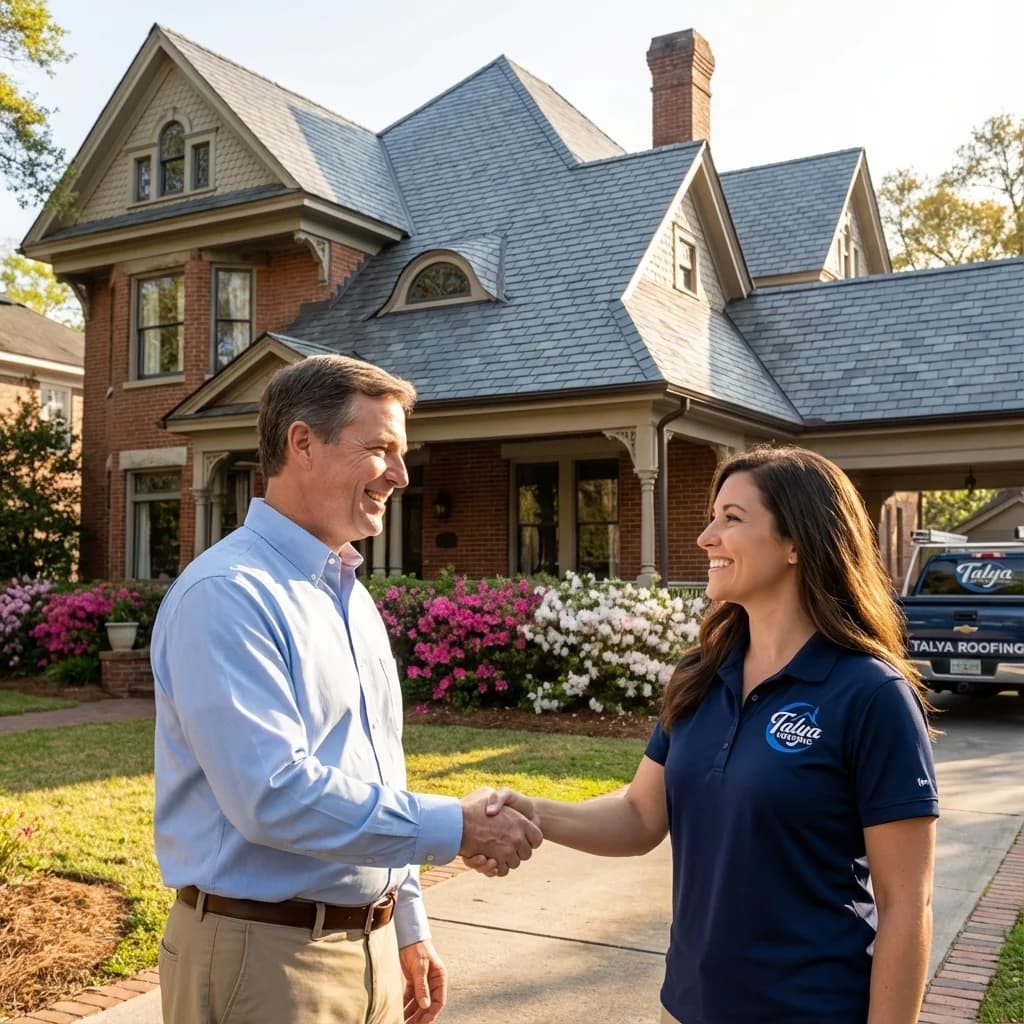

Quick answer: how to choose a roofer near you
The best roofer near you is the contractor whose current evidence, written scope, and service process fit your property. A high search position or a nearby address can help you create a shortlist, but neither proves workmanship, insurance, product knowledge, or warranty coverage.
- Verify the legal business name and applicable local business credentials.
- Request current general liability and workers compensation documentation.
- Compare recent projects that resemble your roof type and requested service.
- Review materials, flashing, ventilation, decking allowances, cleanup, payment terms, and exclusions in writing.
- Confirm the exact manufacturer program and warranty terms attached to the proposed roof system.
When a Savannah homeowner searches for the best roofer near me, the results mix local companies, regional contractors, paid listings, map results, directories, and educational pages. The order can change by location, device, search history, and the wording of the query. Treat the results as a starting point for research, not as a final ranking of contractor quality.
Your decision should rest on evidence that can be checked before you sign. This guide shows how to verify a contractor, compare estimates at the same scope, and identify questions that matter for a Savannah roof. It also explains where Talya Roofing fits the checklist without asking you to accept a self-awarded “best” label.
What “best roofer near me” should mean in Savannah
“Best” is not one universal category. A contractor who is a good fit for a small leak may not be the right fit for a full standing-seam metal replacement. A company experienced with new construction may use a different process from one focused on occupied residential homes. Start by defining the job: repair, replacement, storm-related documentation, inspection, gutter work, or a material comparison.
Next, look for evidence that matches that job. Ask to see recent work using a similar roof system. Ask who will inspect the property, who will explain the scope, and who will handle questions during installation. Confirm whether the proposal covers only the visible roofing surface or also addresses flashing, penetrations, ventilation, deck conditions, accessories, and cleanup.
Local relevance matters because Savannah properties vary. Roof geometry, tree cover, exposure, historic-district requirements, neighborhood rules, existing ventilation, and the selected manufacturer system can change the correct scope. No honest contractor can decide every detail from a search result or promise that one product will overcome every storm. The contractor should inspect the property and explain project-specific choices in plain language.
Seven checks before you schedule an estimate
1. Match the company name to public records
The legal or registered business name should appear consistently on the proposal, insurance documents, and other project paperwork. The Georgia Secretary of State business search provides entity information of record. That search is useful for confirming an entity, but it should not be treated as a universal roofing-license lookup or proof of workmanship.
2. Check applicable local business credentials
The City of Savannah explains that businesses operating within the city must have a current Business Tax Certificate, also known as a business license. Review the City of Savannah business-license guidance, then ask the contractor to identify the company name shown on its current credential. Requirements can vary by jurisdiction and project, so verify questions with the applicable local authority.
3. Request current insurance documentation
Ask for current general liability and workers compensation documentation applicable to the contractor and project. Check the named insured, policy dates, and company name instead of accepting a logo or an old screenshot. If the crew structure includes subcontractors, ask how the contractor verifies the coverage and responsibility that apply to the people working at your property.
4. Verify manufacturer status and warranty details separately
A contractor badge and a project warranty are related but not identical. Use the manufacturer’s public tools, such as the Atlas contractor directory, to check current program information. Then ask for the exact warranty name, covered products, required components, eligibility rules, registration or application steps, exclusions, and current written terms for your proposed roof.
5. Review recent, relevant project proof
A broad gallery may show that a company performs roofing work, but relevance is more useful than volume. Ask for recent examples of the material and service you are considering. For a repair, look for diagnostic documentation and a clearly limited repair scope. For a replacement, look for details around flashing, penetrations, ventilation, edge conditions, cleanup, and final documentation. Browse our roofing project gallery as one part of that review.
6. Read reviews for patterns, not just the average
Look across recent and older reviews. Pay attention to repeated comments about communication, scheduling, property protection, cleanup, change orders, and follow-up after payment. A short five-star comment and a detailed project review do not provide the same evidence. Read lower-rated reviews too, then see whether the response is specific, respectful, and focused on resolution.
7. Ask how the company handles changes and follow-up
Decking damage or another concealed condition may become visible only after tear-off. The proposal should explain how discoveries are documented, priced, and approved. Ask who can authorize a change, how you will receive photographs, and what happens if you have a workmanship concern after completion. A clear service process is more useful than a vague promise to “take care of everything.”
Compare written estimates line by line
Three totals are not comparable when the underlying scopes are different. One proposal may include permit costs, upgraded underlayment, new flashing, and a defined decking allowance while another omits those items. Before choosing a price, put each estimate into the same categories and mark missing or unclear information.
| Estimate category | Evidence to look for | Question if unclear |
|---|---|---|
| Tear-off and disposal | Number of layers, debris handling, and property protection | What is included if another layer is found? |
| Decking | Allowance, unit price, approval method, and documentation | How will concealed damage be shown and priced? |
| Roof system | Named shingles or panels, underlayment, starter, ridge, and accessories | Are all required components identified? |
| Flashing and penetrations | Scope for walls, valleys, chimneys, vents, and pipe penetrations | What is replaced, reused, or excluded? |
| Ventilation | Existing conditions, proposed intake and exhaust, and compatibility | How was the ventilation scope determined? |
| Permits and inspections | Responsible party and included costs where applicable | Which authority and process apply to this address? |
| Warranty documents | Separate workmanship terms and named manufacturer coverage | What must happen for each warranty to apply? |
| Payment and changes | Schedule, milestones, change-order process, and exclusions | Who approves additional work and when is it due? |
For a deeper worksheet, use our guide to comparing Savannah roofing estimates. If a contractor cannot explain a major difference in writing, do not fill the gap with an assumption. Ask for a revised proposal before deciding.
Coastal Georgia questions that reveal relevant experience
Local experience should show up in the contractor’s questions and scope, not only in the marketing copy. Ask how the proposed installation follows current manufacturer instructions for the selected roof system and how the scope accounts for the actual deck, edges, penetrations, flashing, and ventilation found at your home.
- What conditions on my roof would make a repair reasonable, and what findings would point toward replacement?
- Which roof components will be replaced, and which may be reused after inspection?
- How will wall flashing, chimney flashing, pipe penetrations, valleys, and roof-to-wall transitions be handled?
- How will intake and exhaust ventilation be evaluated for this property?
- What material and fastening instructions apply to the quoted system?
- How will weather affect tear-off, dry-in, installation, and scheduling?
- Will photographs document the deck and critical installation stages?
- Who confirms permit requirements for this address, and who is responsible for the process?
Listen for project-specific answers. A contractor should be willing to say when an inspection is needed before answering. Be cautious when every roof receives the same recommendation before anyone has evaluated its age, condition, geometry, leaks, deck, and ventilation.
How to read reviews and project proof
Reviews are most useful when they help you understand a process. Look for details about whether the contractor arrived when promised, explained changes, protected the property, completed cleanup, and responded after the work. Recent reviews show current operations, while older reviews can show whether the company has maintained service over time.
Project photographs should also answer questions. Can you identify the type of work? Is the roof similar to yours? Do the images show only a finished surface, or do they also show inspection findings and important installation stages? Not every homeowner approves public photographs, so a smaller gallery is not automatically a negative. Ask what relevant proof can be shared with appropriate permission.
Do not rely on an exact review-count threshold. A company with many reviews can still be a poor fit for a specialized project, and a smaller company may have relevant work that deserves consideration. Use review patterns alongside business credentials, insurance, scope completeness, manufacturer information, and direct communication.
Why local accountability matters after a storm
Storm activity can increase demand quickly. Scheduling, material availability, safe access, and inspection timelines may change. A contractor should explain the next available step without guaranteeing an arrival time or claim result. For storm-related work, the contractor can document observed conditions and construction scope, but the insurance carrier and policy determine coverage, payment, and claim decisions.
Ask how the company stores project documents and photographs, who will answer questions after the initial visit, and how you can reach the business after installation. A local credential is one helpful fact, but accountability also depends on a written agreement, named contacts, consistent communication, and a defined workmanship-service process.
If you need help separating a targeted repair from a replacement, review our roof-repair service and roof-replacement process. The final recommendation should depend on observed conditions and the requested scope.
Where Talya Roofing fits the checklist
Talya Roofing is a family-run Savannah roofing company. We hold a current City of Savannah Business License, carry insurance, are an Atlas PRO+ member, and provide a written 5-year workmanship guarantee. We can identify the proposed products, accessories, installation scope, exclusions, and applicable manufacturer warranty information in the project documents.
Atlas PRO+ membership is one verifiable company fact. It does not make every Atlas warranty identical and does not guarantee a project outcome. Coverage depends on the quoted products or roof system, required components, property and project eligibility, installation, registration or application, and the current written Atlas terms. We encourage homeowners to review those details before signing.
We also encourage a fair comparison. Start with our Savannah roofing overview, read more about Talya Roofing, review relevant work, and use the same checklist with every contractor you contact. A decision made from matched scopes and verified evidence is stronger than one based on a banner, a directory label, or a search position.
Request a written Savannah roofing estimate
Tell us what you are seeing and which service you need. We will confirm the next available step and provide project-specific information after the roof can be evaluated.