
Key Takeaways
- ✓ Garden City roofing is two different jobs — 40,000-150,000 sq ft warehouses on the Hwy 21 corridor, and shingle work on 1940s-1990s homes in Rossignol Hill, Chatham Villa, and Chatham City.
- ✓ Mechanically attached 60-mil TPO over new polyiso runs $7-$10 per sq ft installed in 31408; silicone restoration coating over a sound existing roof runs $2-$5 per sq ft.
- ✓ A qualifying TPO recover runs roughly 30-40% less per square than a full tear-off — until core samples show more than 25% wet insulation.
- ✓ Salt exposure here is rated Low. The real agers are the heat island (+5-8°F), diesel soot, freight vibration, and 48 inches of annual rain.
- ✓ Garden City sits inside the coastal wind-borne-debris region, so roofs here are built to the design wind speed on the permit; permits route through the City of Garden City or Chatham County depending on the parcel.
Garden City is a town of roughly 9,000 people in ZIP 31408 sitting on top of the largest single container terminal in Georgia. It started in 1939 as Industrial City Gardens — a community built to house workers for the factories and plants west of Savannah — and that origin still describes the roofing market. This guide covers what our location data records as ageing a roof here, what the commercial and residential work costs, how the recover-versus-tear-off call gets made, and which office issues your permit.
Who does roofing in Garden City, GA, and what makes 31408 different?
Garden City roofing splits into two very different jobs: 60-mil TPO and coating work on the 40,000-150,000 sq ft warehouses along the Hwy 21 corridor, and shingle replacement on 1940s-1990s homes in Rossignol Hill, Chatham Villa, and Chatham City. Both are specified to the coastal wind design on the local permit.
Salt exposure in Garden City is rated Low — Tybee Island, by contrast, is rated Extreme in the same data set. What our location data records as shortening roof life in 31408 is a stack of industrial-corridor conditions instead: paved yards that run 5-8°F hotter than the surrounding residential areas, airborne diesel particulate from round-the-clock container traffic, low-frequency vibration from heavy freight, 48 inches of annual rainfall that has to reach a drain, and a Medium hurricane-risk rating.
You can see how we split the two service lines on our Garden City roofing page.
What does a commercial flat roof cost per square foot in Garden City?
Mechanically attached 60-mil TPO over new polyiso runs $7-$10 per square foot installed in 31408, and a silicone restoration coating over a structurally sound existing roof runs $2-$5 per square foot. Recovers land roughly 30-40% below a full tear-off when the existing assembly qualifies.
Those are wide bands on purpose, because on a warehouse the variables are large. Insulation thickness, deck condition, parapet complexity, and whether tapered polyiso is needed to build positive slope to drains and overflow scuppers all move the number. Ponding rainwater is one of the weather factors recorded for this town, and drainage remediation shows up as its own line item — typically $1,500-$5,000 on our flat-roofing pricing — rather than being buried in a membrane price.
The practical defence against a bad bid is line-item pricing. Every commercial proposal we write breaks out membrane, insulation, accessories, and labor by the square, so a facilities manager can compare two bids against each other instead of comparing two lump sums that hide different assumptions. Full system detail lives on our commercial roofing service page and our TPO membrane page.
TPO recover or full tear-off on a Garden City warehouse?
Recover if core samples show dry insulation, one existing membrane layer, and sound parapet flashings; tear off when cores show more than 25% wet insulation, the roof already carries two layers, or the deck shows fastener pullout. Recovering over saturated polyiso traps water and voids most manufacturer NDL warranties.
This decision should be settled by a core sample rather than by whoever is more confident in the meeting, so we core-sample for moisture before bidding. A recover over a separator sheet runs roughly 30-40% less per square, and on a qualifying roof it is the right answer. On a non-qualifying roof, recovering over saturated polyiso traps moisture, voids most manufacturer NDL warranties, and cuts the new system's life.
The third tear-off trigger is deck fastener pullout from years of truck-corridor vibration — the same freight traffic that works fasteners loose on the shingle roofs in the neighborhoods nearby.
| Condition found in cores | Recommendation | Relative cost per square |
|---|---|---|
| One membrane layer, dry polyiso, sound parapet flashings | 60-mil TPO recover over separator sheet | Roughly 30-40% below tear-off |
| More than 25% wet insulation | Full tear-off | Baseline ($7-$10/sq ft installed) |
| Two existing layers already in place | Full tear-off | Baseline |
| Deck shows fastener pullout from corridor vibration | Full tear-off, deck remediation first | Baseline plus deck scope |
| Structurally sound roof, aging but intact | Silicone restoration coating | $2-$5 per sq ft |
Why do Garden City house roofs look dirty and wear out early?
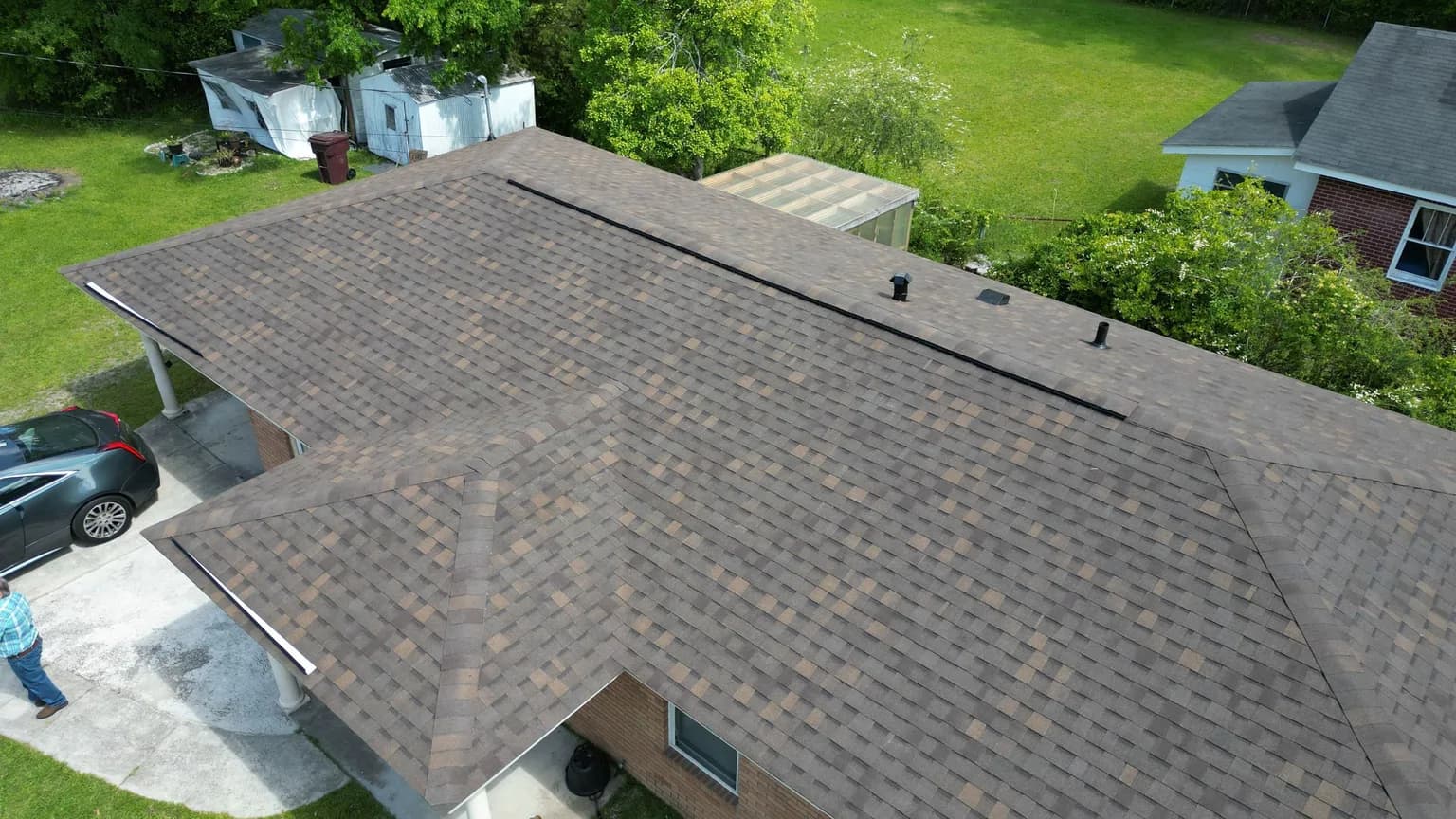
Airborne diesel soot from container traffic stains shingles years before the roof actually fails, and steady freight vibration works builder-grade fasteners loose over decades. Garden City's paved industrial yards also run 5-8°F hotter than surrounding residential areas, which accelerates thermal cycling on architectural asphalt rated for 20-25 years here.
Soot staining can make a roof look failed years before it actually is. The questions that actually decide replacement are whether the deck and flashings are sound, and how the covering's age compares against that 20-25 year service life. If the staining is only cosmetic and the deck and flashings are sound, we will tell you that rather than push an unnecessary replacement.
Vibration is the slower problem. Many of these homes date from the 1940s through the 1990s and were originally finished with thin builder-grade nailing. When we reroof in Rossignol Hill, Chatham Villa, or Chatham City, we specify algae- and stain-resistant granule lines in darker profiles that mask soot between rain washes, and we refasten to a 6-nail ring-shank pattern so the new roof holds against both coastal wind and freight-corridor vibration. Reinforced starter strips and sealed eaves are specified rather than left as the lighter builder-grade detail.
What wind code and permit apply to a roof in Garden City, GA?
Garden City sits in Chatham County's wind-borne-debris region, so roofs are built to the design wind speed the permitting office sets, and a full replacement generally needs a permit. Parcels inside city limits permit through the City of Garden City; unincorporated parcels go through Chatham County.
We verify the correct jurisdiction before quoting, handle the permit paperwork, schedule the closeout inspection when one is required, and provide the permit copy for your resale and insurance records.
In practice, the wind design is not paperwork — it is a fastening schedule. It means 6-nail ring-shank fastening, reinforced starter strips at the eaves, and sealed perimeter details rather than the lighter nailing many older homes here were originally finished with. Repair-only work may fall below the permit threshold depending on scope, which is another reason to confirm requirements before anyone opens the roof. For the county-wide picture, see our Chatham County permit guide.
How often should a Hwy 21 corridor warehouse roof be inspected?
Inspect a Hwy 21 corridor warehouse roof annually at minimum, and keep a documented five-year cycle on any roof carrying a manufacturer NDL warranty. We walk decks in spring before hurricane season and again in late fall, photo-documenting seams, terminations, drains, and equipment penetrations.
The case for the cadence is arithmetic, not sentiment. Catching a failed pitch pan or a split seam at year four is a $400 fix. Missing it through year seven on a 100,000 sq ft footprint becomes a deck rebuild. The written report matters as much as the walk: prioritized repairs with budget tiers let a spend land in the right fiscal year.
Hwy 21 does not slow down for a roof job, so deliveries, crane setups, and roll-off swaps get placed outside peak container-traffic windows, tear-off debris is staged to keep loading docks clear, and hot-work permits, fire-watch protocols, and odor-control planning are standard on occupied warehouse mobilizations. Timing on any given job depends on weather, safe access, materials, and crew availability. Ongoing care specifics are covered in our flat roof maintenance guide.
What did Matthew, Idalia, and Helene actually do to Garden City roofs?
The damage recorded in 31408 across Matthew (2016), Idalia (2023), and Helene (2024) was torn membrane edge metal, lifted parapet copings, and debris-struck rooftop equipment. In Matthew, mechanically attached membranes generally held, and older fully adhered systems past 15 years saw the most edge-detail failures.
Hurricane Matthew on 7-8 October 2016 pushed sustained winds near 50 mph (gusting past 70 mph) at the Savannah stations and stressed flat-roof terminations on the Hwy 21 warehouses adjacent to Garden City Terminal, with torn membrane edge metal and lifted parapet copings on aged single-ply assemblies in 31408. Residential shingle uplift hit the older 4-nail installs in the surrounding neighborhoods. That damage pattern is why mechanically attached membrane with reinforced parapet termination bars is our standard on Garden City commercial bids, and 6-nail patterns are our residential standard in 31408.
Hurricane Idalia on 30 August 2023 tracked across south Georgia after a Category 3 Florida Big Bend landfall; NWS Charleston logged a 40 mph gust at the I-95 Chatham weigh station and 52 mph at Savannah/Hilton Head International, and no hail was reported anywhere in Georgia on August 30-31, 2023 (SPC storm reports). For aged TPO on the Hwy 21 corridor the exposure in a storm like this is drainage, meaning scupper and drain capacity when ponding approaches deflection limits during the rainbands, not impact. Hurricane Helene's Category 4 Florida Big Bend landfall on 26-27 September 2024 sent damaging winds inland, and in the Garden City industrial corridor airborne debris struck rooftop HVAC and process equipment on several Hwy 21 warehouses, and a few aged modified-bitumen roofs in 31408 took blow-offs at unreinforced parapet corners where prior repairs had skipped membrane re-termination.
On the insurance side, here is exactly what we do and do not do. We photograph visible roof conditions, take measurements, and provide an itemized construction estimate. When requested, we can attend an on-site adjuster meeting to explain our repair scope. The policyholder files the claim, and the carrier and the policy decide coverage and payment. We do not file or negotiate claims. Documented pre-storm inspection photos are the most useful thing you can have, because they give everyone a baseline to compare against.
A straight word about our presence in Garden City
Our primary market is Savannah, with Pooler and Rincon as our secondary markets, and Garden City sits inside the same service radius. We would rather say that plainly than imply we are the biggest name in a town of 9,000 people.
What does not change is how a roof gets specified, cored, fastened, permitted, and documented. Talya Roofing holds a current City of Savannah business license — a local business license, not a Georgia state contractor licence — carries documented insurance, is an Atlas PRO+ Silver Member, and backs installations with a 5-year workmanship guarantee. Call and we will tell you honestly whether your Garden City job is a good fit before anyone drives out. Commercial membrane options are compared in our TPO vs EPDM guide for coastal Georgia buildings, and the town-level detail lives on the Garden City service area page.
Storm sources: NOAA NHC Tropical Cyclone Report — Hurricane Matthew (AL142016) · Hurricane Idalia (AL102023) · Hurricane Helene (AL092024). Pricing and local roof-condition detail come from Talya Roofing's published Garden City location data.
Warehouse roof on Hwy 21, or a shingle roof in Rossignol Hill?
Get a written, line-item scope for your Garden City property. Call (912) 999-7989.