
Roofing material prices in 2026 are not climbing in one polite annual step — they're climbing in waves. Every major asphalt-shingle manufacturer announced a price increase in February or March 2026 with effective dates clustered between March 22 and April 15. Then, before the ink was dry on those notices, a second round of letters started arriving in April and May with effective dates of May 18, June 1, and June 15. That's two industry-wide hikes inside 90 days, both 5-10% deep, hitting on top of an already-elevated 2025 baseline.
For a Savannah homeowner thinking about a re-roof in 2026, or sitting on an open insurance claim, the practical question is: what does this actually mean for my project cost, why is it happening, and what should I do? This guide pulls together every confirmed 2026 manufacturer announcement (GAF, Atlas, Owens Corning, CertainTeed, Malarkey, TAMKO, and the metal-accessory side from Gibraltar), reconstructs the 2025 history that put us here, explains the four real drivers in plain English, and gives you five specific moves you can make right now to protect your project budget. All dollar examples are tuned to a typical 2,500 sq ft Coastal Georgia home with a moderate-pitch roof — what we actually quote in Chatham, Bryan, Effingham, and Liberty counties.
Key Takeaways
- ✓ Two industry-wide manufacturer hikes inside 90 days: April (5-8%) then June (6-10%) on top of the 2025 baseline.
- ✓ A Savannah homeowner who priced a roof in early 2024 and waited is paying 16-28% more for the same shingle in mid-2026 — materials alone.
- ✓ Real drivers: petroleum-tied asphalt cost, tariffs on MDI (60%) + TCPP (272.7%) + steel/aluminum (50%), labor inflation, freight that never reset.
- ✓ A typical 2,500 sq ft Savannah re-roof sees roughly $600-$1,500 added to materials between April and June 2026 from the manufacturer hikes alone.
- ✓ Practical move: compare a current written estimate with your project timeline. If you have an open insurance claim, ask the carrier how it accepts updated material-pricing documentation.
The Full 2026 Shingle-Price-Increase Timeline — Every Manufacturer, Every Date
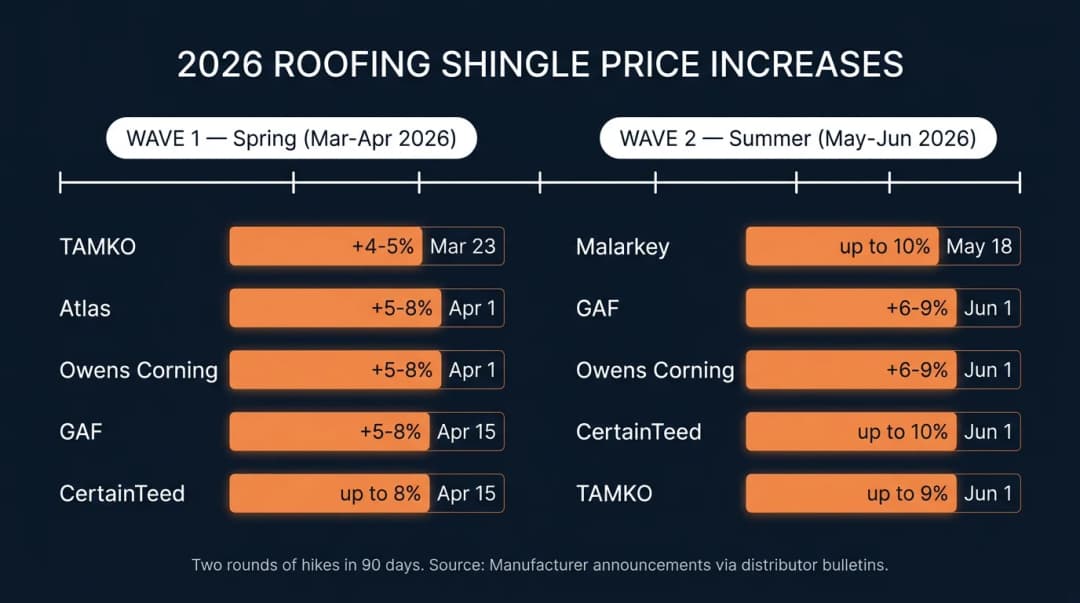
Here's the complete picture of confirmed 2026 announcements from the six major asphalt-shingle manufacturers plus Gibraltar (the dominant accessory and trim supplier). Every entry below is sourced from the manufacturer's own price-increase letter, distributed through national distributors like Mid-Atlantic Roofing Supply, Carolina Atlantic, ABC Supply, and SRS Distribution.
| Manufacturer | Increase | Effective date | Scope |
|---|---|---|---|
| TAMKO | 4-5% | Mar 22-23, 2026 | Residential roofing + waterproofing |
| Atlas Roofing | 5-8% | Apr 1, 2026 | Shingles, underlayment, ventilation |
| Owens Corning | 5-8% | Apr 1, 2026 | All shingle + accessory products |
| Malarkey | Up to 8% | Apr 1, 2026 (US) | Residential roofing |
| GAF | 5-8% | Apr 15, 2026 | All residential roofing products |
| CertainTeed | Up to 8% / 6% siding | Apr 15, 2026 | Residential roofing + siding |
| Gibraltar | 10-13% aluminum / 5% steel / ~15% imports | Early Q2 2026 | Trim, flashing, accessories |
| Malarkey (Wave 2) | Up to 10% | May 18, 2026 | Residential roofing (cumulative) |
| GAF (Wave 2) | 6-9% | Jun 1, 2026 | Shingles + roofing accessories |
| Owens Corning (Wave 2) | 6-9% | Jun 1, 2026 | Shingles + accessory products |
| CertainTeed (Wave 2) | Up to 10% | Jun 1, 2026 | All residential roofing |
| TAMKO (Wave 2) | Up to 9% | Jun 1, 2026 | Residential roofing + waterproofing |
| Malarkey (Wave 3) | Up to 10% | Jun 15, 2026 | Residential roofing (cumulative) |
Wave 1 (white rows) hit between March 22 and April 15. Wave 2 (orange-shaded rows) hits between May 18 and June 15. Note that each Wave 2 increase is cumulative on top of Wave 1 — they don't replace each other. A Savannah distributor buying GAF Timberline HDZ in late June 2026 is paying roughly 11-17% more than they paid in March 2026 for the same bundle.
2025 Was the Year That Set the Stage — Three Rounds of Compounding Hikes
The 2026 wave didn't come out of nowhere. 2025 had its own pattern of compounding increases that set the new baseline:
- April 1, 2025 — Round 1: Owens Corning, GAF, and CertainTeed all announced 6-10% increases on shingles and roofing accessories effective the same day. First major industry-wide hike of 2025.
- August-September 2025 — Round 2: The same three brands announced another 5-7% on asphalt-shingle product lines, citing rising raw-material costs. Most increases landed in early Q3.
- Late 2025 — Round 3: A smaller follow-on round of 3-5% rolled through several manufacturers in the back half of the year, pushing the cumulative 2025 increase to roughly 14-22% on top of where prices started the year.
- National installed-roof reference point: the average asphalt-shingle re-roof in the US rose from roughly $18,000 in 2024 to over $19,800 by year-end 2025 — about an 11% increase in installed price (material + labor) over twelve months. Source: industry roof-cost summary.
So when a Savannah homeowner says "my neighbor paid $14,000 for the same roof a couple years ago, why am I being quoted $17,500?" — the answer is straightforward arithmetic: 6-10% (Apr 2025) + 5-7% (Aug 2025) + 3-5% (late 2025) + 5-8% (Apr 2026) + 6-9% (Jun 2026) compounds to roughly +25-39% on materials over two years. Labor moved in step. The neighbor's old $14K quote at today's pricing is closer to $17K-$19K depending on the exact material mix.
Why Prices Keep Climbing — The Four Real Drivers in Plain English
Manufacturer letters typically cite "rising costs" without much detail. The real picture, pulled from manufacturer earnings calls, distributor bulletins, and the Bureau of Labor Statistics Producer Price Index data:
- Petroleum-tied asphalt cost. Asphalt shingles are 30-40% asphalt by weight, and asphalt is a petroleum byproduct. When crude oil prices move, shingle costs move with them — historically about 1.5-2x the underlying oil-price swing because asphalt is at the back end of the refining cascade. Oil markets have been volatile since 2022 and elevated overall, so the asphalt input cost line has not gone down in any meaningful way since 2021.
- Tariffs on chemical and metal inputs. This is the biggest 2025-2026 driver and the one most homeowners don't see. MDI (methylene diphenyl diisocyanate, used in shingle adhesives and roofing foam) carries a 60% anti-dumping duty as of 2025. TCPP (a flame retardant used in shingle composition) carries a 272.7% tariff rate. Section 232 tariffs on imported steel and aluminum doubled from 25% to 50% in June 2025 — that's the line item driving the 10-13% Gibraltar aluminum-trim hike and a meaningful chunk of the metal-roofing price increases. Fiberglass mat components carry 10-15% tariffs. Canadian lumber (used in roof decking replacements) carries 8-12% reciprocal tariffs. None of these are in the headline CPI inflation number but they all land in your roof quote. Source: 2026 tariff impact analysis.
- Labor and wage inflation. Roofing labor in Coastal Georgia is in a structural shortage. Most experienced crews are running at capacity through hurricane season (June 1-November 30), which gives crews and the distributors that support them pricing leverage that didn't exist in 2018-2020. Bureau of Labor Statistics data shows construction labor costs have not declined in any year since 2015. Wage inflation in skilled trades has run 4-6% annually since 2022.
- Freight and logistics that never fully reset. Trucking rates spiked in 2021-2022 and partially eased, but settled into a new, higher post-pandemic baseline rather than reverting. Shingle bundles are heavy and bulky, so freight is a meaningful per-bundle line item. Diesel fuel volatility compounds this. Several 2026 manufacturer letters specifically cited freight as a named driver — Atlas added a separate freight surcharge effective April 20, 2026 on top of the April 1 product hike.
The overall picture, per the Bureau of Labor Statistics Producer Price Index: construction materials sit roughly 42% above December 2020 levels as of early 2026 (BLS PPI index 248 in Dec 2020 to ~352 in early 2026). Roofing-specific materials track at the higher end of that range because of the petroleum and chemical-tariff exposure. None of these drivers have a clear near-term reversal path.
What This Means for a Savannah Homeowner in Dollar Terms
Translating manufacturer-letter percentages into real Coastal Georgia project cost. A typical 2,500 sq ft home with a moderate-pitch (5/12 to 8/12) asphalt-shingle roof is roughly 30 squares (3,000 sq ft of roof surface accounting for pitch and overhang). Approximate cost split on a $14,000 baseline early-2026 project:
| Project line item | Early-2026 cost | Late-Jun 2026 cost | 2026 delta |
|---|---|---|---|
| Architectural asphalt shingles (30 sq) | $3,600-$4,500 | $4,000-$5,100 | +$400-$600 |
| Synthetic underlayment + ice-and-water | $700-$1,000 | $780-$1,100 | +$80-$100 |
| Drip edge, ridge cap, flashing (Gibraltar) | $500-$750 | $565-$850 | +$65-$100 |
| Ridge / soffit ventilation materials | $350-$500 | $390-$560 | +$40-$60 |
| Nails, sealant, misc consumables | $200-$300 | $225-$340 | +$25-$40 |
| Materials subtotal | $5,350-$7,050 | $5,960-$7,950 | +$610-$900 |
| Labor (tear-off, install, cleanup) | $5,500-$6,500 | $5,650-$6,700 | ~$150-$200 |
| Permits, dump, overhead | $800-$1,200 | $820-$1,250 | ~$20-$50 |
| Total installed | ~$14,000 | ~$14,800-$15,200 | +$800-$1,200 |
A few clarifications on the table above:
- The "early-2026 cost" column is pre-April-1 pricing. The "late-Jun 2026 cost" column applies both Wave 1 (Apr) and Wave 2 (Jun) manufacturer hikes.
- For a metal-roof project, the delta is steeper. A typical 2,500 sq ft Galvalume standing-seam re-roof in the $22,000-$28,000 range sees roughly $1,500-$3,500 of 2026 increase due to the steel/aluminum tariff layer compounding on top of the Gibraltar accessory hike. See our 2026 metal roof cost guide for Savannah for the full breakdown.
- For an open insurance claim, current material pricing may differ from an earlier construction estimate. Ask the carrier how it accepts updated pricing documentation. Our Savannah storm-damage team can provide a current itemized repair estimate and manufacturer pricing documentation to the property owner.
When Can You Expect the Next Hike? — Predicting the Rest of 2026 and Into 2027
Based on the 2024-2025-2026 announcement cadence, manufacturers have settled into a roughly quarterly hike rhythm rather than annual. The pattern from the last 24 months:
- Q1 announcement window (Feb-Mar) → Q2 effective dates (Mar-Apr). The largest and most predictable hike of the year. Manufacturers reset list pricing for the spring building season. Expected magnitude: 5-8%.
- Q2 announcement window (Apr-May) → Q3 effective dates (Jun-Jul). Second wave. Often initially announced as a "freight surcharge" or "select-product adjustment" and broadened. This is what we saw in 2026 with the June 1 wave. Expected magnitude: 3-6%.
- Q3 announcement window (Aug-Sep) → Q4 effective dates (Sep-Oct). The autumn round. Smaller and more selective — sometimes only the premium tiers. Expected magnitude: 2-5%.
- Q4 announcement window (Nov-Dec) → Q1 next-year effective dates (Jan-Feb). The fiscal-year-reset hike. Has reappeared in the calendar starting 2024.
Translating that into a forward forecast for Coastal Georgia homeowners: expect another 2-5% announcement landing late summer 2026 with effective dates in September or October, and a probable Q1 2027 announcement window opening in February 2027 with effective dates around April 1, 2027. Whether prices stabilize after that depends on whether the underlying drivers ease — there's no current signal that they will. Manufacturers do occasionally pause hikes for a quarter when demand softens (we saw this briefly in late 2023), but the pattern of two-to-three meaningful hikes per year has held since early 2024.
What Savannah Homeowners Can Do Right Now (5 Practical Moves)
- If a re-roof is on your 6-12 month horizon, lock pricing before May 31, 2026. The June 1 Wave 2 increase is fully avoidable if your contract is signed and materials are ordered before the effective date. On a $14,000 project that's roughly $400-$700 saved on the materials portion specifically. Talya will hold quoted pricing for 30 days from estimate date — request a quote before Memorial Day weekend to give yourself a clear decision window.
- If you have an open insurance claim, compare current material pricing with the carrier document. Ask the carrier how it accepts updated pricing information. Talya Roofing can provide a current itemized repair estimate and available manufacturer pricing documentation to the property owner, but coverage and payment remain the carrier's decision.
- If you're 5+ years from needing a re-roof, don't rush it. The math of pulling a re-roof forward 5 years to save $1,500 on the 2026 hikes doesn't pencil — you give up 5 years of remaining useful life worth far more than the savings. Better play: establish a real condition baseline with a documented homeowner inspection, then revisit the replacement decision as conditions change.
- If you're considering metal, factor the steeper tariff exposure into the decision. Metal roofing's 2026 price increase is larger in percentage terms than asphalt because of the steel/aluminum tariff layer. The long-term ROI on metal is still favorable for Coastal Georgia salt-air exposure, but the upfront cost gap vs asphalt has widened in 2026. See our metal roof cost guide and Atlas vs GAF asphalt comparison for the side-by-side math.
- If cash flow is the constraint, consider 0%-APR financing instead of waiting. A 12-month 0% financing plan on a $14,000 roof costs you nothing in interest and lets you lock 2026 pricing before the next hike. Waiting 12 months at the current trajectory means paying 5-10% more for the same project. See our 0%-down roof financing guide for how this works in Savannah.
How Talya Roofing Handles Material Pricing During the 2026 Surge
Two things we do specifically to protect Savannah customers from the wave-on-wave 2026 pricing environment:
- 30-day price hold on every written estimate. The quote you receive is honored at the quoted price for 30 days from estimate date, even if a manufacturer effective date falls inside that window. That gives you a real decision window without the pressure of a "this price expires tomorrow" sales tactic.
- Bulk pre-buy on the brands we install most. For frequently installed products, including Atlas roofing systems, we may pre-buy material at the pre-hike pricing when a manufacturer announces a hike with a 30+ day lead time. That buffer is what lets us hold quoted pricing on signed projects through the effective date. We can't do this indefinitely (warehouse space is finite), but it covers most of the customers who quote-to-contract within the 30-day window.
- Current pricing documentation. When material pricing changes, we can provide the property owner with an updated itemized repair estimate and any available manufacturer letter. The policyholder or an appropriately licensed representative decides whether and how to submit that information to the carrier.
Get a 30-day price-hold estimate before the June 1 wave
Talya Roofing serves Savannah, Pooler, Rincon, Tybee Island, Wilmington Island, Richmond Hill, and Bluffton. Request a complimentary project assessment and written estimate; appointment timing and quote validity are confirmed for the specific property and scope.
Sources: Manufacturer price-increase letters distributed via Mid-Atlantic Roofing Supply, Carolina Atlantic Roofing Supply, ABC Supply, and SRS Distribution; Atlas Roofing official announcement; RoofVista 2026 tariff price guide; Bureau of Labor Statistics Producer Price Index; RoofSmart 2026 manufacturer price increase summary.