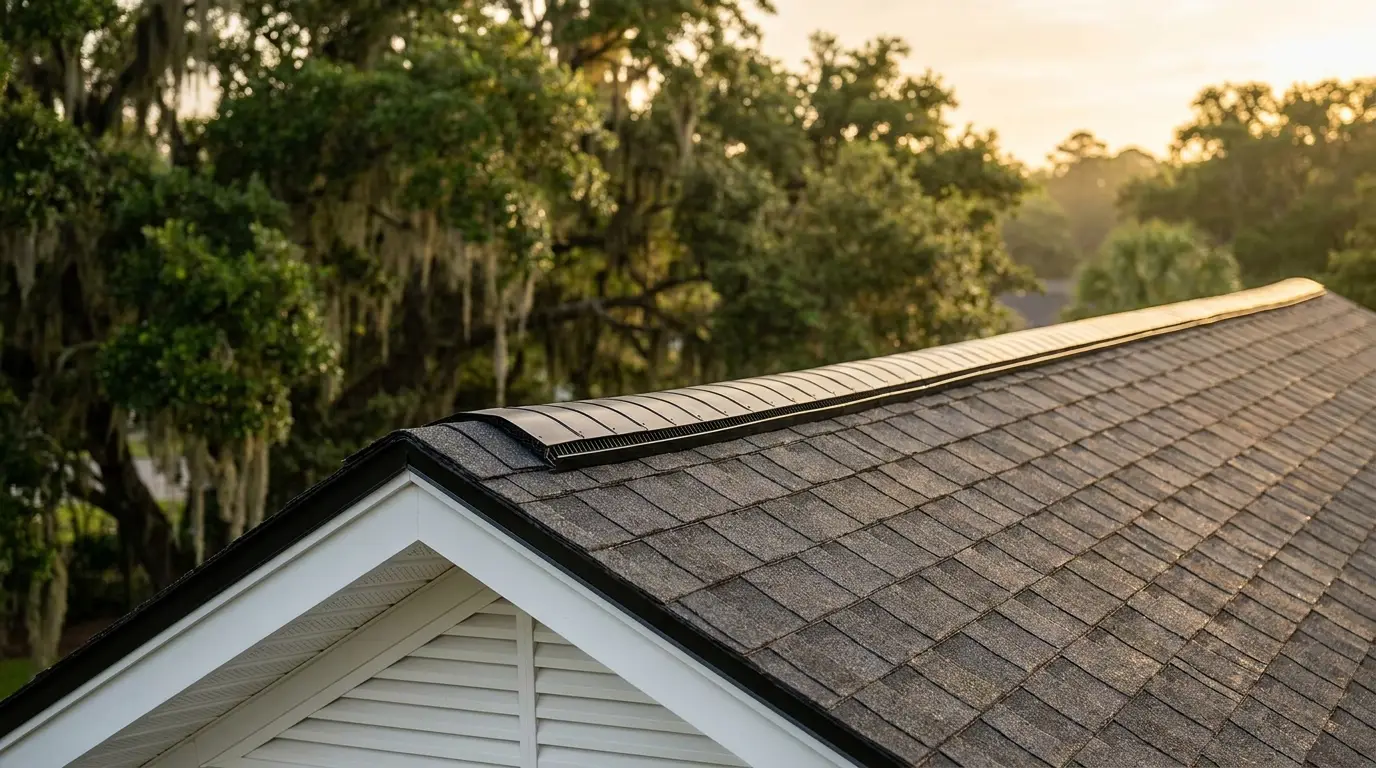

If your upstairs rooms run hot no matter how hard the AC works, your summer power bill keeps climbing, or your attic smells musty, the cause is often the same overlooked system: attic ventilation. In Savannah's hot, humid, salt-air climate it is one of the highest-leverage and most misunderstood parts of a roof — inexpensive to get right during a re-roof, and expensive to ignore.
This guide gives you the real 2026 numbers: what each vent type costs installed, the code minimum your roof has to meet, which system actually works on a Coastal Georgia home, the warning signs of an underventilated attic, and what poor ventilation does to both your energy bills and your shingle warranty. When ventilation is corrected as part of a full roof replacement in Savannah, it often adds little or nothing to the project.
Key Takeaways
- ✓ Typical 2026 installed pricing: a continuous ridge vent runs about $400–$725. Our own solar attic fan (solar exhaust vent) pricing is $1,200 for a single unit and $800 each additional; with a full roof replacement, one unit is included through our Green Savannah promotion when the attic intake supports it, and extra units are $750 each. As part of a re-roof, a balanced ridge-and-soffit system often adds little or nothing.
- ✓ Code minimum (IRC R806.2): 1 sq ft of Net Free Area per 150 sq ft of attic floor — 1/300 when venting is balanced with 40–50% of the area high near the ridge.
- ✓ Balanced intake (soffit) matters more than fan power. Most underventilated Savannah attics fail on intake, not exhaust.
- ✓ Poor ventilation can void your shingle warranty — GAF and Owens Corning both exclude inadequate-ventilation damage.
- ✓ Coastal reality: under-vented Savannah attics commonly run well above 140°F in mid-summer — hot enough that shingles age from below, not just from the sun.
How much does attic ventilation cost in Savannah in 2026?
A continuous ridge-vent-plus-soffit-intake system — the most common upgrade — runs roughly $400–$725 installed on a typical Savannah single-family home in 2026, while our installed price for an add-on solar attic fan is $1,200 for a single unit and $800 for each additional unit. With a full roof replacement, one solar exhaust vent is included through our Green Savannah promotion when the attic intake supports it, and extra units are $750 each. Intake (soffit) work is usually bundled into the same labor, and a passive turbine is the budget exhaust option.
Here is what the major options cost installed in 2026, based on national cost data and what we see quoted across the Savannah market:
| Ventilation type | Typical 2026 installed cost | Best for |
|---|---|---|
| Continuous ridge vent | $400–$725 installed | Most homes — even, passive exhaust |
| Solar attic fan | $1,200 single · $800 each additional · 1 included with a qualifying full roof replacement (Green Savannah promotion), extras $750 each | Cutting run cost; sunny exposures |
| Powered attic fan (electric) | Mid-range — get a current quote | Complex or low-slope roofs with strong intake |
| Roof turbine (whirlybird) | Lowest-cost exhaust | Budget option on older homes |
| Soffit / intake vents | Often bundled with the above | Required intake for any system to work |
The single biggest way to save: fix ventilation while the roof is already open. During a tear-off, adding a ridge vent and clearing or adding soffit intake is incremental labor on work that's already happening — far cheaper than a standalone callout later. That is why we build it into every Savannah roof replacement rather than selling it as an add-on.
Cost ranges verified against sources updated within the last few months: Modernize — Ridge Vent Installation Cost (updated Feb 2026) and CountBricks — Solar Attic Fan Cost Guide (Feb 2026). Get a current Talya quote for your specific roof.
How much attic ventilation does my roof actually need?
Code (IRC R806.2) requires 1 square foot of Net Free Area (NFA) for every 150 square feet of attic floor — or 1 per 300 when the venting is balanced with 40–50% of the area high near the ridge. "Net Free Area" is the actual open airflow area of a vent, not its physical size, and it should be split roughly half intake, half exhaust.
Worked example for a typical Savannah home: an 1,800 sq ft attic needs about 12 sq ft of NFA at the 1/150 ratio (or ~6 sq ft if it qualifies for 1/300). You would aim for roughly 6 sq ft of intake at the soffits and 6 sq ft of exhaust at or near the ridge. Get the ratio wrong — too much exhaust, not enough intake — and a powered fan will simply pull conditioned air up out of your living space.
The intake problem nobody checks
In our experience the majority of underventilated Savannah attics have adequate exhaust but starved intake — soffit vents that were painted over, stuffed with insulation, or never adequately sized. You can add all the ridge vent you want; without matching intake, air can't move. Our soffit and fascia guide covers how coastal moisture and pests block intake over time.
Code reference: ICC — IRC R806.2 Minimum Vent Area and the Asphalt Roofing Manufacturers Association (ARMA).
Ridge vent vs. turbine vs. powered vs. solar fan — which is best for a Coastal Georgia roof?
For most Savannah homes, a continuous ridge vent paired with clear soffit intake is the best primary system. It's passive, has no moving parts to corrode in salt air, and moves air evenly across the whole attic. Powered and solar fans are useful supplements on complex or low-slope roofs — but only when intake is already adequate.
| System | How it works | Coastal Georgia notes |
|---|---|---|
| Ridge + soffit (passive) | Hot air rises out the ridge; cool air drawn in at the soffits | Best primary system — no motor or bearings to fail in salt air |
| Turbine (whirlybird) | Wind spins a turbine that pulls attic air out | Cheap, but bearings seize and units can leak as they age in humid, salty air |
| Powered attic fan | Electric fan forces hot air out on a thermostat | Effective with strong intake; backdrafts AC if intake is starved; motor is a failure point |
| Solar attic fan | Panel-powered exhaust; some models support compatible backup power or controls | Operating requirements, installed output, and electricity use depend on the selected model; adequate intake is still required |
Talya's recommendation for coastal homes
Start with a balanced ridge-and-soffit system — it solves ventilation for the majority of Savannah, Pooler, and the islands with nothing to maintain. Add a solar fan only on roofs where the ridge is short or the roof is low-slope and passive airflow can't do the job alone. Skip stacking multiple exhaust types on one attic; mixing a ridge vent with powered fans can short-circuit airflow instead of improving it.
What are the signs your Savannah attic is poorly ventilated?
The clearest signs are a second floor that's much hotter than the first, a musty or moldy attic smell, rusty nail tips or damp insulation, shingles that curl or blister early, and cooling bills that climb year over year. Any one of these is worth an inspection; two or more usually means the attic is running hot and wet.
Hot upstairs that the AC can't beat. A baking attic radiates heat down through the ceiling faster than the AC removes it — the most common complaint we hear in two-story Savannah homes.
Musty smell or visible mold in the attic. Trapped humid air condenses on the underside of the deck. See our attic mold and humidity guide for what that does to decking.
Rusty nails, damp insulation, or frost-free moisture. Metal connectors that drip or rust point to chronic attic moisture with nowhere to escape.
Shingles curling or blistering early. Heat damage from below ages shingles years ahead of schedule — and may not be covered by warranty (see below).
Cooling bills creeping up. As intake clogs over the years, attic temperatures rise and your AC works harder for the same comfort.
What we see in Savannah attics
On our roof inspections across Chatham County, we routinely find unvented or under-vented attics running well above 140°F on a typical mid-summer afternoon — far above outdoor highs. At those temperatures shingles age from below, and much of the premature curling we see on coastal roofs is driven by trapped attic heat and starved intake rather than a product defect. A complimentary ventilation project assessment can identify potential intake-and-exhaust work and support a property-specific estimate; a homeowner inspection report is a separate documented service.
Does attic ventilation actually lower your AC bills?
A properly balanced, correctly sized ventilation system may support attic heat and moisture management, but the energy result is property-specific. Weather, insulation, air sealing, duct location, HVAC efficiency, occupancy, existing intake and exhaust, controls, and the selected product all affect performance. Talya Roofing does not promise a fixed temperature change, utility savings, or solar-fan payback period.
One honest caveat: ventilation is not a substitute for insulation and air-sealing — it works alongside them. If your attic floor is poorly insulated or full of air leaks, fix those at the same time for the full benefit. Done together, balanced ventilation plus good insulation is one of the best comfort-per-dollar upgrades a Savannah homeowner can make, and it protects the roof investment on top of the energy savings.
Compare ventilation options using the property conditions and current product documents. Any performance observation should use consistent measurement locations and comparable conditions; one reading cannot prove long-term savings.
Can poor attic ventilation void your shingle warranty?
Yes. GAF, Owens Corning, and every other major shingle manufacturer exclude damage caused by inadequate ventilation. Owens Corning's warranty explicitly excludes damage from "inadequate ventilation," and GAF's language is nearly identical — meaning the curling, blistering, and premature aging a baked attic causes can be a denied claim.
The warranty trap
Homeowners often pay extra for a premium 50-year shingle, then lose the coverage because the attic underneath was never properly vented. If a manufacturer inspector finds heat damage and inadequate ventilation, they can deny the claim — leaving you to pay for a roof the warranty was supposed to protect. This is exactly why ventilation should be corrected during the re-roof, when the deck is exposed and it's cheapest to do right.
The practical takeaway: ventilation isn't a luxury upgrade, it's warranty insurance. Before you choose shingles, make sure your installer is sizing intake and exhaust to the manufacturer's specification — not just nailing down a nicer product over the same starved attic. Our team builds the ventilation calculation into every roof replacement and documents it so your warranty stays intact, and handles ventilation-only corrections through roof repair when a full replacement isn't needed yet.
Warranty terms: Owens Corning warranty overview and GAF ventilation & warranty explainer. Always confirm against your specific manufacturer warranty document.
Not sure if your attic is properly ventilated?
Talya Roofing offers complimentary attic-ventilation project assessments and estimates across Savannah, Pooler, and the islands. We review accessible intake and exhaust conditions for proposed work; the visit is not a code certification or the separate paid homeowner inspection report.
Call (912) 999-7989 or request a complimentary ventilation project assessment.