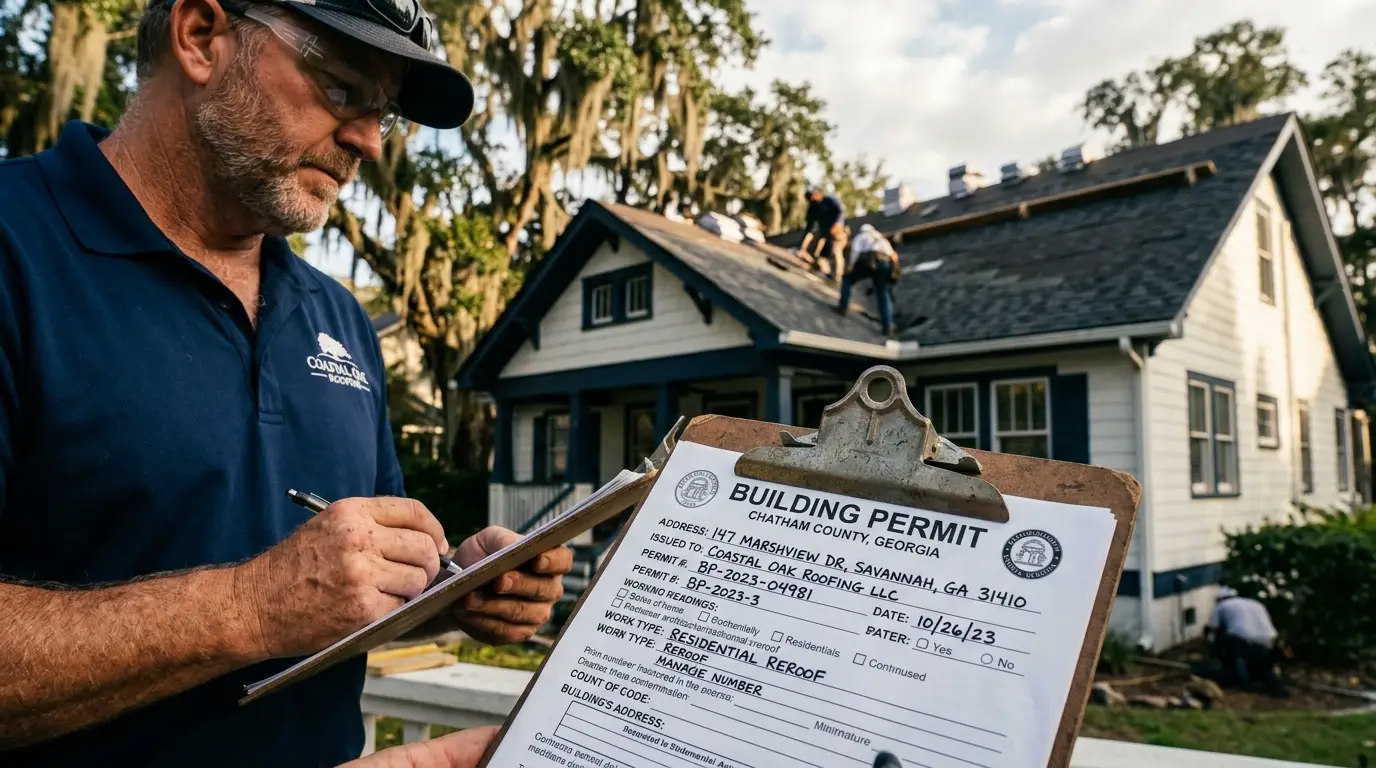

Almost every Chatham County homeowner who calls Talya Roofing with a roof question eventually asks the same one: do I really need a permit for this? The short answer is yes for a full tear-off re-roof or any project that touches the sheathing or structural deck — and no for a small like-for-like targeted repair. The long answer is more useful, because Chatham County's permit process has specific Coastal Georgia rules that don't exist in Atlanta or Macon: high-wind uplift requirements, sealed-plan triggers in flood-overlay zones, and an inspection sequence that out-of-county contractors routinely get wrong.
This guide walks through what triggers a permit, what the 2026 fee schedule actually charges, what your roofer should be filing on your behalf, what the inspector is checking when they show up, the most common reasons applications stall, and why hiring an unlicensed contractor who promises to "skip the paperwork" is the single most expensive shortcut a Savannah homeowner can take. Pulled directly from current Chatham County Building Safety + Regulatory Services documentation and our day-to-day permit work across Savannah, Pooler, Garden City, Port Wentworth, and the unincorporated county.
Key Takeaways
- ✓ Permit required for a full roof replacement (tear-off), or any job that replaces sheathing or alters the structural deck — a small like-for-like repair generally does not need one. Confirm the exact permit trigger with your local building department.
- ✓ Standard fee for a Savannah single-family re-roof: $75 flat on the City of Savannah's published fee schedule ($150 plan-review tier for larger construction values), plus any local administrative add-ons. Add $80–$150 if you're in the V-zone or AE flood overlay (sealed wind-uplift plan required).
- ✓ Typical issuance: 7–14 business days for a clean application. Expect 21+ days if wind-uplift docs, manufacturer ratings, or contractor license status get flagged.
- ✓ Every roof system installed under a Chatham County permit must meet the design wind speed on that permit — confirm the figure with Chatham County Building Safety.
- ✓ Hiring an unpermitted roofer = stop-work order risk + code-violation lien + automatic insurance-claim denial on the work. The "savings" can turn into $20,000+ in unrecoverable cost.
When You Need a Roofing Permit in Chatham County (And When You Don't)
In Chatham County and the City of Savannah, a building permit is required for roof replacement — a full tear-off, replacing the sheathing, or any structural-deck work. A small like-for-like repair generally does not need one. Georgia has no statewide "25% of the roof" permit rule, so always confirm the exact permit trigger for your specific job with the local building department before you start.
In plain Savannah-homeowner terms, this means:
- Full re-roof (tear-off and replace) — always needs a permit, even for a like-for-like asphalt-shingle swap on a 1,200 sq ft cottage.
- Reroofing one slope of a hip roof — usually needs a permit because it is a re-roofing of a full roof plane rather than a small spot repair; confirm with the local building department.
- Replacing 3-4 squares of shingles after wind damage — usually does NOT need a permit on a typical 25-square home, since a small like-for-like spot repair is not a roof replacement.
- Cutting in a new skylight or solar tube — needs a permit regardless of size, because deck-cutting is structural work (any deck modification triggers the permit on its own).
- Replacing rotten sheathing during repair — needs a permit if you're replacing more than one panel; sheathing is structural and the inspector cares.
- Emergency tarp after a storm — no permit required for temporary weather protection (per emergency-services exemption in the IRC).
If you're in a homeowners association — Berwick Plantation, The Landings, Godley Station, Plantation Lakes, most of the planned Pooler subdivisions — your HOA has its own architectural-review approval process that runs in parallel with the county permit. The HOA approval is about aesthetics (color matching, shingle profile, ridge-cap style); the county permit is about safety and code compliance. You need both. Skipping the HOA approval gets you a violation notice from the management company; skipping the county permit gets you the stop-work order described later in this article.
What the 2026 Chatham County Permit Fee Schedule Actually Costs
Chatham County publishes the fee schedule but most homeowners never see it because the roofing contractor pulls the permit on their behalf. Here's what's actually being paid — useful to know so you can sanity-check what a contractor invoices you for permit costs.
| Project Size | Typical Permit Fee | Add-Ons That Push It Up |
|---|---|---|
| Small ranch (1,200–1,800 sq ft, reshingle only) | $75–$110 | +$80–$150 if home is V-zone (Tybee, Wilmington, Skidaway) |
| Mid-size single-family (2,000–2,800 sq ft, full re-roof) | $110–$155 | +$45 if sheathing replacement included; +$80–$150 if flood-overlay |
| Large 2-story (3,000–4,500 sq ft, tear-off, hip-and-valley) | $150–$185 | +$45–$90 sheathing supplement; +$150–$300 if engineered drainage cut-in needed |
| Small commercial (under 10,000 sq ft) | $200–$420 | +$300–$600 sealed-plan review (always required commercial); +TPO/EPDM wind uplift calc surcharge |
| Skylight or solar-tube cut-in (residential) | $60–$95 | Generally no add-on; framed as small alteration permit |
All fees follow the published fee schedule for your jurisdiction (city or county), plus any local administrative add-ons. Cash, check, or credit card accepted at the Chatham County Government Center on Aberdeen Street. Online filing is supported through the county's e-permit portal for licensed contractors (homeowners can pull their own permits in-person but cannot file online for roofing work).
A note on the V-zone surcharge: if your property is in a V-zone or coastal AE flood overlay (most of Tybee Island, much of Wilmington Island, Skidaway Island west of the marsh, the Vernon River corridor, and select Bull River frontage), FEMA-amended building code requires a sealed wind-uplift plan from a Georgia-licensed structural engineer. That's a separate $80–$150 line item from the engineer (not the county) and adds 3–7 business days to your permit timeline. We've handled dozens of these on Tybee since 2024 — it's normal, it's predictable, but it's a real cost.
The Wind Code and What Your Contractor Has to Prove
Chatham County roofs are designed to ASCE 7 wind loads at the design wind speed on the permit — confirm the figure with Chatham County Building Safety. Every roof system installed under a Chatham County permit must demonstrate that it can resist those design uplift loads at the building corners, perimeters, and field zones.
What that looks like in practice for an asphalt-shingle re-roof:
- Shingle wind rating: an ASTM D3161 or D7158 class that covers the design wind speed on the permit (most major-brand laminated architecturals — Atlas Pinnacle Pristine, GAF Timberline HDZ, Owens Corning Duration — qualify out of the box; standard 3-tab shingles rated to 60 mph do NOT qualify and the inspector will reject the system).
- Fastener pattern: 6-nail pattern minimum in all zones. The inspector will visually verify nail placement is in the upper shingle's nailing strip and within manufacturer spec.
- Edge metal: Drip edge required on all eaves and rakes per Georgia amendment to IRC R905.2.8.5 (this is enforced in Chatham more strictly than most metro Georgia counties).
- Underlayment: Self-adhered ice-and-water barrier required at all eave returns + valleys + penetrations on any home in the wind-borne debris region — which covers virtually all of Chatham south of Highway 80.
- Ridge venting: If using ridge vent, must be a hurricane-rated profile (Cobra Snow Country, GAF Cobra Ridge Runner XT, or equivalent) — older non-rated profiles fail the inspector's visual check.
For metal-roof projects the documentation requirement is more substantial: the contractor needs to file the manufacturer's uplift calculation spreadsheet showing clip spacing meets the permit's design wind speed for both field and edge conditions. For a McElroy or Atlas standing-seam system, that's typically 16" clips at field, 12" at perimeter, 8" at corners — but the exact spacing depends on panel gauge, clip type, and exposed-fastener vs. concealed-fastener system. An out-of-county roofer filing without this calc will be told to resubmit, costing a week.
Permit Application — Documents Your Roofer Should Be Filing
A clean Chatham County roofing-permit application includes seven documents. If your contractor doesn't volunteer all seven without prompting, that's a red flag about their experience pulling permits in this county.
- Permit application form (county-provided, contractor + homeowner signatures, parcel ID, project scope description).
- Applicable contractor documentation — provide the business or trade licensing and registration required by the permitting jurisdiction for the project.
- Certificate of insurance showing general liability $1M+ and active workers' comp policy. The county verifies these against the insurer's system in real-time.
- Manufacturer technical data sheet for the proposed roofing material showing wind rating, fire rating (Class A required), and impact rating if claiming an insurance discount.
- Scope-of-work narrative — short paragraph naming tear-off-or-overlay, decking-status assessment, underlayment system, ventilation plan.
- Property survey or parcel sketch for any project that's adding new penetrations, modifying ridge lines, or affecting drainage flow.
- Sealed wind-uplift plan (only for V-zone or AE flood-overlay properties, or for any commercial project regardless of zone).
Talya Roofing files all of the above as a packet — the county knows our submissions and we typically get clean approvals inside the 7-day window. We do not subcontract permit work to a third-party expediter, which means there's no markup on permit fees on our invoices: the line item is exactly what the county charged.
Inspection Visits — What the Inspector Is Checking and When
A typical Chatham County residential roof permit triggers two inspection visits, occasionally three:
- Dry-in inspection (after tear-off, after deck repair if needed, after underlayment install — BEFORE shingles or panels go down). The inspector verifies deck condition, ice-and-water placement, drip-edge install, and underlayment overlap. This visit catches the most common deficiencies: missing ice-and-water at penetrations, drip edge installed upside down, deck sheathing nail spacing wrong.
- Final inspection (after the roof is complete). The inspector verifies shingle pattern, fastener visible spacing, ridge venting, and overall workmanship. They also confirm the manufacturer rating on installed product matches the application docs.
- Optional follow-up if the dry-in catches something needing correction — the contractor schedules a re-inspection, which is included in the original permit fee unless it's the third visit (then a re-inspection fee applies).
Inspections in Chatham County are scheduled through the permit office and typically happen within 24–48 hours of request. We coordinate timing so the dry-in happens the same day as the underlayment install — that means the crew can shingle the next morning instead of losing a day waiting for sign-off.
Common Reasons Chatham County Permits Get Delayed or Denied
From our last 200+ Chatham permits, here are the top six reasons applications take longer than the 7–14 day standard:
- Wind-rating shortfall on the proposed shingle — most common. Filed shingle's documented rating falls below the design wind speed on the permit. Fix: switch to an Atlas Pinnacle Pristine, GAF Timberline HDZ, Owens Corning Duration Premium, or equivalent. Adds 1 week.
- Missing or expired contractor documentation — if the business or trade credentials required by the permitting jurisdiction are incomplete, the application can be held until corrected.
- Workers' comp policy expired or not on file — Georgia requires active WC for any contractor with three or more employees. County system pulls real-time status from the National Council on Compensation Insurance database. Adds 1–5 days.
- Missing manufacturer cut-sheet — contractor filed brand name without attaching technical data sheet. Adds 2–4 days.
- V-zone property without sealed plan — applicant didn't realize their address is in the FEMA flood overlay. Fix: hire a Georgia-licensed structural engineer for a 1-page uplift letter. Adds 3–7 days.
- Scope-of-work too vague — "re-roof house" doesn't tell the inspector enough. They'll ask for tear-off-or-overlay, sheathing status, underlayment system. Fix: contractor amends the scope description. Adds 1–2 days.
None of these are deal-breakers if caught early. All of them are avoidable if the contractor has experience filing in Chatham specifically — which is one of the practical reasons "local Savannah roofer" beats "out-of-state contractor" on insurance and permit work regardless of price.
Why Hiring an Unlicensed "No Permit" Roofer in Savannah Is the Most Expensive Option
Every post-storm season, door-to-door contractors show up in Chatham County offering re-roofs at 30–50% under market — with the catch that they "don't bother with the permit, you'll never need it." Three things happen, in escalating severity, when a Savannah homeowner accepts that deal:
- Stop-work order and code violation. The inspector who eventually sees the work — during a future permit on the same property, a neighbor's permit inspection, a real-estate inspection at sale, or after a complaint — issues a Stop Work Order. The violation goes on record against the parcel.
- Title lien at sale. Code-violation liens survive ownership transfer. The title company at your closing will require the violation to be cured before releasing funds. "Cured" usually means tearing off the unpermitted roof and re-roofing under a proper permit — your buyer's closing schedule, not yours.
- Insurance claim denial. Every Georgia-issued homeowners policy we've reviewed contains exclusion language for damage to work done without required permits. If a future hailstorm or hurricane damages your unpermitted roof, the carrier has a documented basis to deny the claim — and they will. We've seen $18,000–$45,000 claims denied on this basis after Helene and Idalia.
The math doesn't work. A $150 permit, properly filed by a licensed contractor, is the cheapest insurance you'll buy on a $15,000–$45,000 roofing project. Talya Roofing pulls a permit on every project, every time, and the permit fee is itemized on the invoice exactly as the county charges — no markup, no expediter add-on, no surprise line items.
Need a Chatham County roofing permit pulled correctly?
Talya Roofing handles every step of the permit process across Chatham, Bryan, Effingham, and Liberty counties — from initial application through final inspection sign-off. We've filed 200+ Chatham permits since 2023, all approved within the standard 7–14 day window. Free estimates include a permit-cost line item itemized at the county's published rate.
Call (912) 999-7989 or request an estimate — most permit-included quotes turn around in 24–48 hours.