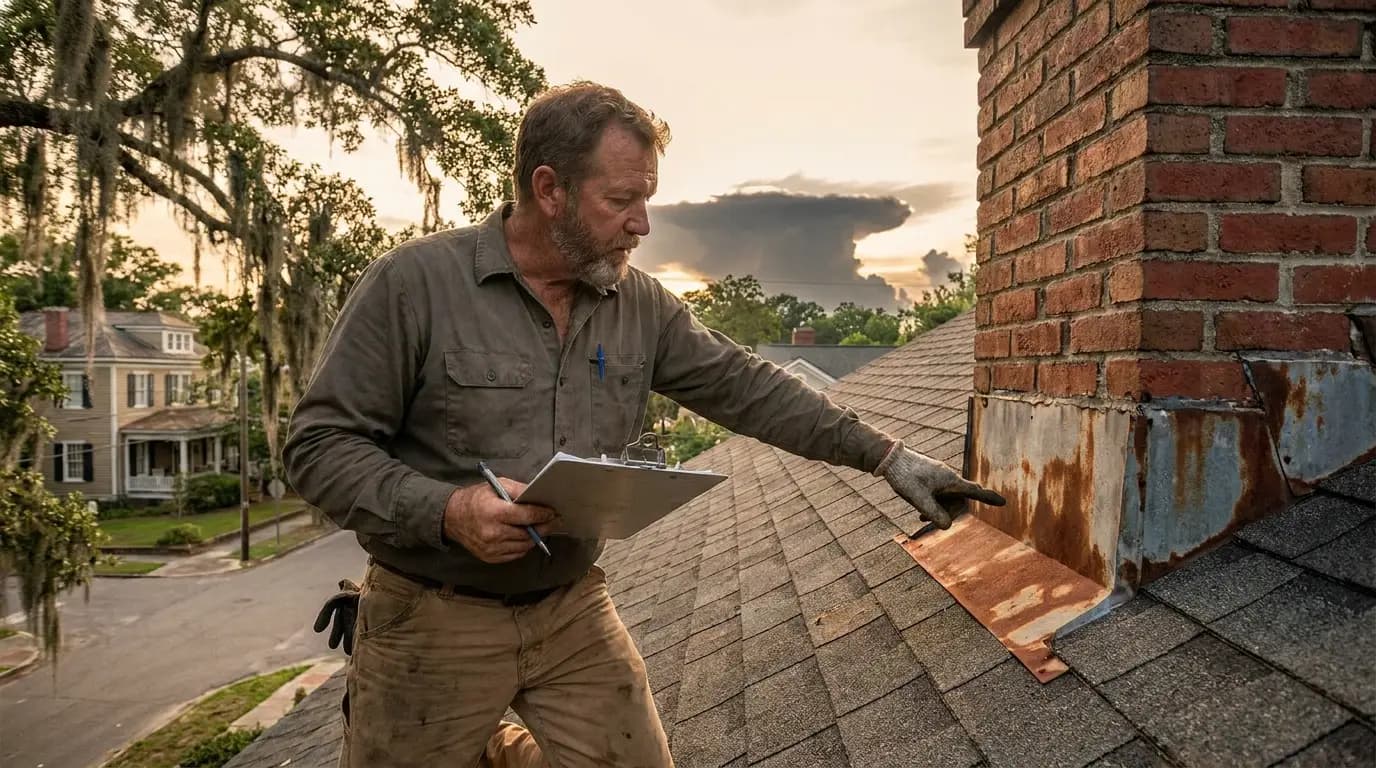

Atlantic hurricane season runs June 1 through November 30, but the Savannah-area threat window is narrower — most named-storm impacts on Coastal Georgia land between mid-July and early October. That gives every Chatham, Bryan, Effingham, and Liberty county homeowner a 4-8 week pre-season window where roof repairs can actually be scheduled, materials sourced, and permits pulled before a named storm makes the contractor backlog 6+ weeks deep.
A pre-hurricane roof inspection isn't a regular inspection with a different name on the invoice. It checks 9 specific failure points that account for ~85% of post-storm Savannah insurance claims, and it produces a report formatted to document pre-storm condition — which becomes critical evidence if a storm damages the roof and your carrier disputes the cause. This guide covers what the inspection should include, when to schedule it, what it should cost, and how to avoid the storm-chaser version that shows up after a storm rather than before.
Key Takeaways
- ✓ Atlantic hurricane season starts June 1 — Savannah threats mostly land July–October, giving 4-8 weeks after a May inspection to actually fix issues.
- ✓ Pre-hurricane inspections check 9 specific failure points (vs. 4-5 in routine); reports formatted for insurance pre-storm-condition documentation.
- ✓ Optimal scheduling window: May 15 – June 15. In active-forecast years (10+ named storms predicted), book by April 30.
- ✓ Typical cost in Savannah: $0 with reputable local contractors (lead-gen channel), $150–$300 with independent third-party inspectors.
- ✓ Biggest red flag: door-to-door "free hurricane inspection" the week after a named storm passes through. That's storm-chaser timing, not pre-season prep.
Why Pre-Hurricane Roof Inspection Matters More in Savannah Than Inland Georgia
Atlanta and Macon roofers don't see the same wind-uplift, salt-spray, and storm-surge failure modes that Coastal Georgia roofs face. A 110 mph gust at the building eave in Savannah — common in any named storm passing within 80 miles offshore — generates upward pressures of 40–80 psf on the corners and ridges of a typical residential roof. Asphalt shingles installed without 6-nail patterns or with degraded fastener seal lift in those conditions; flashing that's been baking in 90°F+ summer heat for 8+ years fails at the metal-to-roof interface; ridge vents with corroded fasteners blow off in single pieces, opening 30-foot-long water paths into the attic.
A pre-hurricane inspection catches these failure points before the storm. Post-storm inspections catch them after the damage is already done — at which point the cost is repair-plus-secondary-damage (interior drywall, insulation, flooring, sometimes mold remediation) rather than just the cost of preventive maintenance. The math heavily favors a $0–$300 pre-season inspection over a $5,000–$25,000 post-storm repair-and-restoration job.
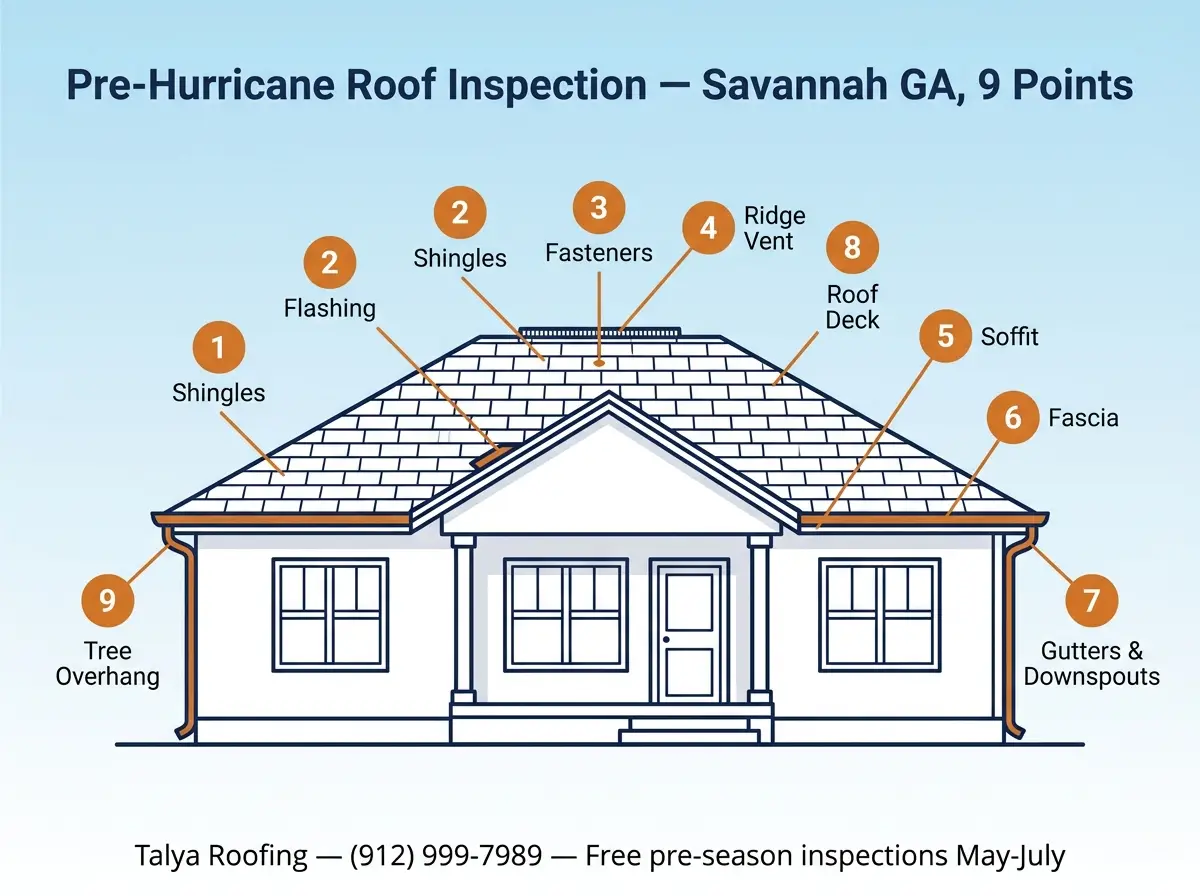
The 9-Point Hurricane Roof Inspection Checklist
These are the 9 specific items a Savannah-area hurricane inspection should cover. Print this and ask any contractor for written notes on each one — a real hurricane inspection produces a report that walks through all 9. A "free inspection" that's just a 10-minute walk-around with a verbal "looks fine, here's our quote for a new roof" doesn't count.
| # | Inspection Point | What's Being Checked + Hurricane-Season Significance |
|---|---|---|
| 1 | Shingle adhesion + nail-line integrity | Inspector lifts random shingles in the field, corners, and ridges to verify the adhesive seal is intact and nails haven't backed out. Wind uplift at the unsealed-shingle level is the #1 storm-damage trigger in Savannah. |
| 2 | Flashing — chimney, skylight, wall, valley | Step flashing, counter flashing, and valley metal checked for separation, rust, or sealant degradation. Failed flashing is the #2 trigger and accounts for ~30% of post-storm interior water damage. |
| 3 | Ridge venting + ridge cap shingles | Ridge vent fasteners checked for corrosion (especially within 5 mi of saltwater). Ridge cap shingles checked for proper sealing and overhang. A blown-off ridge vent in a Cat 1 storm exposes 30+ ft of decking to direct rain. |
| 4 | Pipe boots + plumbing vent collars | Check the collar, base flashing, surrounding shingles, and material compatibility. Replacement is quoted after assessment because access and supported damage vary. |
| 5 | Soffit + fascia attachment | Soffit panel attachment checked at corners and along the long runs. Detached soffits are the #1 way wind gets into the attic, where it then pushes the roof deck upward from below — a "roof from the inside" failure mode unique to coastal homes. |
| 6 | Gutter system + downspout secure-attachment | Gutters detach in wind and become projectiles. Downspouts disconnected from drainage cause foundation pooling. Both checked at hangers (every 24-36" per Chatham code) and at the end-cap and outlet. |
| 7 | Penetrations — HVAC, satellite, solar mounts | Any roof penetration is a leak risk. Inspector verifies each penetration has intact flashing, sealant, and (where applicable) mechanical attachment. Solar mounts especially — improperly installed mounts pull through the deck in high wind. |
| 8 | Deck condition (from interior attic inspection) | Inspector goes into the attic to check deck for moisture stains, soft spots, daylight at the eaves, or insulation displacement. Rotted decking will not survive a Cat 2 storm regardless of how good the shingles look from above. |
| 9 | Overhead tree + branch hazards | Trees within "fall radius" of the roof identified — branches that could break and become projectiles, or whole trees showing decline. Tree removal is owner-arranged but the inspector flags it. The single most-common Coastal Georgia post-storm claim is "tree on roof." |
What Separates a Pre-Hurricane Inspection From a Routine One
A routine annual roof inspection in Savannah usually covers 4-5 items: shingle condition, gutter cleanliness, obvious flashing issues, attic ventilation. That's adequate for ordinary maintenance — it catches granule loss, missing shingles, and the kind of slow leaks that show up in stained ceiling tiles. It doesn't catch the wind-uplift and water-intrusion failure modes that hurricanes cause.
A pre-hurricane inspection is different in three ways:
- →It includes the 4 items above PLUS the 9-point hurricane checklist. The full list takes 45-75 minutes on a typical 2,000 sq ft Savannah home, including the attic inspection. Routine inspections often skip the attic.
- →The report format is designed for insurance documentation. Pre-storm photos with timestamps, GPS coordinates of identified vulnerabilities, contractor signature, and pre-storm condition statement. If a storm damages the roof and the carrier disputes whether the damage was pre-existing, this report is the deciding evidence.
- →Repair recommendations are prioritized by hurricane risk, not just chronological age. An 8-year-old shingle that's still sealed isn't a hurricane priority. A 5-year-old pipe boot showing UV cracking IS a priority. The report ranks issues by storm-failure-likelihood, not just by what's worn out.
When to Schedule — The Savannah Timing Matrix
Booking the inspection is straightforward; booking the repair work if anything is found is the bottleneck. Use this matrix to time both:
| Window | Inspection Availability | Repair Lead Time | Status |
|---|---|---|---|
| Apr 1 – Apr 30 | Wide open — most contractors have May calendar gaps | 1-2 weeks for typical repairs | ✓ Optimal — book in active-forecast years |
| May 1 – May 31 | Still good availability | 2-3 weeks | ✓ Optimal — recommended for most years |
| Jun 1 – Jun 30 | Calendars filling but bookable | 3-5 weeks | ~ Acceptable — last reasonable window |
| Jul 1 – Jul 31 | Inspections still available, repairs harder to schedule | 5-8 weeks (and storm-damage work starts taking priority) | ~ Risky — repairs may not finish before peak storm window |
| Aug 1 onward | Pre-season inspections largely irrelevant; reactive mode | 6+ weeks if storm-damage work has begun on the Atlantic | ✗ Too late — schedule for emergency response instead |
Project Estimates, Qualifying Inspections and the Separate $250 Documented Inspection
Choose the service based on why you need the visit. Confirm the scope and any fee before scheduling:
- →Project estimates are free. Request an estimate for proposed roofing work.
- →Qualifying project inspections are free. This applies when you are planning roofing work with Talya, including wind or hail inspections when considering roof replacement.
- →Home-purchase and separate additional documented inspections use our $250 package. Confirm which service fits your needs before booking.
A complimentary project assessment can be useful when the purpose is to evaluate repair or replacement work, but it should not be confused with a homeowner inspection report. Talya Roofing's $250 documented homeowner inspection includes a physical assessment when access and conditions are safe, annotated condition photographs, AI-assisted image organization with human review, and a written report. Annotated inspection documentation may support an insurance review; coverage decisions remain with the carrier. A project estimate is prepared separately when requested.
Red Flags for "Free" Hurricane Inspections That Aren't Really Free
The contractor model only works when the contractor is reputable. Out-of-state storm-chasers also offer "free hurricane inspections" — but their version is structured to manufacture damage findings that justify a quick-turnaround insurance claim and a high-margin re-roof. Watch for:
- ⚠Door-to-door solicitation the week AFTER a named storm. Reputable Savannah contractors are too busy with existing post-storm work to canvass neighborhoods door-to-door. Door-to-door inspection offers after a storm = storm-chaser. Door-to-door inspection offers BEFORE a storm = also storm-chaser, just opportunistic.
- ⚠Pressure to sign anything during the inspection. A real inspection produces a report, then the contractor leaves. A storm-chaser asks for a signed contract or AOB (Assignment of Benefits) in the driveway during the first visit.
- ⚠"We found damage; your insurance will cover everything." A reputable contractor reports what they found and lets you decide. A storm-chaser tells you the insurance angle before you've even asked.
- ⚠Climbing on your roof without your explicit permission. Real inspectors confirm permission, set ladders carefully, and document the access. Storm-chasers often climb up unsupervised — sometimes deliberately creating damage they can "find."
- ⚠Out-of-state license plates or no permanent local address. Same red flag as for any post-storm contractor — but applies in pre-season too. A "Florida Roofing Services" truck pulling into your Savannah driveway in May is not your local hurricane-prep partner.
- ⚠Confusing an estimate visit with a documented inspection. A complimentary project assessment may support an estimate, but a documented inspection should clearly state its fee, scope, photographs, and written deliverable before the visit.
If you're uncertain about a contractor offering a free inspection, the 5-minute verification process is the same as for any Savannah roofer: confirm a permanent local business address, verify manufacturer certifications on the manufacturer's website, check Google reviews for named local neighborhoods, request a Certificate of Insurance. Our full Savannah roofer vetting guide walks through each step.
$250 Documented Homeowner Inspection
Physical assessment when safe, annotated condition photographs, AI-assisted image organization with human review, and a written report.
Serving Savannah, Pooler, Richmond Hill, Hinesville, Tybee Island, and Coastal Georgia. Availability depends on weather, safe access, location, and current demand.
Sources: NOAA National Hurricane Center · IBHS — Insurance Institute for Business & Home Safety · HAAG Certified Inspectors · Florida Building Code Wind Load Standard