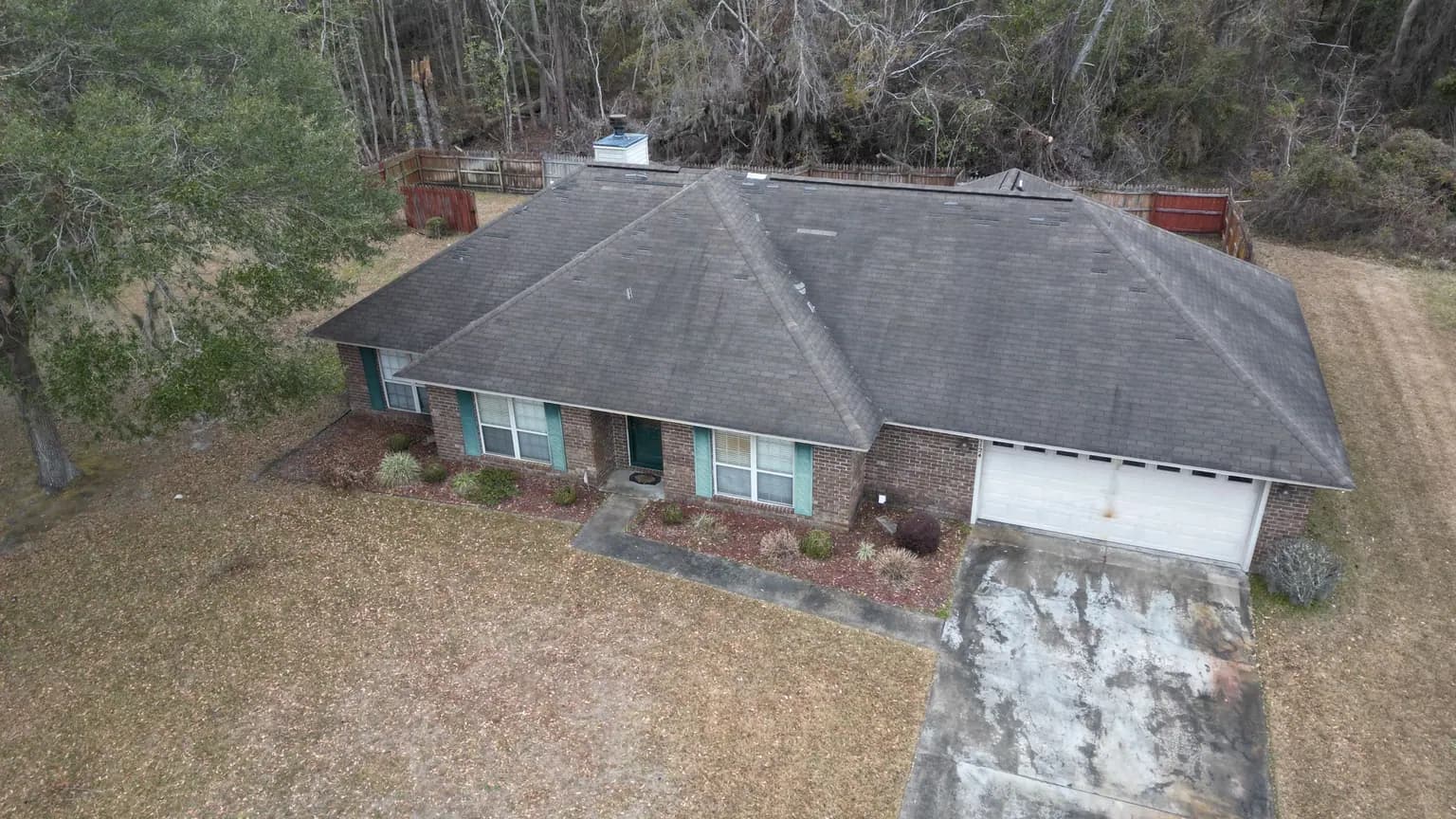

Hinesville is 38 miles from the coast. That single fact changes what a tropical system does to your roof, and it changes what you should be looking at in the hours after one passes. Storm surge and salt corrosion are barrier-island problems. In Liberty County the threat is what the wind picks up and puts down — pine and the open terrain around Fort Stewart that lets gusts run unbroken across a rooftop.
This is the Liberty County version of the post-storm playbook: what genuinely matters in the first 48 hours, which photographs decide how smoothly a file moves, and where our 31313 damage patterns diverge from what our crews find in Chatham County. For the general Coastal Georgia walkthrough of repair-versus-replacement and the claim sequence itself, read the complete storm damage repair guide for Coastal Georgia — this post does not repeat it.
Key Takeaways
- ✓ Hinesville's exposure profile is Medium hurricane risk and Low salt exposure — against High and High for Savannah, and Extreme salt for Tybee Island.
- ✓ Helene (Sep 26–27, 2024) was tree strike — trunks, not just branches, through decks. Idalia (Aug 30, 2023) was edge uplift — lifted starter strips and back-edge tab loss on older 3-tab around 31313.
- ✓ In the first 48 hours only three things are urgent: personal safety, stopping active water entry, and a dated photographic record made before any cleanup.
- ✓ Do not climb a storm-loaded roof. Photograph from the ground and from inside the house.
- ✓ We photograph visible roof conditions and provide measurements and an itemized construction estimate. You file the claim; your carrier decides coverage and payment.
- ✓ Reporting deadlines vary by policy, loss, and applicable law — use your policy's stated process, not a number from an article.
What should I do in the first 48 hours after storm damage to a Hinesville roof?
Stay off the roof, stop water from spreading inside, and photograph everything before you clean up. Those three actions cover the first 48 hours. Notify your carrier through the process your policy states, get the roof assessed in writing, and keep receipts for any temporary protection you pay for.
The sequence matters more than the speed. In the first six hours, deal with people: if there is a downed line, a leaning tree, or a sagging ceiling, that is an emergency-services call, not a roofing call. Move furniture and electronics out from under any active drip and put a container under it. Photograph the interior before you mop — a timestamped photo of a wet ceiling cannot be recreated once the ceiling is dry.
In the first day, work the outside from ground level. Walk all four elevations, photograph each one wide enough to establish the house, then photograph every specific thing that looks wrong. If a tree or a large limb is on the structure, photograph it where it landed before anyone removes it. In the second day, notify your insurer through your policy's stated reporting process and arrange a written roof assessment. Do not authorize permanent repairs before the roof has been documented and you understand what your carrier is doing with the claim — a well-meaning same-day fix can erase the evidence that the damage was storm-caused at all.
One honest caveat about timing: after a widespread event, every roofer in the region is triaging at once. We prioritize active water intrusion across the 31313 area and provide photo documentation, but temporary protection and project scheduling depend on weather, safe access, storm volume, materials, and crew availability. Anyone quoting you a guaranteed arrival time an hour after a hurricane is selling you something.
How is Liberty County storm damage different from coastal Chatham County?
Liberty County trades salt and surge for trees and open-terrain wind. Our exposure profile for Hinesville is Medium hurricane risk and Low salt exposure on 49 inches of annual rain. Savannah's is High and High on the same rainfall; Tybee Island's salt exposure is Extreme. Same rain, different failure mechanism.
| Exposure factor | Hinesville / Liberty County | Savannah / Chatham County | Tybee Island |
|---|---|---|---|
| Annual rainfall | 49" | 49" | 49" |
| Hurricane risk rating | Medium | High | High |
| Salt exposure | Low | High | Extreme |
| Dominant Helene 2024 claim mode we logged | Pine snapping; trunks through the deck | Oak strike, heaviest at Isle of Hope and Ardsley Park | — |
Read that bottom row carefully, because it is the practical difference. Both counties took tree damage from Helene, but the tree is not the same tree: Isle of Hope and Ardsley Park took the heaviest oak-strike claims in Chatham, while pine snapping was widespread on rental properties south and west of Fort Stewart and several Hinesville homes had trunks — not just branches — through the deck. Describe to your carrier what actually came down on your roof, and photograph it before it is moved.
The Low salt-exposure rating is the other half of the difference. Tybee Island is rated Extreme and Savannah High on the same measure; Hinesville is Low.
What storm damage can I actually see from the ground in Hinesville?
More than you would expect, if you know the four things that fail on 31313 roofs. Across our Hinesville work the recurring findings are backed-out nails on roofs 15 years and older, lifted starter strips, gutters packed with pine straw, and missing shingles from tree strikes during tropical events.
Start at the eave line and work up, using your phone's zoom rather than a ladder. Lifted starter strips read as a slightly wavy or shadowed bottom edge where the first course should sit dead flat — this is the exact failure Idalia produced across older 3-tab roofs around 31313 in August 2023, and it is easy to miss because the roof still looks intact from the street. Back-edge tab loss shows as a subtle checkerboard of lighter rectangles where tabs have gone. Missing shingles are obvious. Granule loss shows up as dark patches on the roof and as heavy grit accumulation at the downspout outlets.
Then check what the storm left behind. Clogged gutters from pine straw are one of the four recurring findings above, and they matter after a storm because a blocked gutter turns a survivable rain event into a fascia and soffit problem. Look at the ridge line from across the street: a ridge that is no longer straight, or a visible dip in a field of shingles, points at deck or framing damage underneath and is a reason to stop looking and start calling. Inside, check ceilings in every room including closets, and check the attic with a flashlight if you can do it safely — daylight visible through the deck is the fastest confirmation there is.
Forest Lake Estates is an established Hinesville subdivision — older streets, mature canopy, original builder-grade roofs now aging out. Independence Settlement runs roughly 1,300 to 2,800 square feet and is popular with Fort Stewart families and military landlords. Flemington Village is a newer Liberty County community off Flemington Village Blvd with quick gate access, and Walthourville — which shares 31313 — is newer HOA subdivisions on smaller lots. Allenhurst sits on larger lots off US-84 with a mix of mature and newer roofs.
What roof damage documentation actually matters after a Liberty County storm?
Dated photographs taken before cleanup, in three layers: wide, close, and interior. Wide shots establish the property and the overall condition. Close shots prove each specific defect. Interior shots prove the water actually got in. Add a written log with dates and keep every receipt.
Cleanup before capture is the failure worth guarding against. The limb gets hauled to the curb, the ceiling gets mopped and repainted, the wet insulation goes to the dump, and three weeks later there is no visual record that any of it happened. Photograph first. It costs five minutes and it is the difference between a file that reads clearly and one that relies on your memory.
- Wide exterior, all four elevations. Include enough context that the images are obviously your house.
- Close exterior of every defect. One frame per area, and take more than you think you need.
- The tree or debris where it landed, before removal — this is the Liberty County-specific one.
- Interior of every stain, drip, and wet spot, plus attic shots if the attic is safe to enter.
- A dated written log — when the storm hit, when you found each item, who you called and when.
- Receipts for tarps, containers, temporary lodging, or anything else you paid for in response.
On top of your own record, you can have the roof assessed in writing. Our documented homeowner roof inspection is $250 and includes a physical, on-roof assessment when it is safe to perform one, annotated photographs, documented limitations, and practical next steps. That report is yours. What we contribute to a claim file is described precisely on our roof damage documentation page, and it is worth reading before you talk to anyone about your claim.
Who files the insurance claim, and what does a roofer actually do?
You file the claim. Your carrier decides coverage and payment. Your roofer documents and builds. A roofer is not a public adjuster and does not negotiate coverage or payment. What a roofer contributes is narrower and concrete: photographs of visible roof conditions, measurements, and an itemized construction estimate for your records.
Here is the honest scope of what Talya Roofing does on a storm file. We photograph visible roof conditions. We provide measurements and an itemized construction estimate for your records. We can attend an on-site adjuster meeting when requested and explain our repair scope. We complete the construction scope you authorize as the property owner. That is the entire list.
What we do not do: we do not file your claim, we do not negotiate with your adjuster, we do not tell you what your policy covers, and we do not promise you a payment outcome. If you want the mechanics of the filing sequence itself, the Georgia roof claim filing walkthrough covers it step by step.
On deadlines, be equally careful about what you read. Reporting deadlines vary by policy, by loss type, and by applicable law. Review your own policy and your carrier's communications and report through the insurer's stated process. If a deadline is genuinely in dispute, that is a question for a qualified Georgia insurance professional or attorney — not for a roofer and not for a blog post.
How do I handle Hinesville storm damage while I'm deployed or stationed elsewhere?
By photo report and email — the whole thing, start to finish. Hinesville wraps the Fort Stewart gate, and a large share of local rental property is owned by people currently posted somewhere else. Our 31313 workflow is built around that: dated annotated images, a one-line summary, an itemized estimate, and approval by reply.
The first move is getting eyes on the property the same day, not the same week. A tenant, a neighbor, or a local contact photographing four elevations from the ground and every ceiling inside — with the phone's date stamp enabled — gives you a defensible baseline before anything is disturbed. Then notify your carrier through your policy's stated process yourself; you are the policyholder and that step does not delegate cleanly.
From there it runs on paper. After we assess, you get a PDF with annotated images, a one-line summary per property, and flat-rate quotes on anything that needs work. You approve by reply, we schedule the repair around your tenant, and a second photo report lands when it is done. Most of the owners we work with have not been back to Liberty County in over a year. If you own several properties in the 31313 corridor, the same route logic applies after a storm as before one — we hit them on a single pass and you get one consolidated report rather than five separate conversations. The Fort Stewart housing and roofing guide covers the VA-loan and PCS-timing side of this in more detail, and our Hinesville service page lists the neighborhoods we route through.
One boundary worth stating plainly: roofs inside the gate on Fort Stewart proper are managed by the on-post privatized housing partner, not by us. Everything off-post in the 31313 footprint is ours to work.
What does storm roof repair or replacement cost in Hinesville?
A partial storm repair runs $1,500–$6,000 and a full Hinesville tear-off with an architectural upgrade runs $8,000–$15,000 on a 1,500–2,400 sq ft home. Emergency tree-impact response is $800–$3,000 and stopping an active leak is $300–$800. Your out-of-pocket on a covered loss is policy and scope dependent.
| Scenario | Published range |
|---|---|
| Documented homeowner roof inspection | $250 |
| Emergency — active leak stop | $300–$800 |
| Emergency — tree impact response | $800–$3,000 |
| Storm wind damage repair (partial) | $1,500–$6,000 |
| Hinesville full tear-off + architectural upgrade, 1,500–2,400 sq ft | $8,000–$15,000 |
| Your out-of-pocket on a covered loss | Policy & scope dependent |
Ranges, not quotes — the number for your roof depends on pitch, layers, decking condition, and the authorized scope, and the written estimate states its own validity period. Active duty receives 10% off and veterans receive 5%. For landlords running a portfolio through the 31313 corridor, any repair under $500 gets handled the same week on our portfolio schedule, and volume pricing starts at three or more properties on the same route.
For grounding, this is the kind of work we have actually closed here: 16 completed full replacements and repairs across the 31313 footprint between 2023 and 2025, concentrated in the Fort Stewart rental belt; a documented insurance-claim roof replacement in Hinesville in March 2024 finished in Atlas Pinnacle Pristine, Pewter; a cluster of roofs replaced on the same rental-corridor street at Lancaster Loop in 2023–2024; a full architectural tear-off on a Montclair-area family home; and a community church reroof near downtown Hinesville completed in 2023. Every install carries our written 5-year workmanship guarantee, and Talya Roofing is fully insured.
Should I sign what a storm chaser hands me after a Liberty County hurricane?
No — not on the doorstep, not the same day, and not before you have read it. After a named storm, out-of-area crews work storm-hit neighborhoods door to door. The document offered is often a contract, not the free inspection being described.
The tells are consistent. An offer to take the claim off your hands, or a guarantee that the insurer will pay for a whole new roof, is the loudest one — that is a payment outcome nobody but your carrier can decide. Pressure to sign today, an offer to cover or waive your deductible, a request to sign before anyone has been on the roof, an out-of-state phone number and no local address, and a vehicle with no permanent signage all point the same direction. There is also a version of this that is worse than useless: a same-day "free repair" that removes the visible evidence of storm damage before it was ever documented.
The safe response is boring and it works: take the card, do not sign anything, and tell them you will call after you have had the roof assessed. Then verify whoever you are considering — a real local address, a written estimate you can read at your kitchen table, and a contractor who can explain what they will and will not do on an insurance file. For the full script, what to say when a storm chaser knocks walks through the conversation line by line.
What else do Hinesville homeowners ask after a storm?
Four more, answered short. Reporting deadlines, whether a tree strike is documented differently from ordinary wind damage, what a roofer does and does not do on an insurance claim, and how to run the whole process from another duty station while a tenant is in the house.
How long do I have to report roof storm damage to my insurer in Georgia?
Reporting deadlines vary by policy, by the type of loss, and by applicable law — there is no single Georgia number that fits every homeowner. Read your policy's reporting instructions and your carrier's post-storm communications, and report promptly through the process the insurer states. Promptness helps regardless of the deadline, because the longer visible damage sits, the harder it becomes to separate storm damage from ordinary wear. A disputed deadline is a question for a qualified Georgia insurance professional or attorney.
A pine came down on my roof. Is that different from wind damage on the claim?
The documentation is different even though you report both the same way. Tree damage was the dominant claim mode across Liberty County after Helene — trunks, not just branches, through decks on Hinesville homes in September 2024. Photograph the tree where it landed, before removal, from several angles including one wide enough to show the house, plus the impact point and the interior below it. Keep tree-removal receipts and roof photos as distinct records.
Can Talya deal with my insurance company for me?
No. A roofer is not a public adjuster and does not negotiate coverage or payment. We photograph visible roof conditions, we provide measurements and an itemized construction estimate for your records, and we can attend an on-site adjuster meeting when requested to explain our repair scope. You file the claim and your carrier decides coverage and payment. An offer to take the claim off your hands is itself the warning sign.
I'm stationed elsewhere and my Hinesville rental was hit. What comes first?
Eyes on it, then a dated record. Ask your tenant or a local contact to photograph all four elevations from the ground and every ceiling inside, with the date stamp on, the same day. Notify your carrier through your policy's stated process. Then have the roof assessed in writing — you get an annotated photo-report PDF, a one-line summary, and an itemized estimate you approve by email reply. Repair and temporary-protection timing depends on weather, safe access, storm volume, materials, and crew availability.
Sources
Hurricane Helene (September 26–27, 2024) — NOAA National Hurricane Center Tropical Cyclone Report
Hurricane Idalia (August 30, 2023) — NOAA National Hurricane Center Tropical Cyclone Report
Hurricane Irma (September 11, 2017) — NOAA National Hurricane Center Tropical Cyclone Report
Local damage patterns, neighborhood detail, job records, and price ranges: Talya Roofing's own Hinesville project history and published pricing.
Storm damage on a Hinesville or Liberty County roof?
Get it photographed and documented in writing before anything is cleaned up. Call (912) 999-7989 or start with our storm damage documentation service.
Response and scheduling depend on crew availability, travel conditions, and safe weather.