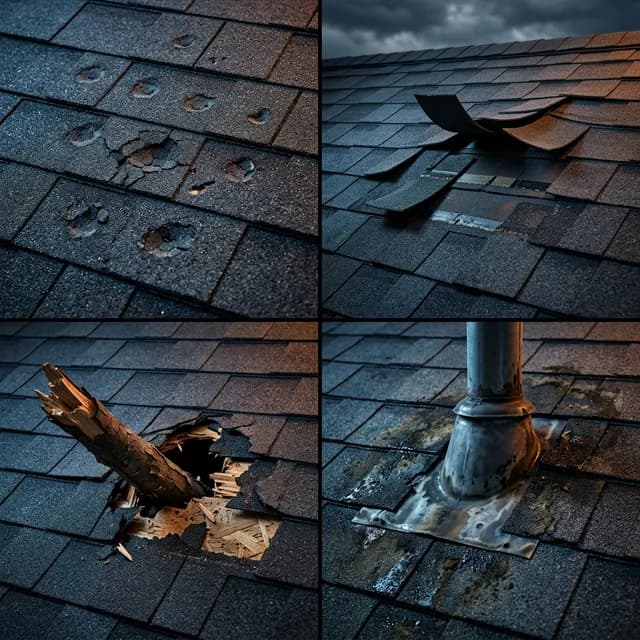

⚠️ What You Need to Know
- ✓ Storm damage is not always visible from the ground
- ✓ Bruised shingles and lifted edges can void your manufacturer warranty
- ✓ Most warranties require prompt repair of storm damage
- ✓ A professional inspection after any storm is the only way to know for sure
Here is something most Savannah homeowners do not realize: your roof can sustain significant storm damage that is completely invisible from the ground. No missing shingles. No visible dents. No water staining on the ceiling. Everything looks fine — but the damage is there, quietly compromising your roof's performance and, critically, voiding your manufacturer warranty.
We see this pattern constantly across Coastal Georgia. A homeowner gets through a storm, sees no obvious damage, and moves on. Two or three years later, a leak develops. They file a warranty claim with Atlas or GAF or CertainTeed. The manufacturer sends an inspector who identifies unrepaired storm damage — and denies the claim entirely.
What Invisible Storm Damage Actually Looks Like
The damage types that hide from ground-level view are the same ones that cause the most long-term problems:
- Bruised shingles: Hail impacts that crack the fiberglass mat beneath the granule surface. The shingle looks normal from a distance, but the internal structure is compromised. These spots become leak points within 12 to 24 months.
- Lifted edges: High winds can partially lift shingle tabs without tearing them off. The seal strip breaks but the shingle lays back down, appearing normal. Water now has a path beneath the shingle.
- Micro-fractures in flashing: Wind stress on metal flashing around chimneys, vents, and valleys creates hairline cracks that are invisible until water finds its way through.
- Displaced granules: Wind-driven rain and hail strip granules from localized areas. The shingle underneath is now exposed to UV degradation, which accelerates dramatically in Savannah's intense sun.
How Invisible Damage Voids Your Warranty
Every major shingle manufacturer — Atlas, GAF, CertainTeed, Owens Corning — includes language in their warranty that excludes damage caused by "acts of nature" or "severe weather events." That language exists to protect the manufacturer from paying for storm damage that should be covered by your homeowner's insurance.
But there is a critical nuance: most warranties also require homeowners to maintain the roof in good repair and address damage promptly. If a warranty inspector finds evidence of unrepaired storm damage — even old damage you never knew about — the manufacturer can use that as grounds to deny a warranty claim for an unrelated issue.
In practical terms, this means that hail bruising from a storm two years ago can be used to deny a warranty claim for a manufacturing defect discovered today. The manufacturer's position is that the homeowner failed to maintain the roof, which is a valid warranty exclusion.
The 72-Hour Rule for Insurance
Delayed discovery can complicate both diagnosis and insurance review. Notice requirements and deadlines vary by policy, event, and applicable law. Review your policy and contact the carrier or a licensed insurance professional promptly for claim-specific instructions; a roofing contractor cannot determine whether late-reported conditions are covered.
This is why a professional roof inspection may be useful after significant wind, hail, or debris impact. It can document visible roof conditions at that point in time, but does not determine insurance coverage or warranty eligibility. Review the policy and current written manufacturer terms for any notice requirements.
What a Professional Storm Inspection Covers
When our team inspects your roof after a storm, we check every component that could be affected:
- Every shingle for bruising, lifting, cracking, and granule displacement
- All flashing at chimneys, walls, vents, and valleys
- Ridge caps and hip shingles (these catch the most wind)
- Pipe boots, exhaust vents, and other roof penetrations
- Gutter and downspout condition
- Soffit and fascia for wind damage
- Interior attic inspection for moisture or daylight penetration
We document everything with photos, provide a written report, and give you an honest recommendation on whether filing an insurance claim makes sense. No pressure, no obligation. We have completed over 300 roofs across Savannah, Pooler, Richmond Hill, and surrounding areas — and our 5.0 Google rating reflects the trust our customers place in our assessments.
Protect Your Warranty, Protect Your Investment
Your roof is typically the most expensive single component of your home. A new roof replacement in Savannah runs between $8,500 and $18,000 depending on size and materials. Protecting that investment means staying ahead of invisible damage that could void your warranty and leave you paying full cost for the next replacement.
After any storm that produces hail, sustained winds above 60 mph, or significant debris impact in the Savannah metro area, schedule a professional inspection. It costs you nothing and could save you thousands.
$250 Documented Post-Storm Inspection
Protect your warranty and catch invisible damage before it becomes a costly problem.
Types of Invisible Storm Damage in Savannah
Not all storm damage is visible from the ground or even from a casual rooftop walk. The most insidious damage occurs at the microscopic level, weakening the roofing system without any obvious signs until a subsequent storm causes catastrophic failure.
Hidden Damage Types
| Damage Type | How It Happens | Why It's Invisible | How to Detect |
|---|---|---|---|
| Hail bruising | Hail impacts compress granules into mat | No surface break — only felt by touch | Professional inspection with tactile exam |
| Adhesive strip failure | Wind vibration breaks thermal seal | Shingles lay flat but are no longer bonded | Lift test during inspection |
| Nail pull-through | Wind uplift partially extracts nails | Nails still present but grip reduced | Attic-side inspection for daylight at nails |
| Flashing micro-cracks | Thermal shock from hail on hot metal | Cracks too small to see without magnification | Water testing or infrared scan |