
Key Takeaways
- ✓ We do not have a sourced lifespan figure for Statesboro roofs. What we can say is that a lot of the Bulloch County family-home roofs we upgrade are 15-25 years old and still on their original builder-grade 3-tab shingles.
- ✓ Statesboro sits 60 miles inland, so storm surge is not the threat here — pine strikes and straight-line winds are.
- ✓ During Hurricane Helene, pine snapping became the dominant damage mode across Bulloch County. Most Helene claims here were tree, not wind.
- ✓ The big four we find on Statesboro rentals: backed-out nails, pine-straw-clogged gutters, lifted starter strips and shingles missing from tree strikes.
- ✓ Full tear-off with a 130 mph architectural upgrade: $7,500-$14,000 on a typical 1,400-2,400 sq ft home or rental.
How long does a roof last in Statesboro, GA?
We do not have a sourced lifespan number for Statesboro. What we can give you is the age of the stock we work on: a lot of the Bulloch County family-home roofs we upgrade are 15 to 25 years old and still on their original builder-grade 3-tab shingles. That is an observed age, not a manufacturer rating.
The distinction matters more than it sounds. A warranty term describes a product under test conditions. The age at which a specific roof in Bulloch County actually needs replacing is something we only know after looking at it. Statesboro is 60 miles up Hwy 80 from our Savannah shop, carries a Low salt-exposure and Low hurricane-risk profile, and takes about 46 inches of rain a year, with severe inland thunderstorms and extreme summer heat as the weather factors we plan around. Storm surge is not the threat here. Pine strikes and straight-line winds are, because Bulloch County is heavily wooded and the same pines that shade a rental in summer can fall during severe thunderstorms and tropical remnants.
Across the four Statesboro ZIPs we cover — 30458, 30459, 30460 and 30461 — the housing splits roughly in two. Statesboro's rental market runs on Georgia Southern's 27,000+ students, and most of that stock sits within a few miles of campus: the Gentilly Road corridor, the Hwy 301 corridor, the older blocks behind GSU, much of it absentee-owned. Outside the rental belt there is a steady base of family homes in Gentilly, the subdivisions off Hwy 301 and the older streets near downtown, along with areas like Cypress Lake, Brannen Lake and Buckhead Plantation, and the 1910-1930 Craftsman bungalows of the South Main Street historic district.
How is a Bulloch County roof different from a coastal Savannah roof?
Different exposure. Savannah carries High salt exposure and High hurricane risk, and Savannah roofs contend with humidity-driven algae, hurricane wind uplift and chloride attack on standard galvanized fasteners. Bulloch County carries Low salt exposure and Low hurricane risk, 60 miles inland, where storm surge is not the threat — pine strikes and straight-line winds are.
Our Savannah roof lifespan guide covers that coastal market. In Statesboro, salt exposure is rated Low, and the variables we actually plan around are the pines, the severe inland thunderstorms and the extreme summer heat.
| Factor | Savannah (coastal Chatham) | Statesboro (inland Bulloch) |
|---|---|---|
| Salt exposure | High | Low |
| Hurricane risk profile | High | Low |
| Annual rainfall | ~49" | ~46" |
What do we find on Statesboro roofs?
On Statesboro rentals there are four recurring finds. Backed-out nails on roofs 15 years and older, gutters clogged with Bulloch County pine straw, lifted starter strips after summer thunderstorms, and shingles missing from tree strikes. Tenants do not report small leaks until the ceiling stains, so these usually surface at inspection rather than by phone call.
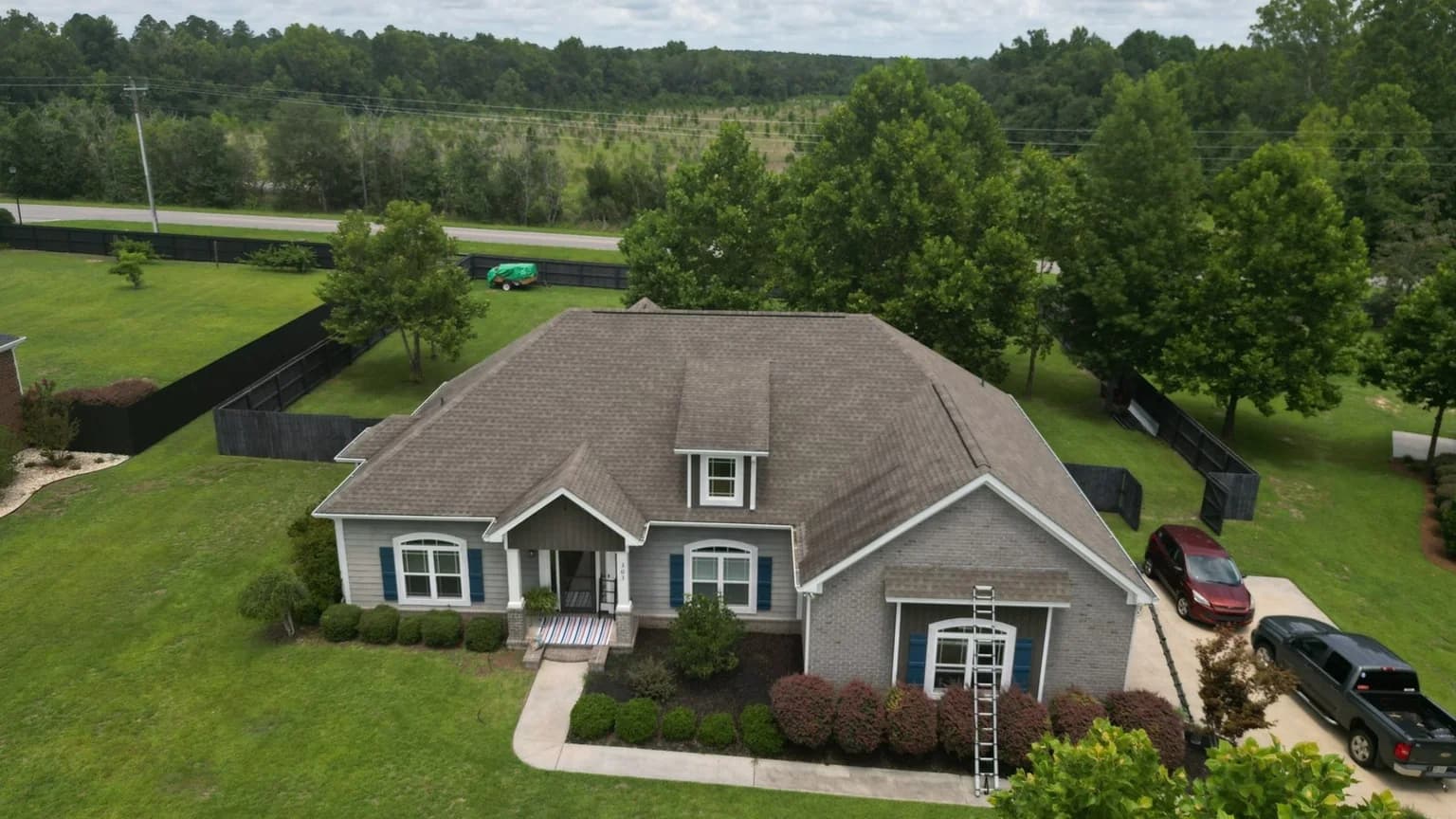
On the family-home side the pattern is similar. A lot of those roofs are 15 to 25 years old and still on their original builder-grade 3-tab shingles, and Bulloch County's severe summer thunderstorms find the weak spots first: lifted starter strips, popped nails, hail bruising on the south slopes. We upgrade those roofs to 130 mph architectural shingles with a 6-nail wind pattern and reinforced starter, then file the permit with Statesboro.
On the 1910-1930 Craftsman bungalows in the South Main Street historic district we add two checks: decking condition and attic ventilation. Both are common weak points on roofs that have been replaced more than once, and these homes need a more careful hand than a modern subdivision reroof — we match the existing profile and protect the original woodwork and porch details during tear-off.
Our documented Bulloch County work sits across those ZIPs: an active project on a single-family home in the Cypress Lake subdivision near Georgia Southern (30458), a Two Chop Road-area single-family job documented with a full CompanyCam photo set (30461), two neighboring single-family projects on Jeremiah Court (30461), and additional residential work on Hardwick Drive and Sandy Way (30461).
What did Helene and Debby change about what we inspect?
They moved trees and drainage to the top of the list. Hurricane Helene made pine snapping the dominant damage mode across Bulloch County on 26-27 September 2024. Hurricane Debby, a month and a half earlier, showed that a slow-moving rain event was what got inside older Statesboro homes.
Helene tracked north out of the Florida Big Bend. Rental properties along the GSU corridor and Hwy 301 saw repeated tree strikes through the night, with several roofs holed by pine trunks rather than just branches. The takeaway we carry forward is blunt: for a Statesboro rental, a pre-season tree assessment matters more than any extra wind nail, because most Helene claims here were tree, not wind.
Debby, on 5-7 August 2024, parked over south Georgia and dumped 10-20 inches of rain in three days. Older rentals near GSU with aging flat carport roofs and undersized gutters saw ponding and fascia rot, and several Gentilly-area homes had attic moisture intrusion show up on the ceilings a week later. Gutter capacity and attic ventilation now get checked on every Statesboro inspection — Debby exposed how many rentals were one slow-mover away from interior damage.
If a storm does hit your property, here is exactly what we do and do not do. We photograph visible roof conditions, take measurements, provide an itemized construction estimate, and can attend an on-site adjuster meeting when requested to explain our repair scope. We do not file or negotiate the claim or promise a recovery. The policyholder or an appropriately licensed representative handles submissions and advocacy, and the carrier decides coverage and payment.
What does a Statesboro roof inspection cover?
Roof condition, gutter status, flashing notes and a repair priority list, all in a dated photo report. For portfolios we run one route across every property, timed to tenant turnover so we are not blocking move-ins, and you get a single PDF covering all of them rather than a separate visit per house.
Since Debby, gutter capacity and attic ventilation are on every Statesboro inspection. On older homes near downtown, attic ventilation and aging flashing are what show up most, and in the South Main historic district we also check decking condition. Any repair under $500 gets handled the same week we find it, which is the practical reason the annual cycle works — catching problems between leases is roughly a tenth the cost of a mid-tenancy emergency.
If you are trying to judge a roof yourself first, our roof replacement warning signs guide walks the visual cues, and a documented roof inspection gives you the annotated photo record to decide from instead of a gut call.
How much does a roof replacement cost in Statesboro?
$7,500 to $14,000 for a typical Statesboro home or rental. That covers a full tear-off and an upgrade to 130 mph architectural shingles with a 6-nail wind pattern and reinforced starter, on a 1,400-2,400 sq ft roof, permitted through Statesboro.
Simpler rental roof lines on the older GSU-corridor stock often come in lower. Estimates are free across all Bulloch County ZIPs, we hold pricing for 30 days, and there is no travel surcharge for standard residential or rental work anywhere in the Statesboro service area. Most full replacements run 1-2 days on a typical 1,400-2,000 sq ft Statesboro rental, and we schedule against your move-out and move-in dates. Full roof replacement details and scope are on our services page, and everything specific to this market lives on our Statesboro roofing page.
Architectural shingles or metal for a Bulloch County home?
Both work well 60 miles inland. Architectural shingles upgraded to a 130 mph wind spec with a 6-nail pattern and reinforced starter are the value choice and the most common pick across Bulloch County family homes and GSU-corridor rentals. Metal costs more up front but sheds pine debris better and lasts longer.
The deciding factor here is your lot, not the coast. Metal is a good fit if your lot is heavily wooded and prone to limb strikes during severe summer thunderstorms — which describes a lot of the west-side lots around Brannen Lake, where the same pines that shade the property are the dominant storm-damage risk. We walk both options on the free estimate so you can weigh cost against longevity for your specific roof rather than picking off a chart.
Talya's recommendation
Do not start with a replacement quote — start with a documented inspection. Backed-out nails, clogged gutters, lifted starter strips and tree-strike shingle loss are the four things we find on Statesboro rentals, and an annotated photo record is what tells you which of them you actually have. If you own rentals here, put the whole portfolio on one annual route timed to turnover; volume pricing kicks in at three or more properties on the same route.
Sources:
National Hurricane Center — Tropical Cyclone Report: Hurricane Helene (AL092024)
National Hurricane Center — Tropical Cyclone Report: Hurricane Debby (AL042024)
Statesboro roof observations, inspection scope and cost range come from our own Bulloch County project records and published Statesboro pricing (ZIPs 30458-30461).
Not sure what shape your Statesboro roof is in?
Free estimates across all Bulloch County ZIPs — no travel surcharge.
Call (912) 999-7989