
Key Takeaways
- Poor roof ventilation in Coastal Georgia accelerates shingle aging by 25–40%, turning a 25-year roof into a 15-year roof.
- Savannah's combination of extreme heat (90°F+ days) and extreme humidity (70%+ average) makes proper ventilation more critical here than almost anywhere in the country.
- The most common ventilation mistake in Chatham County homes is insufficient soffit intake — without balanced airflow, exhaust vents pull conditioned air from your living space instead of attic air.
- Signs of ventilation problems include wavy or buckled shingles, excessive attic heat, mold on sheathing, ice dam formation (rare but possible in Savannah), and peeling interior paint near ceilings.
- Talya Roofing assesses and corrects ventilation on every roof replacement and offers standalone ventilation upgrades for existing roofs.
Why Ventilation Matters More in Coastal Georgia
Roof ventilation is important everywhere. In Coastal Georgia, it is critical. The physics are straightforward: hot air rises. On a 95°F day in Savannah — which happens roughly 90 days per year — an unventilated or poorly ventilated attic reaches temperatures of 150–170°F. That superheated air bakes the underside of your roof decking and shingles from below, while the sun bakes them from above. The shingles are caught in a thermal vise that accelerates every form of deterioration: asphalt drying, granule loss, adhesive failure, and substrate cracking.
But heat is only half the problem. Coastal Georgia's humidity adds a moisture dimension that most ventilation guides — written for drier climates — do not adequately address. When warm, moisture-laden attic air contacts cooler surfaces (the underside of the roof deck in winter, HVAC ductwork year-round), condensation forms. In Savannah's climate, this condensation cycle happens far more frequently and aggressively than in drier regions. Without adequate ventilation to carry that moisture out, it accumulates on the sheathing, causing mold, rot, and structural degradation.
How Roof Ventilation Is Supposed to Work
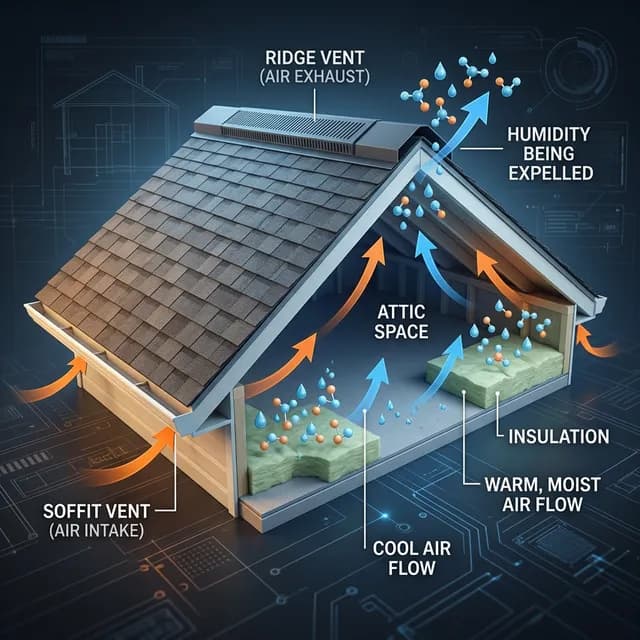
A properly ventilated roof uses natural convection — the tendency of hot air to rise — to create continuous airflow through the attic. The system has two components:
Intake Vents (Low Position)
Soffit vents installed along the eaves allow cooler outside air to enter the attic at the lowest point. This incoming air displaces the hot air above it, initiating upward airflow. The most effective configuration is continuous soffit venting — a perforated strip running the entire length of each eave. Individual soffit vents (rectangular or circular) work but provide less consistent airflow.
Exhaust Vents (High Position)
Ridge vents, roof-mounted vents, or gable vents near the roof peak allow hot air to escape. As warm air exits through the high vents, it creates negative pressure that draws more cool air in through the soffits. A continuous ridge vent running the full length of the ridge is the most efficient exhaust design.
Size Ventilation for the Attic
Ventilation sizing depends on the attic design, applicable local code and selected vent products. Measure the attic and use the vent manufacturer's net free area ratings to establish the required intake and exhaust. Assess soffit intake, air sealing and compatibility with existing exhaust before choosing vent quantities or types.
The Six Most Common Ventilation Problems in Chatham County
1. Blocked or Missing Soffit Vents
This is the number one ventilation problem we encounter in Savannah, Pooler, and Richmond Hill. Soffit vents get blocked by insulation that has been pushed against the roof deck (filling the gap where air should flow), by paint that has sealed over perforated vinyl soffits, by wasp nests, by debris accumulation, or by retrofit enclosures that were installed without understanding the ventilation function. Many homes built in the 1960s–1980s in Georgetown, Kensington Park, and other Savannah neighborhoods were constructed with minimal or no soffit venting.
Without soffit intake, the ridge vent has nothing to exhaust. Instead of drawing cool air from outside, it pulls conditioned air from your living space through ceiling light fixtures, attic hatches, and plumbing penetrations. This wastes energy and does nothing to cool the attic.
2. Mixed Exhaust Vent Types
A common mistake is combining different exhaust vent types — for example, a ridge vent and powered attic ventilator on the same roof, or a ridge vent and gable vents. These systems fight each other. The gable vents short-circuit the ridge vent by providing a lower-resistance exhaust path, pulling air across only part of the attic while leaving dead zones. A powered ventilator can pull air backward through an unpowered ridge vent, actually drawing rain into the attic.
The fix is straightforward: choose one exhaust system and seal the others. For most Chatham County homes, a continuous ridge vent with baffled rain protection is the best solution.
3. Insufficient Ventilation Area
Even when soffit and ridge vents are present, their rated net free area and unobstructed airflow paths need to be checked. Confirm the attic dimensions, vent product ratings and applicable design requirements before deciding whether more ventilation is needed. During re-roofing, assess the existing system rather than simply replicating it.
4. Bathroom and Kitchen Exhaust Vented Into the Attic
This violation of building code is surprisingly common in older Chatham County homes. Bathroom exhaust fans and kitchen range hoods that terminate in the attic — instead of through a roof or wall cap to the outside — pump warm, moisture-saturated air directly into the attic space. In Savannah's climate, this creates conditions for rapid mold growth on the roof sheathing. We find this issue in roughly one out of every five attic inspections.
5. Vapor Barriers in the Wrong Location
In cold climates, a vapor barrier on the warm side of the insulation prevents moisture from migrating into the attic. In Savannah's hot-humid climate, this guidance is reversed. A vapor barrier on the attic side of the insulation traps moisture in the attic instead of allowing it to diffuse downward into the conditioned space where it can be removed by the HVAC system. Misplaced vapor barriers combined with poor ventilation create mold factories.
6. Spray Foam Insulation Without Proper Planning
Closed-cell spray foam applied directly to the underside of the roof deck creates an unvented (sealed) attic assembly. When done correctly — with the right foam thickness and a proper thermal analysis — this can work well. When done incorrectly (insufficient thickness, gaps in coverage, or combined with existing ventilation that was not sealed), it creates pockets where moisture condenses and has no path to escape. This is an increasingly common problem in Pooler and Richmond Hill where spray foam has been applied during energy upgrade projects without full understanding of the ventilation implications.
Signs Your Roof Has a Ventilation Problem
Watch for these indicators in your Savannah-area home:
| Symptom | What It Indicates | Urgency |
|---|---|---|
| Wavy or buckled shingles | Excessive heat distorting the decking beneath | High — shingle warranty may be voided |
| Attic temperature above 140°F in summer | Inadequate exhaust ventilation | High — accelerating shingle degradation |
| Mold or dark staining on attic sheathing | Moisture accumulation from poor airflow | Critical — structural and health risk |
| Peeling paint on interior ceilings | Moisture migrating from attic through ceiling | Moderate — cosmetic sign of deeper issue |
| HVAC running constantly in summer | Attic heat radiating into conditioned space | Moderate — energy waste |
| Rusty nail tips protruding from sheathing | Condensation forming on metal fasteners | Moderate — indicates chronic moisture |
| Musty smell when attic hatch is opened | Active mold growth in attic space | High — inspection needed immediately |
Solutions for Coastal Georgia Ventilation Problems
Balanced Ridge-and-Soffit System
The gold standard for Chatham County homes. Continuous soffit intake vents along all eaves, combined with a continuous ridge vent along the full ridge line, create uniform airflow that reaches every corner of the attic. Baffles installed at each rafter bay keep insulation from blocking the soffit-to-ridge airflow path. This system works passively — no electricity, no moving parts, no maintenance beyond keeping debris off the soffits.
Soffit Vent Retrofit
For homes with solid (non-vented) soffits, we cut openings and install vented soffit panels or individual vent inserts. This is often the single most impactful ventilation improvement we make on older Savannah homes — adding intake where none existed before transforms a stagnant attic into a breathing system.
Exhaust Vent Rerouting
Bathroom fans, dryer vents, and kitchen exhausts that terminate in the attic must be extended through the roof or an exterior wall with proper caps. We handle this rerouting during roof replacements or as a standalone repair project.
Radiant Barrier Addition
While not a ventilation fix per se, adding a radiant barrier to the underside of the roof rafters reduces the radiant heat load that ventilation must remove. In Savannah's climate, the combination of proper ventilation and a radiant barrier creates attic temperatures 40–60°F cooler than an unvented, unshielded attic. That temperature reduction extends shingle life, reduces energy costs, and improves indoor comfort.
The Impact on Roof Lifespan
The connection between ventilation and roof lifespan is not theoretical. Shingle manufacturers document it in their warranty requirements — and enforce it by denying claims on roofs with inadequate ventilation. Here is the measurable impact:
- A 25-year architectural shingle on a properly ventilated roof in Savannah will typically last 22–28 years.
- The same shingle on a poorly ventilated roof will fail in 15–18 years — and the manufacturer will deny the warranty claim because the ventilation specification was not met.
- That is 7–10 years of lost roof life — worth $8,000–$15,000 in premature replacement costs.
Ventilation is not an optional upgrade. It is the foundation that every other roofing component depends on. At Talya Roofing, ventilation assessment is part of every roof inspection we perform in Chatham County.
Frequently Asked Questions
Can I add ventilation without replacing my roof?
Yes. Soffit vent installation, ridge vent addition (when shingles at the ridge are replaced), and attic exhaust rerouting can all be done as standalone projects. However, the most cost-effective time to address ventilation is during a roof replacement, when the entire system is accessible.
Are powered attic fans a good solution for Savannah?
Suitability depends on the roof and attic ventilation system. If intake vents are blocked and the attic is poorly sealed from the living space, an attic fan can draw conditioned air into the attic. Assess intake, air sealing and compatibility with existing exhaust vents before selecting a powered or solar exhaust fan. For eligible roofs, we include a solar exhaust fan at no additional cost with your roof replacement. Eligibility depends on an assessment of your roof and attic ventilation.
How do I know if my ventilation meets code?
Calculate your attic square footage and compare it to the total net free area of your existing vents (found on the vent manufacturer's specifications). If the system may be undersized or unbalanced, request a property-specific ventilation review. Talya Roofing can perform an intake-and-exhaust calculation as part of a complimentary ventilation project assessment and estimate; this estimate visit is separate from the $250 documented homeowner inspection.
Is Your Attic Ventilation Costing You Money?
Poor ventilation silently shortens your roof's life and inflates your energy bills. Talya Roofing provides free ventilation assessments for homeowners in Savannah, Pooler, Richmond Hill, and Tybee Island. We will measure your current ventilation, identify deficiencies, and recommend the most cost-effective upgrades for your home.
Schedule Your Free Ventilation Assessment
Or call us directly: (912) 999-7989
Attic Ventilation Importance: Why It Matters in Coastal Georgia
Proper attic ventilation is one of the most overlooked yet critical components of roof health in Savannah and the coastal Georgia region. With average annual humidity exceeding 74%, local attics are particularly vulnerable to moisture-related damage that can cost thousands in premature repairs.
The Science of Ventilation in Humid Climates
Coastal Georgia's humid subtropical climate creates unique ventilation challenges not found in drier regions. During summer months, attic temperatures can reach 150°F+ while relative humidity stays above 80%. Without adequate ventilation, this moisture-laden air condenses on cooler surfaces — the underside of roof decking, rafters, and insulation — creating ideal conditions for mold colonies and wood rot.
The solution is a balanced ventilation system using the stack effect: cool air enters through soffit (intake) vents at the eaves, warms and rises through the attic space, and exits through ridge vents or powered exhaust fans at the peak. This continuous convective loop removes both excess heat and moisture year-round.
Assess Ventilation Requirements for Savannah Homes
Start with the attic design, dimensions and selected vent products. Check available soffit intake, air sealing between the attic and living space, and compatibility with the existing exhaust system. Use rated net free area and the applicable local code and manufacturer requirements to size the vents.
For homes exposed to wind-driven rain, including Tybee Island and Wilmington Island, assess vent selection, placement and weather protection for the property. Extra vent area alone does not establish that moisture intrusion will be prevented.