
Picking a roof color in Coastal Georgia feels like it should be simple — go light to beat the heat, right? But Savannah's climate sets up a real trade-off. The intense summer sun rewards a reflective, lighter roof, while the heavy coastal humidity rewards a darker shade that hides the black algae streaking our region is notorious for. The honest answer for most homes here is not "light is always best." It is a darker cool-color, algae-resistant shingle that splits the difference and performs on both fronts. This guide walks through the heat science, the algae problem, the Historic District rules, and how to verify a shingle is a genuine cool roof before you commit.
Key Takeaways
- A cool roof reflects more sunlight and sheds heat, absorbing less solar energy than a conventional dark roof (U.S. DOE Energy Saver).
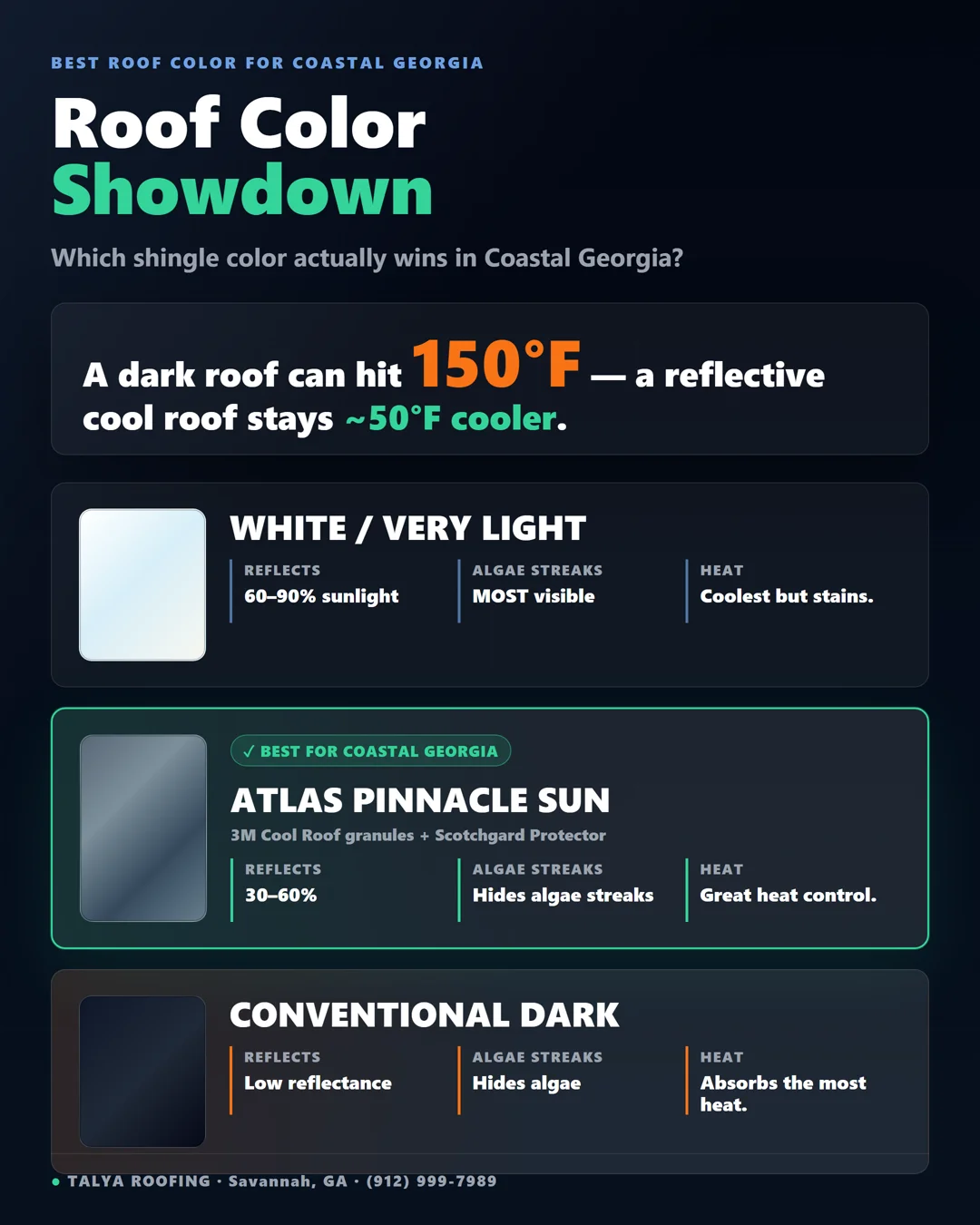
- A dark roof can hit 150°F on a sunny summer afternoon; a reflective cool roof can stay over 50°F cooler (DOE Energy Saver).
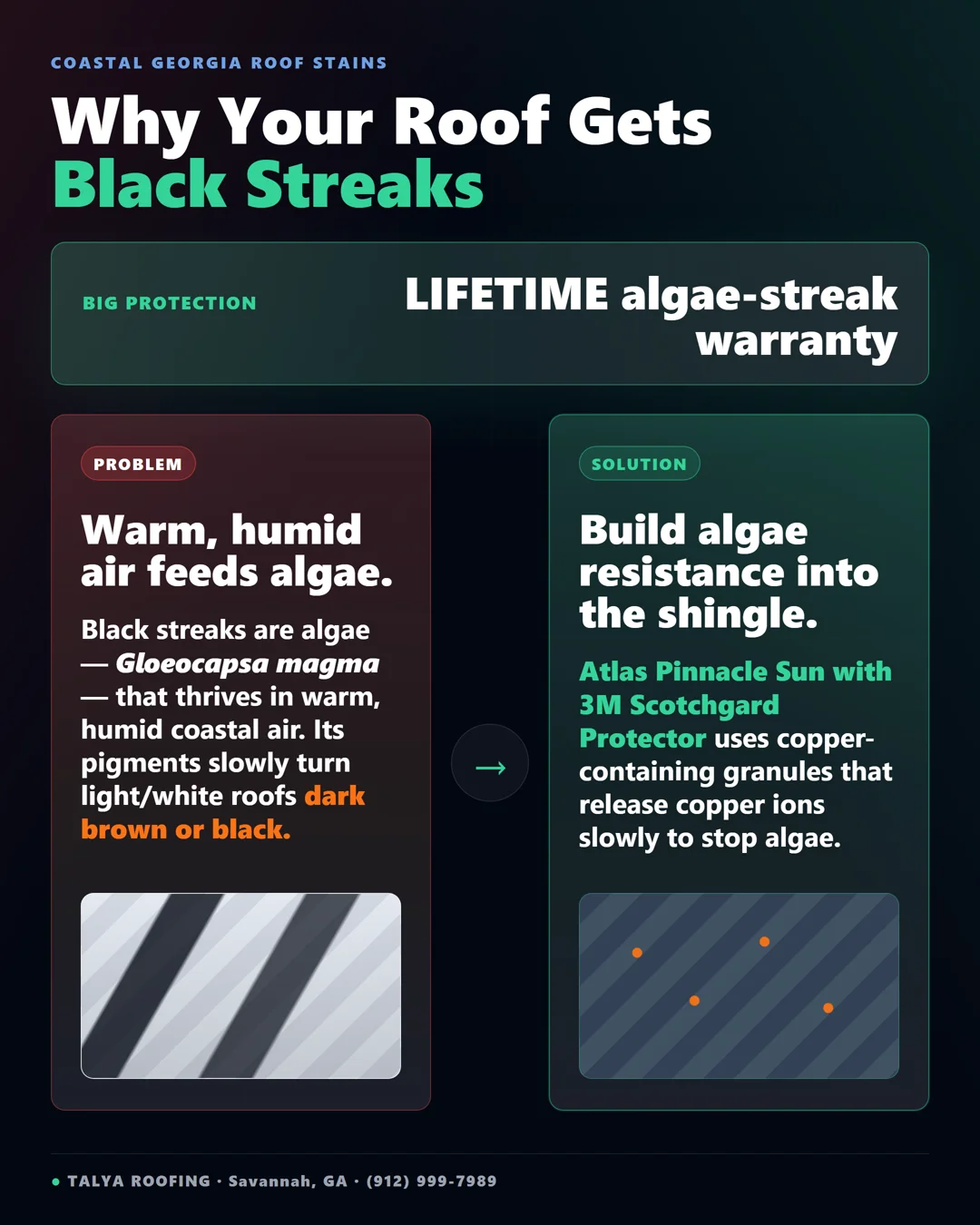
- Black streaks are algae, most prevalent in warm humid Gulf States regions, and far less visible on darker shades (ARMA).
- The Savannah-smart pick is a darker cool-color shingle with reflective granules plus algae-resistant copper granules.
- Historic District color changes visible from the public right-of-way require a Certificate of Appropriateness (MPC Design Manual).
| Roof color approach | Typical sunlight reflected | Algae streak visibility | Coastal GA fit |
|---|---|---|---|
| White / very light | ~60–90% | Most visible | Coolest, but streaks show worst |
| Cool-colored (incl. darker) | ~30–60% | Lower on darker shades | Best overall balance |
| Conventional dark (non-cool) | Low | Least visible | Hides streaks, absorbs most heat |
Reflectance ranges per U.S. DOE Energy Saver; streak visibility per ARMA.
Does roof color actually affect how hot my house gets?
Yes. According to the U.S. DOE Energy Saver, a cool roof reflects more sunlight and sheds more heat, so it absorbs less solar energy than a conventional dark roof. A dark roof can reach 150°F on a sunny summer afternoon, while a reflective cool roof can stay more than 50°F cooler. That temperature gap matters in Coastal Georgia, where the cooling season is long and the sun is relentless from late spring into fall. The performance is described by two properties: solar reflectance, the share of sunlight bounced away, measured on a 0-to-1 scale, and thermal emittance, how efficiently the surface releases the heat it does absorb. A roof that scores high on both runs cooler.
The comfort and energy effects are measurable indoors. The U.S. EPA reports that in air-conditioned homes, cool-roof reflectance can cut peak cooling demand by 11 to 27 percent, and in non-air-conditioned homes it can lower maximum indoor temperatures by 1.2 to 3.3°C (2.2 to 5.9°F). The LBNL Heat Island Group, via ENERGY STAR, found a white roof reflecting 80 percent stays about 50°F cooler than a grey roof reflecting 20 percent on a summer afternoon. ENERGY STAR also notes cool roofs save the most in hot, sunny climates like the Southern U.S. and on low-insulation roofs — a description that fits much of our housing stock. If a cooler, more efficient home is the goal, color and reflectance are levers worth pulling. You can dig deeper into the energy side in our energy-efficient roofing guide.
Source: U.S. DOE Energy Saver — Cool Roofs
What is a cool roof, and does it have to be white?
No, a cool roof does not have to be white. The U.S. DOE Energy Saver explains that cool-colored products use reflective pigments and granules so a darker-looking shingle still stays cooler and transfers less heat. White roofing reflects roughly 60 to 90 percent of sunlight, while cool-colored products typically reflect about 30 to 60 percent. A cool roof is defined by performance, not paint color. The science is in the granules: special reflective pigments bounce away a large share of the near-infrared sunlight that carries most of the sun's heat, even when the visible color reads as a deep charcoal or brown to the eye.
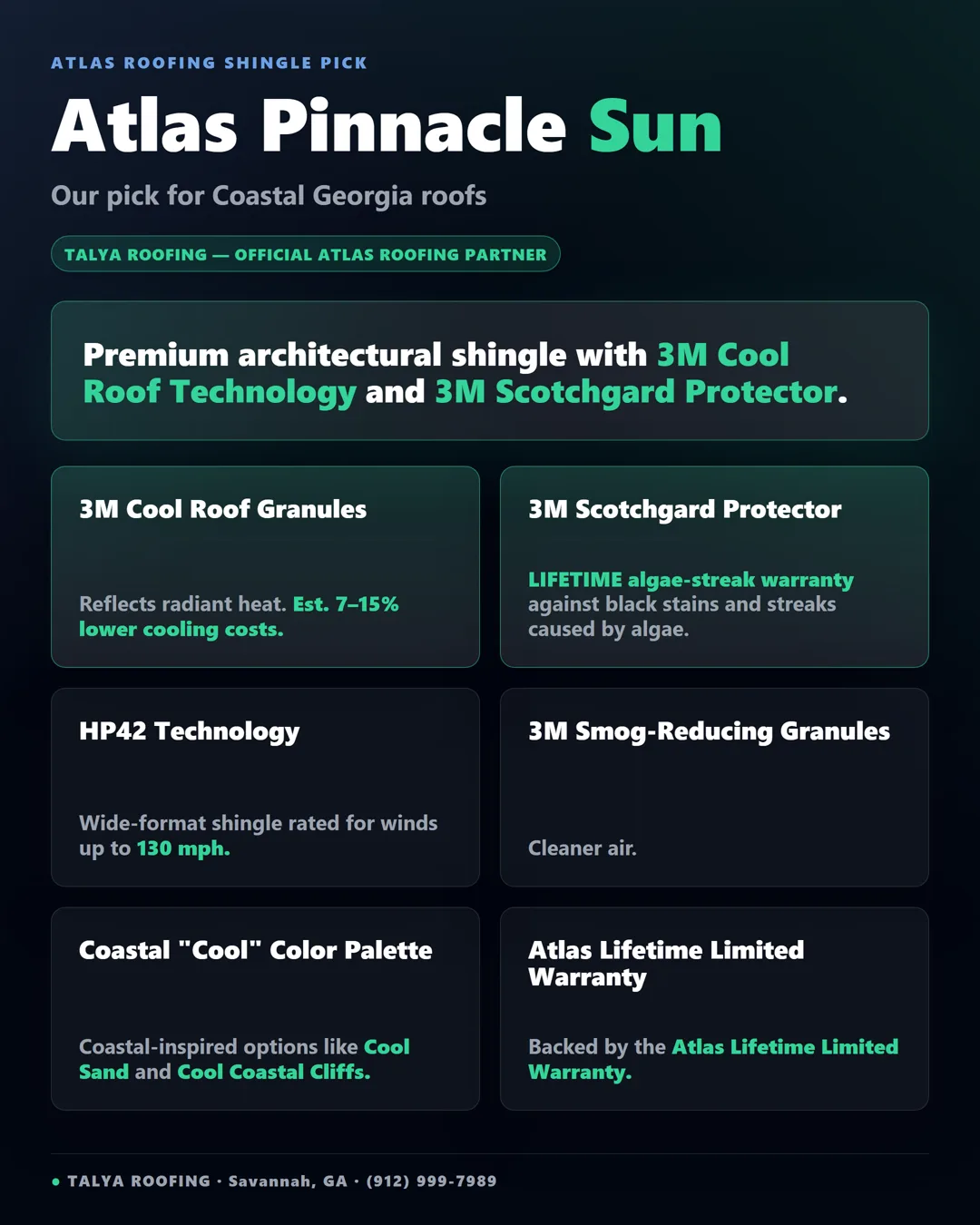
That distinction is the key to choosing well in Savannah. You do not have to accept a glaring white roof to gain heat performance, and you do not have to accept maximum heat absorption to get a darker, more traditional look. Cool-color asphalt shingles let you keep an appearance compatible with our neighborhoods while still cutting solar gain. Manufacturers have built whole product lines around this, such as Atlas Pinnacle Sun, which pairs a darker, coastal-inspired look with 3M Cool Roofing Granules, and the reflective-pigment mechanism is consistent across brands. For a broader look at which shingle families perform best in our climate, see our best roof shingles for Coastal Georgia guide, and explore options on the Atlas shingle lineup.
Source: U.S. DOE Energy Saver — Cool Roofs
Can I get heat savings without a white roof in Coastal Georgia?
Yes. Cool-color shingles use reflective pigments and granules so a darker-looking shingle still stays cooler and transfers less heat than a conventional dark shingle, per the U.S. DOE Energy Saver. You capture meaningful reflectance — typically in the ~30 to 60 percent range for cool-colored products — without committing to a stark white roof. For Coastal Georgia, this is the sweet spot. ENERGY STAR notes cool roofs deliver the biggest savings in hot, sunny Southern climates and on roofs with lower insulation, both of which describe a lot of homes around Savannah and the surrounding coast.
A concrete example helps. Atlas Pinnacle Sun uses 3M Cool Roofing Granules and 3M Cool Roof Technology to reflect the sun's radiant heat — proof that a darker-looking architectural shingle can still qualify as a verified cool roof once you confirm its CRRC reflectance and emittance numbers. That means you can specify a deep, neighborhood-appropriate color and still document real reflectance and emittance numbers from an independent rating body. When you plan a roof replacement, ask specifically for cool-color products with published CRRC ratings rather than relying on the color name alone. Homeowners across Savannah increasingly choose this path because it respects both the energy bill and the look of the street.
Source: ENERGY STAR — Roof Products
Why does my roof get black streaks, and does color help?
Those black streaks are algae — most prevalently Gloeocapsa magma, a blue-green algae that ARMA reports is most widespread in the warm, humid Gulf States. ARMA notes streaking is most visible on light-colored roofs and far less visible on darker shades, and that algae pigments can turn white or light roofs dark brown or black over time. This is the other half of the Coastal Georgia equation. Our humidity, shade trees, and long warm season create near-ideal conditions for algae, which is why so many local roofs develop that dingy, streaked look within a few years.
Color absolutely plays a role in how visible the problem becomes — a key reason the pure-white-for-heat strategy backfires here. A white or very light roof shows every streak, while a darker shade camouflages it. Better still, ARMA notes algae-resistant shingles exist: they embed copper, and sometimes zinc, granules that release copper over time to inhibit growth. Atlas Pinnacle Sun, for example, carries 3M Scotchgard Protector — copper-containing granules that release copper ions over time — backed by a lifetime limited warranty against black stains and streaks caused by algae. Combining a darker cool-color with algae resistance attacks the streaking from two directions at once. For the full cleaning-versus-prevention breakdown, read our guide to black streaks on Savannah roofs.
Source: Asphalt Roofing Manufacturers Association (ARMA)
So what is the best roof color for Coastal Georgia?
For most Coastal Georgia homes, the best choice is a darker cool-color, algae-resistant shingle. It captures real reflectance from cool-color granules (DOE Energy Saver), while the darker shade and copper-based algae resistance keep the streaking that thrives in our humidity far less visible (ARMA). It is the balance, not either extreme. Going pure white maximizes heat reflection but maximizes streak visibility in our climate; going conventional dark hides streaks but absorbs the most heat. A darker cool-color shingle threads the needle.
Think of it as stacking two technologies on one shingle. The reflective pigments handle the sun — a darker-looking shingle that still stays cooler and transfers less heat than a standard dark shingle. The 3M Scotchgard Protector granules handle the algae, with Atlas backing streak resistance through a lifetime limited warranty against black algae stains and streaks. Layered over our long, hot, humid season, that combination delivers a roof that runs cooler than a plain dark roof and stays cleaner-looking than a light roof. When you scope a roof replacement, the spec to request is straightforward: a deeper-toned, CRRC-rated cool-color shingle with built-in algae resistance. That single sentence captures the best-of-both-worlds answer for our region.
Source: U.S. DOE Energy Saver — Cool Roofs
Are there color rules in Savannah's Historic District?
Yes. Per the MPC Design Manual, roofs in the Savannah Historic District must be standing-seam metal, slate, tile, or asphalt shingles, and must be visually compatible with contributing buildings. Exterior changes visible from the public right-of-way — including a roof replacement or color change — require a Certificate of Appropriateness (COA). If your home sits within the district, color is not a purely personal decision. The material and the shade both need to fit the historic character of the surrounding streetscape, and the change has to clear review before work begins.
This does not rule out a smart, performance-minded color choice — it simply adds a step. Cool-color asphalt shingles in deeper, traditional tones are often a natural fit because they read as historically appropriate while still delivering reflectance benefits. The practical move is to confirm the COA requirement and the compatibility expectations early, before you fall in love with a specific color, so you do not have to redo a selection later. Our team handles district paperwork regularly; for the full process, see our guide to Historic District roofing rules.
Source: Metropolitan Planning Commission (MPC) Design Manual
How do I verify a shingle is a real cool roof?
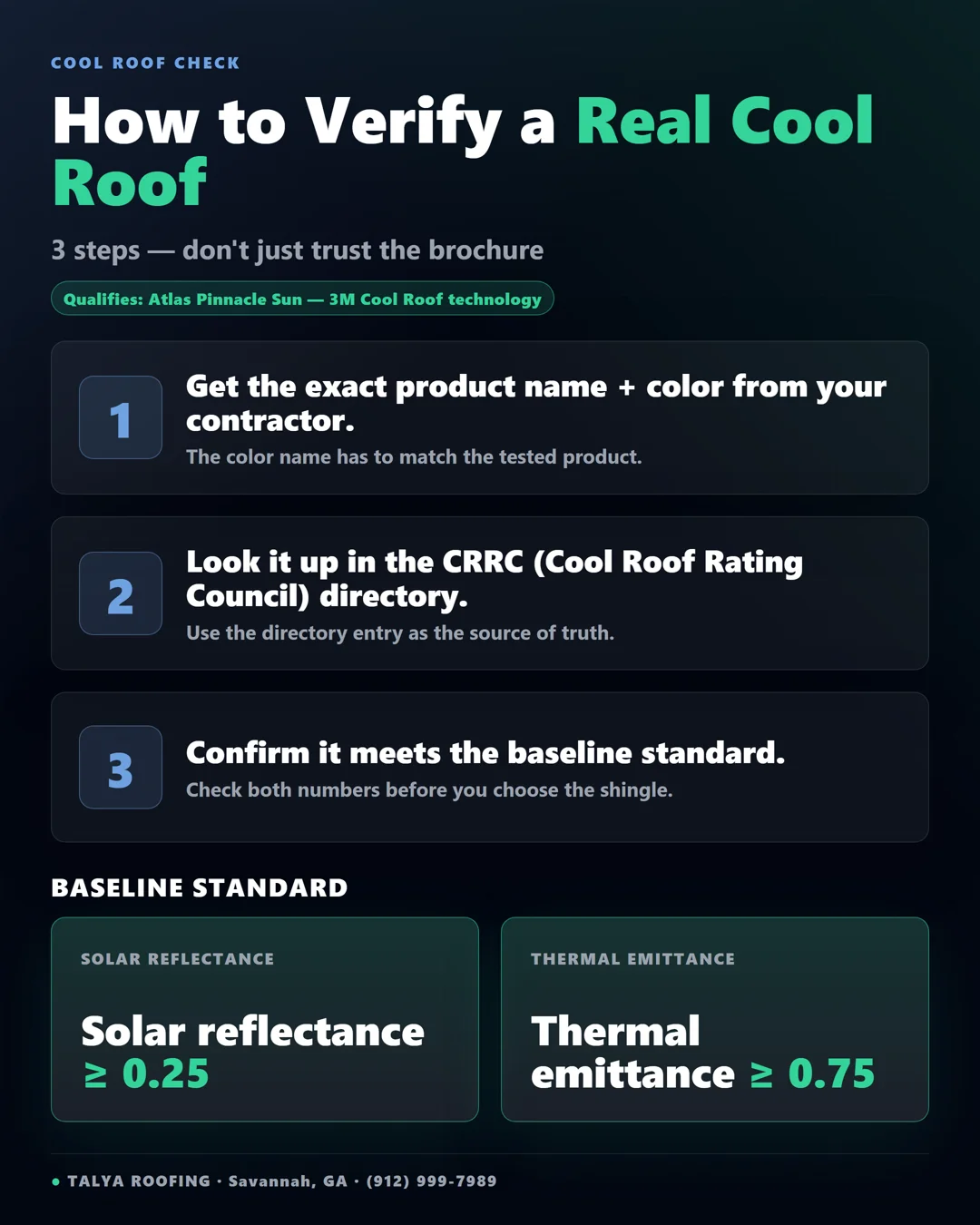
Check the product against the Cool Roof Rating Council (CRRC) directory. The U.S. EPA notes the CRRC rates products' solar reflectance and thermal emittance and maintains a public directory. A practical baseline for an effective cool-roof material is solar reflectance around 0.25 or higher and thermal emittance around 0.75 or higher. Treat that 0.25 figure as a baseline reference, not a building-code number — actual code thresholds vary by jurisdiction and roof type. The point is to verify performance with independent data rather than trusting a "cool" label on a brochure.
Here is the simple verification workflow. First, get the exact product and color name from your contractor. Second, confirm it appears in the CRRC directory with published reflectance and emittance values. Third, sanity-check those numbers against the baseline so you know the cool-color claim is real. A cool-color shingle like Atlas Pinnacle Sun, built with 3M Cool Roof Technology, illustrates what a properly documented cool roof looks like once you confirm its CRRC numbers. We walk every customer through this during a roof replacement consultation so the color you choose has the performance to back it up. Have a product in mind already? Contact our team and we will pull the rating for you.
Source: U.S. EPA — Cool Roofs
Which roof color is best for resale in Savannah?
For broad buyer appeal, neutral roof colors — black, charcoal or gray, brown, taupe, and beige — are generally considered the safest choices. They tend to read as classic and uncontroversial to the widest range of buyers, which keeps your options open if you sell. This is a soft, qualitative guideline rather than a guarantee, and it happens to align well with the heat-plus-algae answer for our climate, since most cool-color algae-resistant shingles come in exactly these neutral, deeper tones.
That alignment is convenient. A charcoal or deep brown cool-color shingle satisfies the energy case, hides algae streaking, and stays within the neutral palette buyers find easy to accept — and it tends to suit the look of established Savannah neighborhoods. There is no need to gamble on a bold or unusual roof color to stand out; in roofing, durability, clean appearance, and verified performance carry far more weight than novelty. Choose a neutral, deeper cool-color with algae resistance and you have covered heat, humidity, curb appeal, and resale in one decision.
Not sure which roof color fits your home?
Our Coastal Georgia roofing team can show you cool-color, algae-resistant shingle samples and review available CRRC ratings as part of a proposed replacement project. Historic-district requirements and approvals remain with the applicable authority.