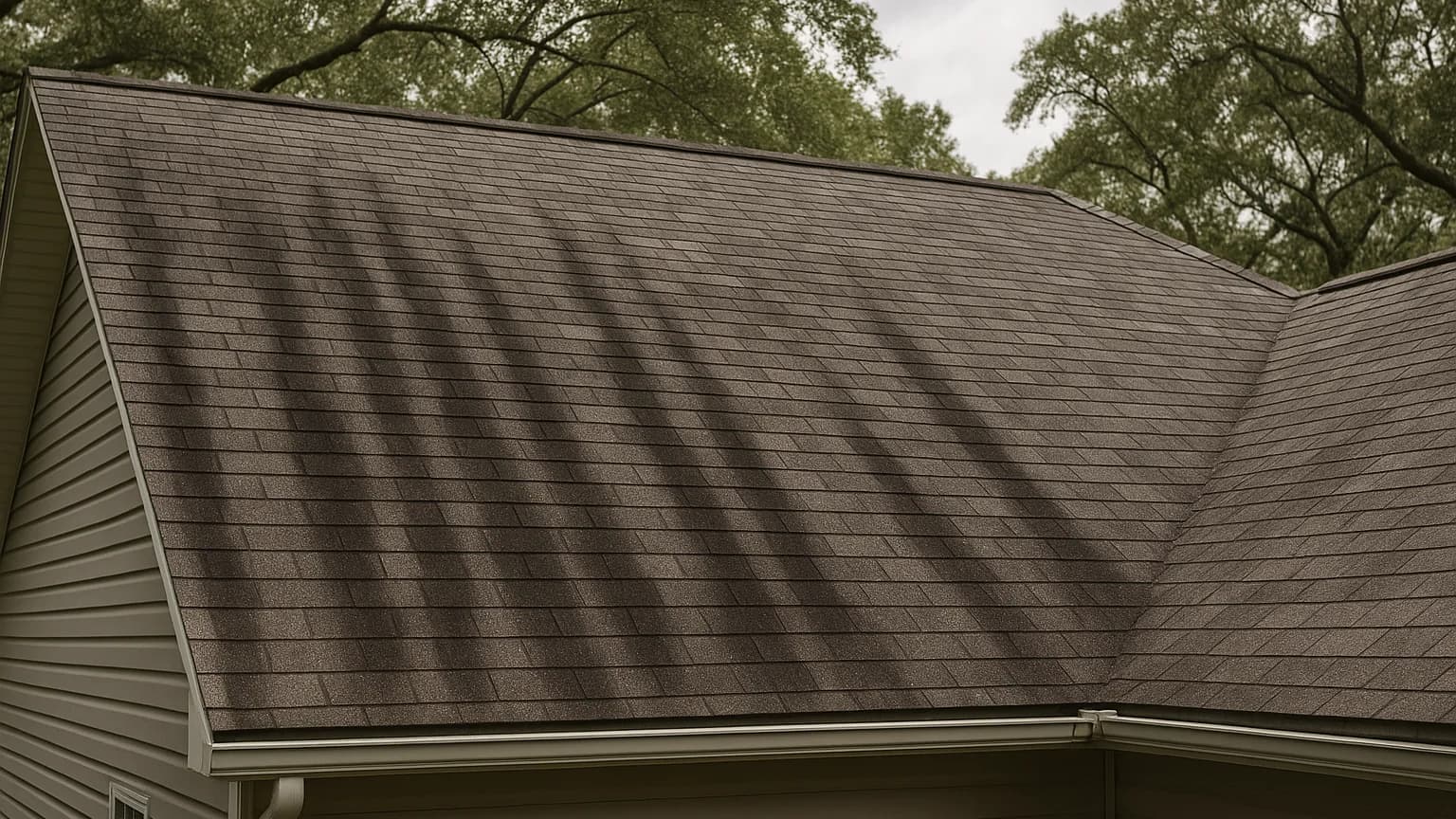

If you have looked up at your home and noticed dark, dripping stains running down the shingles, you are not alone. Black streaks are one of the most common roof complaints we hear from homeowners across Savannah and Coastal Georgia. The good news: they are almost always cosmetic at first, they can be removed safely, and there is a permanent way to stop them from coming back. This guide explains exactly what those streaks are, how to clean them without wrecking your roof, and how to keep them gone for good.
Key Takeaways
- The black streaks are Gloeocapsa magma, a blue-green algae — not dirt, soot, or mildew.
- It looks black because the algae forms a dark, UV-protective pigmented sheath.
- In our local inspections, north- and east-facing slopes and live-oak-shaded roofs streak first; Coastal GA humidity makes it near-universal.
- Never pressure-wash an asphalt roof — ARMA warns it causes granule loss and very likely premature roof failure.
- ARMA's safe method: a 50:50 chlorine bleach and water mix, 15-20 minute dwell, then a low-pressure rinse.
- Algae-resistant shingles with copper granules — like Atlas shingles with 3M Scotchgard — stop streaks at the source.
What are the black streaks on my Savannah roof?
The streaks are not dirt or mildew — they are Gloeocapsa magma, a blue-green algae (a cyanobacteria) that the Asphalt Roofing Manufacturers Association calls probably the most prevalent roof-discoloration species. It appears black because the organism forms a dark, pigmented sheath that protects it from sunlight.
It is a common mistake to assume the dark stains are dirty rainwater runoff, soot from a chimney, or simple mold. In reality, you are looking at a living colony. The algae produces a protective outer layer — a pigmented sheath that shields it from ultraviolet light. That sheath is what gives the streaks their distinctive dark, sometimes nearly black, appearance. The colony spreads as airborne spores land on the roof, take hold in damp spots, and grow downward with gravity and water flow, which is why the stains so often look like vertical streaks cascading down the slope.
Because it is biological, the discoloration will keep spreading and darkening over time if nothing is done. While the staining is primarily a cosmetic and curb-appeal problem in its early stages, a heavy, long-standing colony holds moisture against the shingle surface, which is never ideal in a climate as wet as ours. Understanding that this is algae — not grime — is the first step, because it completely changes how you should clean it and how you prevent it from returning.
Source: Asphalt Roofing Manufacturers Association — Algae Discoloration of Roofs
Why do Savannah roofs streak so badly?
Coastal Georgia is close to a perfect habitat for roof algae: it thrives in hot, humid conditions, spreads by airborne spores, and Atlas Roofing's "algae danger zone" includes the Southeast and Gulf — putting Savannah firmly in the high-risk band. Our heat and humidity make streaking near-universal here.
Algae needs three things to flourish: moisture, warmth, and a food source. Savannah and the surrounding coast deliver all three in abundance. Long, muggy summers keep roof surfaces warm and damp, and frequent rain and high humidity mean shingles often do not get a chance to fully dry out. According to Atlas Roofing, fiberglass-based asphalt shingles also hold moisture longer, and the algae feeds on the limestone (calcium carbonate) filler used in asphalt shingles. That combination of climate and shingle chemistry is exactly why so many roofs in our area stain.
Here is the local pattern we see again and again in the field. In Talya's Savannah inspections, the north- and east-facing slopes are the first to streak, along with any roof shaded by live-oak canopy. Those areas get the least direct sun, so they stay damp the longest after rain and dew — giving the algae the persistent moisture it craves. Sunnier southern and western slopes that dry out quickly usually hold out longer before showing visible discoloration. If you live under mature oaks in a neighborhood like Ardsley Park or out toward the islands, expect the shaded sides to need attention first. You can learn more about our coverage on our Savannah roofing page and our Tybee Island service area, where salt air and shade compound the problem.
Source: Atlas Roofing — Entering the Algae Danger Zone
Will pressure washing remove the black streaks?
No — and it is one of the worst things you can do. ARMA is explicit that pressure washing an asphalt roof will cause granule loss and very likely premature failure of the roof system. The only safe water method for removing algae is a low-pressure rinse, never a high-pressure blast.
It is tempting to point a pressure washer at the stains and watch them disappear, and plenty of well-meaning homeowners and even some uninsured "cleaners" do exactly that. The problem is what you cannot see happening: the high-pressure water tears the protective mineral granules off the shingle surface. Those granules are the shingle's armor against ultraviolet light and weather. Strip them away and you accelerate aging, expose the asphalt to the sun, and can shorten the life of the entire roof — turning a cosmetic issue into an expensive one.
You may also void portions of your shingle warranty by cleaning improperly, and a pressure washer in inexperienced hands can drive water under the shingles and into the deck. The safe path is the opposite of brute force: a gentle, low-pressure rinse combined with the right cleaning solution does the work chemically, not mechanically. If a contractor proposes to "pressure wash" your roof, treat it as a red flag and ask how they plan to protect the granules. If you are already seeing bare patches or granules in your gutters, have us take a look through our roof repair service before any cleaning begins.
Source: Asphalt Roofing Manufacturers Association — Cleaning Guidance
How do I safely remove black streaks from my roof?
ARMA's recommended method is a 50:50 mixture of chlorine bleach (sodium hypochlorite) and water, applied with a sprayer, left to dwell for 15 to 20 minutes, and then rinsed off with low-pressure water. Your shingle manufacturer's mixing directions always take precedence over the general ratio.
The chemistry does the heavy lifting so the water pressure does not have to. The diluted sodium hypochlorite solution kills the algae colony during the dwell time, and the subsequent low-pressure rinse simply flushes away the dead organism and loosened staining. The dwell window matters — too short and the solution has not done its job; letting it sit and work is the whole point. After rinsing, the roof should look dramatically cleaner, though faint shadowing can linger and fade over the following weeks.
That said, this is genuinely hazardous work. You are mixing chemicals, walking a sloped and now-slippery surface, managing a ladder, and protecting the plants, gutters, and siding below from bleach runoff. For most homeowners in our area, the safest and most cost-effective choice is to hire an insured roofing professional who follows the manufacturer's directions and the ARMA guidance. We treat algae and moss together as part of a coastal-home maintenance plan — see our companion guide on roof cleaning and moss removal for coastal homes for the full picture. If you would rather not climb up at all, our team can handle it safely.
| Method | Safe for asphalt shingles? | Removes existing stains? | Prevents regrowth? |
|---|---|---|---|
| Pressure washing | No — causes granule loss | Yes, but damages the roof | No |
| Bleach solution + low-pressure rinse (ARMA) | Yes | Yes | No — algae returns over time |
| Zinc / copper strips | Not recommended as a retrofit | No | Yes — preventative only |
| Algae-resistant (AR) shingles | Yes — built in | N/A (new roof) | Yes — from day one |
Do zinc or copper strips stop roof algae?
Metal strips help prevent future growth but cannot remove existing stains, so you must clean the roof first. They work by leaching copper or zinc ions into rainwater, which coat the granules and suppress algae. Importantly, ARMA does not recommend retrofitting strips to an existing roof.
The science behind the strips is straightforward. When rain hits a strip of copper or zinc installed near the ridge, tiny amounts of metal ions dissolve into the runoff and wash down the slope. Those ions are toxic to algae, so as the water spreads across the shingles it leaves behind a thin protective film that discourages new colonies from taking hold. It is a preventative measure, not a corrective one — the strips do nothing to stains that already exist, which is why cleaning has to come first.
The catch is installation on a roof that is already in place. To fit strips to an existing roof, a contractor must either drive exposed nails through the shingles — which creates a path for leaks — or break the factory sealant bond between courses, which compromises wind resistance. For those reasons, ARMA does not recommend retrofitting strips to a finished roof. If your roof is nearing the end of its life anyway, you are far better served by building algae resistance into the shingles themselves rather than bolting on a partial fix.
What are algae-resistant shingles and do they work?
Algae-resistant (AR) shingles have copper granules embedded across the shingle so that protective ions release with every rainfall, suppressing algae growth from the day the roof goes on. They are the most reliable long-term defense against streaking in a humid climate like ours.
Instead of relying on a strip at the ridge, AR shingles distribute the copper protection across the entire surface. As rain washes over the roof, the copper continuously releases ions that keep algae from establishing a foothold — the same principle as the strips, but engineered into the shingle and spread evenly across every course. That is a far better fit for Coastal Georgia, where shaded slopes and constant humidity give algae every opportunity to return after a cleaning.
The major manufacturers each offer their own AR technology and warranty. CertainTeed's StreakFighter uses copper granules with an algae warranty of 10 or 15 years depending on the product. GAF's StainGuard Plus uses time-release copper microsites and carries a 25-year limited warranty (with a 30-year term on StainGuard Plus PRO) and a 10-year non-prorated period. And Atlas shingles with 3M Scotchgard Protector carry a lifetime algae-resistance limited warranty on qualifying single-family detached homes. For a deeper comparison of how these lines hold up locally, see our guide to the best roof shingles for Coastal Georgia.
Source: Atlas Roofing — Algae Resistance & 3M Scotchgard
Which algae-resistant shingle is right for my home?
The best choice comes down to the algae warranty term and how the shingle fits into a full replacement. For most Coastal Georgia homeowners we recommend Atlas shingles with 3M Scotchgard, which carry a lifetime algae-resistance limited warranty on qualifying single-family detached homes — the strongest protection of the three.
All three of the major AR lines will outperform a standard, non-AR shingle in our climate, so any of them is a defensible upgrade. The differences come down to the length and structure of the algae warranty and how the shingle pairs with the rest of the roofing system you are installing. A shorter 10- or 15-year term may be perfectly fine if you do not plan to stay in the home long, while a lifetime limited warranty offers the most peace of mind for a forever home under heavy oak shade.
Here is the comparison we walk Savannah homeowners through:
| Shingle line | Algae-resistance tech | Algae warranty |
|---|---|---|
| CertainTeed StreakFighter | Copper granules | 10 or 15 years (by product) |
| GAF StainGuard Plus | Time-release copper microsites | 25-year limited (30-year on Plus PRO); 10-year non-prorated |
| Atlas with 3M Scotchgard | 3M Scotchgard granules | Lifetime limited (qualifying single-family detached homes) |
Because the algae-resistance warranty rides along with the shingle you choose, the cleanest time to upgrade is during a planned roof replacement. If your current roof is aging, our roof replacement team can spec an AR system end to end. To dig into the Atlas lineup specifically, visit our Atlas shingles page.
Is it worth replacing my roof to stop the streaks?
If your shingles are aging and heavily streaked, cleaning will buy you time but the stains will inevitably return on a non-algae-resistant roof. Pairing a roof replacement with algae-resistant shingles solves both the root cause and the curb-appeal problem in a single project.
Think of it as a question of timing. A roof that is only a few years old and lightly stained is a clear candidate for a professional cleaning — there is no reason to replace good shingles. But a roof that is already nearing the end of its service life, covered in dark streaks, and shedding granules is sending a different signal. In that case, spending money to clean a roof you will replace within a few years is rarely the best value, especially when the algae will simply grow back on the same non-AR shingles.
When you do replace, building algae resistance into the new roof means you never fight these streaks again. That is the permanent fix: instead of a recurring cleaning bill every few years, the copper-bearing granules quietly do their job with every Coastal Georgia rainstorm. Our team will give you an honest assessment of whether your roof is a clean-it or a replace-it situation — we would rather you clean a roof that has years of life left than oversell a replacement. Reach out through our contact page and we will take a look.
Tired of looking at black streaks on your roof?
Talya Roofing assesses proposed cleaning or replacement projects across Savannah and Coastal Georgia. Request a complimentary project assessment and estimate; a homeowner inspection report is a separate $250 documented service.
Considering a treatment for aging asphalt shingles? Review our Savannah guide to roof rejuvenation evidence and warranty questions before making a decision.