
Key Takeaways
- ✓ Georgia licenses public adjusters. Talya Roofing is not one. We photograph visible roof conditions, provide measurements and an itemized construction estimate, and can attend an on-site adjuster meeting when requested to explain our repair scope. You file; your carrier decides coverage and payment.
- ✓ Four storms are documented in the Richmond Hill storm record since 2016 — and they did not all damage roofs the same way.
- ✓ Hurricane Helene (September 2024) was overwhelmingly tree strike here. Hurricane Idalia (August 2023) was starter-strip uplift. Thirteen months apart, two different inspections.
- ✓ The City of Richmond Hill's residential permit packet requires plans designed to meet the 130 mph wind zone — a city requirement, not drawn along the county line.
- ✓ Documentation you may already own: your Richmond Hill Business Development permit, the final-inspection certificate of completion, and dated photos of the roof while it is still intact.
What can a Richmond Hill roofer actually do on a roof insurance claim?
A roofing contractor can document, measure and estimate — nothing more. In Richmond Hill we photograph visible roof conditions, provide measurements and an itemized construction estimate, and can attend an on-site adjuster meeting when requested to explain our repair scope. The policyholder files the claim. The carrier decides coverage and payment.
That boundary is not a disclaimer we bolted on — it is Georgia law. The state licenses public adjusters, and a roofing contractor who adjusts or argues a claim without that license is breaking it. So when a company promises a Bryan County homeowner a specific payout, or offers to take the whole claim off their hands, it is describing work it is not licensed to perform and an outcome that is not its to promise.
What we actually do is narrower and more useful. We perform a physical, on-roof assessment when access and conditions are safe. We photograph what is visible. We take measurements. We write an itemized construction estimate for your records. If tear-off later reveals hidden decking conditions, we document those too — you decide whether and how that goes to your carrier. And when you ask us to, we can be on the roof during the adjuster's visit to explain what our scope covers and why. If you need claim advocacy, that role belongs to a licensed public adjuster or an attorney. Our full roof damage documentation service for Coastal Georgia sets out exactly where our work stops.
Which Bryan County storms damaged Richmond Hill roofs, and how?
Four storms are documented in the Richmond Hill storm record since 2016. Matthew, Irma, Idalia and Helene. Three are classified as wind events; Helene is classified as a tree strike. Those two classifications do not leave the same signature on a Richmond Hill roof, and they do not call for the same inspection.
Matthew brushed Coastal Georgia as a Category 1-2 on October 7-8, 2016, with tropical-storm-force winds across Bryan County; older 4-nail subdivision roofs along the I-95 corridor lost ridge caps and starter strips by the dozen, and the pine canopy over Richmond Hill Plantation and Belfast Keller dropped enough limbs to keep tree crews busy for weeks. Irma, on September 11, 2017, covered the county in tropical-storm-force winds, and oak strikes on older Richmond Hill streets plus pine snapping toward the Belfast River drove most residential claims.
Then the pattern shifted. Idalia made a Category 3 landfall in Florida's Big Bend on August 30, 2023, and tracked across south Georgia; newer subdivision roofs along the I-95 and Highway 17 corridor — many on builder-grade shingles applied with the older nailing schedule — saw widespread shingle uplift across Bryan and Effingham. Helene, on September 26-27, 2024, made a Category 4 Big Bend landfall and carried devastating tree damage inland as far as Augusta. Pine snapping was the dominant rural damage mode across Bryan, Bulloch and Effingham, and the heavily wooded Richmond Hill Plantation and Belfast Keller subdivisions took repeated pine strikes through the night.
| Storm | Date | Damage type | What it did to Richmond Hill roofs |
|---|---|---|---|
| Matthew | Oct 7-8, 2016 | Wind | Cat 1-2 brush, tropical-storm-force winds. Ridge caps and starter strips off older 4-nail roofs along I-95; heavy pine limb drop. |
| Irma | Sep 11, 2017 | Wind | Oak strikes on older streets; pine snapping toward the Belfast River. |
| Idalia | Aug 30, 2023 | Wind | Widespread shingle uplift on builder-grade 2000s roofs along the I-95 / Hwy 17 corridor. Starter strip fails first. |
| Helene | Sep 26-27, 2024 | Tree strike | Pine snapping dominant rural mode across Bryan, Bulloch and Effingham. Repeated pine strikes in Richmond Hill Plantation and Belfast Keller. |
How is a tree-strike roof claim different from a wind-uplift claim in Richmond Hill?
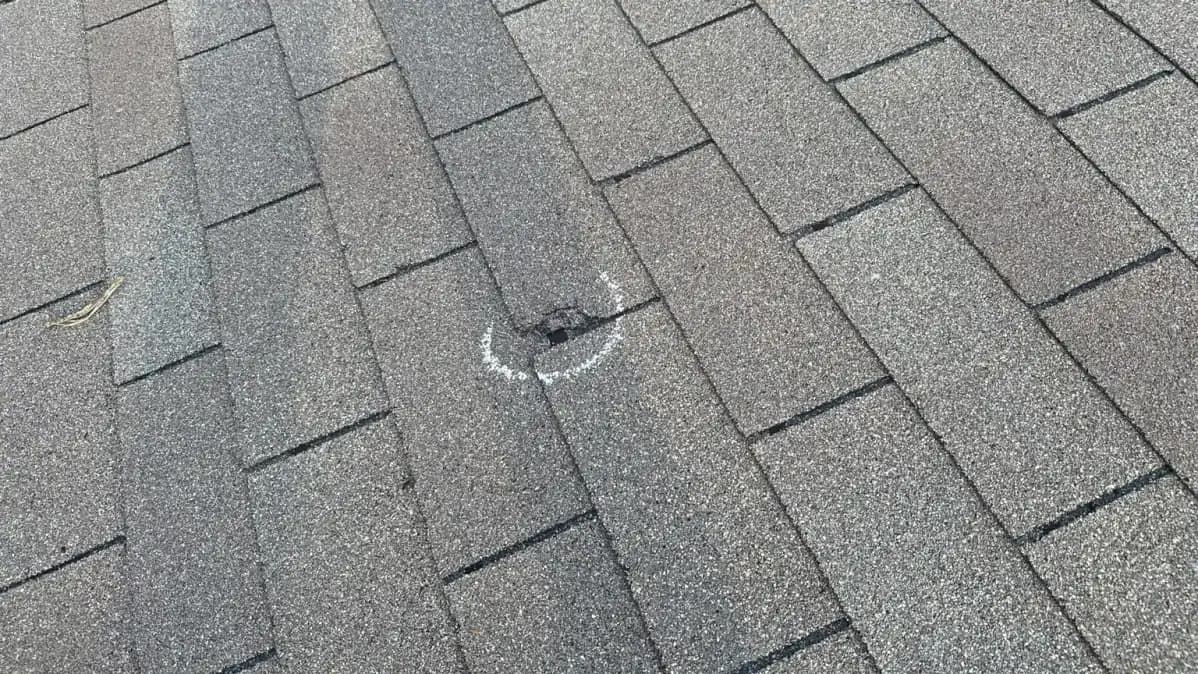
A tree strike is a single dated point of impact; wind uplift is diffuse and sits at the eaves. The pine through your deck is obvious. Starter-strip uplift is the opposite — nothing looks wrong from the driveway, and the evidence sits along the eave line.
Helene is this market's tree-strike example: the heavily wooded Richmond Hill Plantation and Belfast Keller subdivisions took repeated pine strikes through the night. For tree strikes we can coordinate with a local tree crew so debris removal does not delay the roof assessment.
Idalia is the other version. Builder-grade roofs in 2000s Bryan County subdivisions often fail at the starter strip first, and a homeowner in Sterling Creek or Belfast River can stand in the driveway looking at a roof that appears entirely intact. What we find is lifted starter strips at the eaves, backed-out fasteners, and ridge-cap granule loss — small, quiet conditions that are genuinely hard to see from the ground. That is why our documentation for a wind event is a physical, on-roof assessment of safely accessible areas with annotated photographs. Our storm damage roof repair process covers both modes.
What does storm damage look like on a 1990s-2000s Richmond Hill subdivision roof?
It usually looks like nothing, until you are standing on it. Across Buckhead South, the Belfast River neighborhoods, Sterling Creek and Richmond Hill Plantation, the conditions we find most often are lifted starter strips at the eaves, backed-out fasteners, ridge-cap granule loss, and algae on shaded slopes.
Bryan County has been one of Georgia's fastest-growing counties for two decades, and that growth created a very specific roofing cohort: thousands of homes built roughly between 1995 and 2008 inside ZIP 31324, most of them running original builder-grade 3-tab, all reaching their 20-25 year reroof window at the same time. Those are the roofs Idalia found.
Local conditions stack on top of that. Richmond Hill takes 49 inches of rain a year, the Ogeechee River wraps the south side and the Belfast River cuts in from the east, and morning fog sits heavier here than across the rest of Bryan County. Add the pine canopy shading the Plantation and Belfast Keller subdivisions and you get sustained moisture on shaded slopes, which is why algae streaking is such a common finding in 31324 and why we default to algae-resistant architectural shingles on Richmond Hill replacements. Algae is not storm damage and should never be presented as such — but it does sit in the same photographs, and knowing which is which is exactly the distinction a written report should draw for you. There is more background on the local building stock in our Bryan County homeowner roofing guide.
Does the 130 mph wind zone on a Richmond Hill permit matter to a claim?
It governs how the roof should have been built, not what your policy pays. Inside city limits, the City of Richmond Hill's residential permit packet requires plans designed to meet the 130 mph wind zone (unincorporated parcels confirm their figure with Bryan County), and Bryan County enforces the 2018 Georgia Building Code with 2024 amendments. Those criteria shape the permitted attachment schedule — coverage decisions remain entirely with your carrier.
One correction worth making, because it gets repeated constantly in roofing marketing: this is not "a 130 mph county." ASCE 7 design wind speeds are continuous geographic contours mapped to the site, which is why two homes inside the same Georgia county can legitimately carry different design criteria. The verified figure is the City of Richmond Hill permit packet's 130 mph wind zone, which applies inside city limits; unincorporated 31324 parcels confirm theirs with Bryan County. Do not let anyone transfer a neighbouring town's number onto your property, in either direction.
What the criterion actually drives is the attachment detail. For the city's 130 mph wind-zone requirement, the permitted attachment schedule depends on the selected product approval and installation instructions, the roof deck, the roof zones, exposure and other site design criteria, and the applicable adopted code. Our written scope identifies the quoted fastening and starter details so a homeowner can compare them against the product documents and the permit. That is a construction question with a documentable answer — unlike coverage, which is a policy question and belongs to your carrier. If you need the mechanics of filing itself, our step-by-step Georgia roof claim walkthrough covers deadlines, deductibles and valuation.
What roof records should a Bryan County homeowner keep before the next storm?
The permit, the certificate of completion, and dated photographs of an intact roof. Every full replacement inside Richmond Hill city limits and across unincorporated Bryan County requires a permit through the Richmond Hill Business Development office. Permits typically clear in 3-5 business days, and the certificate of completion stays useful for years.
We pull the Bryan County permit on your behalf, schedule the final inspection, and provide the certificate of completion for your records. That matters on resale — Richmond Hill homes change hands often inside the Fort Stewart and Hunter Army Airfield housing market, and PCS season runs hard from May through August — and it gives you a dated, third-party-inspected record of what the roof was before anything happened to it. Whether a carrier finds that record useful is the carrier's call under your policy; what we can tell you is what the file contains.
The second record is photographs of the roof while it is still fine. A written homeowner inspection is a separate $250 documented service covering a physical, on-roof assessment of safely accessible areas, annotated photographs, documented limitations, and practical next steps. For context on the construction side of the ledger, most Richmond Hill replacements land between $8,500 and $17,000 depending on square footage, pitch and material; architectural shingles run $4-$7 per sq ft installed, and standing seam metal — common on the Ford Plantation adjacency — runs $10-$16 per sq ft. Those are construction prices, not claim outcomes, and the quote states its validity period.
What has Talya actually documented in Richmond Hill?
Our 2024 work ran straight through the neighborhoods this post describes. Five documented Richmond Hill projects sit on file from that year alone — Buckhead South, Belfast River, Richmond Hill Plantation, Sterling Creek, and the Ford Plantation adjacency. Those five records are the basis for everything this section states about local conditions.
A few of those, for specificity: an October 2024 Buckhead South 2,600 sq ft reroof in Atlas Pinnacle Pristine, Weathered Shadow, 6-nail pattern, Bryan County permit pulled and final inspection cleared first try. A September 2024 Belfast River algae-streak remediation plus 1,800 sq ft reroof in copper-treated CertainTeed Landmark, Moire Black. An August 2024 Richmond Hill Plantation project for a Fort Stewart family — written second-opinion inspection and reroof completed before closing. A July 2024 Sterling Creek 2,100 sq ft reroof in Owens Corning Duration, ARB approval secured, Richmond Hill Business Development permit cleared in four business days.
And a plain word about what the storm-damage job actually is on our side: we document the roof damage, complete temporary stabilization when conditions allow, and keep the homeowner informed through the replacement. That is the whole job description. Note what is missing from it — no claim handling, no negotiation, no promised payout. Talya Roofing is a City of Savannah business-licensed and insured Atlas PRO+ Silver Member, and required Bryan County permits are coordinated by project. Timing on emergency response depends on crew availability, travel conditions, and safe weather, so arrival times are not guaranteed.
Sources
- Hurricane Matthew (Oct 2016) — NOAA National Hurricane Center Tropical Cyclone Report
- Hurricane Irma (Sep 2017) — NOAA National Hurricane Center Tropical Cyclone Report
- Hurricane Idalia (Aug 2023) — NOAA National Hurricane Center Tropical Cyclone Report
- Hurricane Helene (Sep 2024) — NOAA National Hurricane Center Tropical Cyclone Report
- Wind design criteria, permit routing, neighborhood conditions and documented project records — Talya Roofing Richmond Hill service records
Talya Roofing is a roofing contractor, not a public adjuster. Nothing on this page is insurance, legal or coverage advice. Policy terms, deadlines, valuation methods, deductibles and exclusions vary — review your policy and carrier correspondence, and consult a licensed Georgia public adjuster or attorney when you need claim advocacy.
Storm damage on a Richmond Hill roof?
We can photograph visible roof conditions, provide measurements and an itemized construction estimate, and attend an on-site adjuster meeting when requested to explain our repair scope. You file; your carrier decides.
Call (912) 999-7989 or request a roof damage documentation visit in Bryan County.