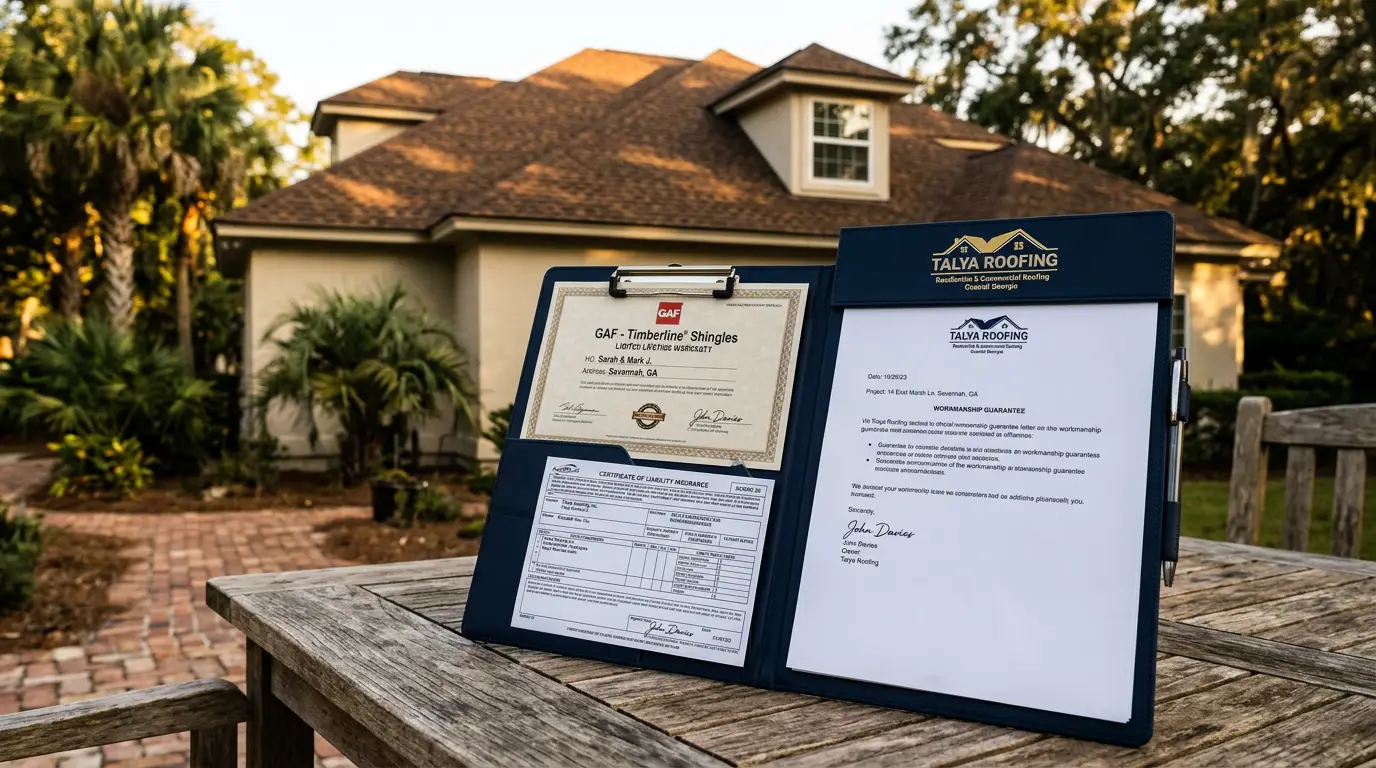

When you ask a Savannah roofing contractor "what's your warranty?" the answer you get is almost always incomplete. There isn't ONE warranty on a roof — there are usually three, and they cover different things, expire at different times, and void for different reasons. The 'lifetime' shingle warranty most homeowners assume covers everything actually covers very little after year 15. The contractor's workmanship guarantee covers what the manufacturer's doesn't, but the term length varies wildly. And the system warranty — the longest-term protection available — only unlocks when a manufacturer-certified contractor installs a complete manufacturer-approved system, not just brand-name shingles.
This guide separates common warranty types so you can evaluate a Savannah roofer's offer with informed questions, understand prorated terms, identify practices that may affect eligibility, and know what to request in writing before signing a contract. Details must be confirmed in the current written manufacturer terms for the exact product and system.
Key Takeaways
- ✓ 'Lifetime' material warranty = full coverage 10-15 years, then prorated (you pay an escalating share). Labor almost never included.
- ✓ Three warranty types: material (manufacturer), workmanship (contractor), system (only when manufacturer-cert contractor + manufacturer-approved full system). You need all three for real coverage.
- ✓ Talya documentation: the applicable Atlas product or system warranty information plus separate written Talya Roofing workmanship terms for the quoted project.
- ✓ Top 4 voiding mistakes: (1) solar/satellite install without pre-approval, (2) aggressive foot traffic on the roof, (3) ventilation not maintained to spec, (4) non-certified contractor for any future repair.
- ✓ Transferability: manufacturer material warranty transfers ONCE within 60 days of sale (50% value cap typical); workmanship warranties usually do NOT transfer.
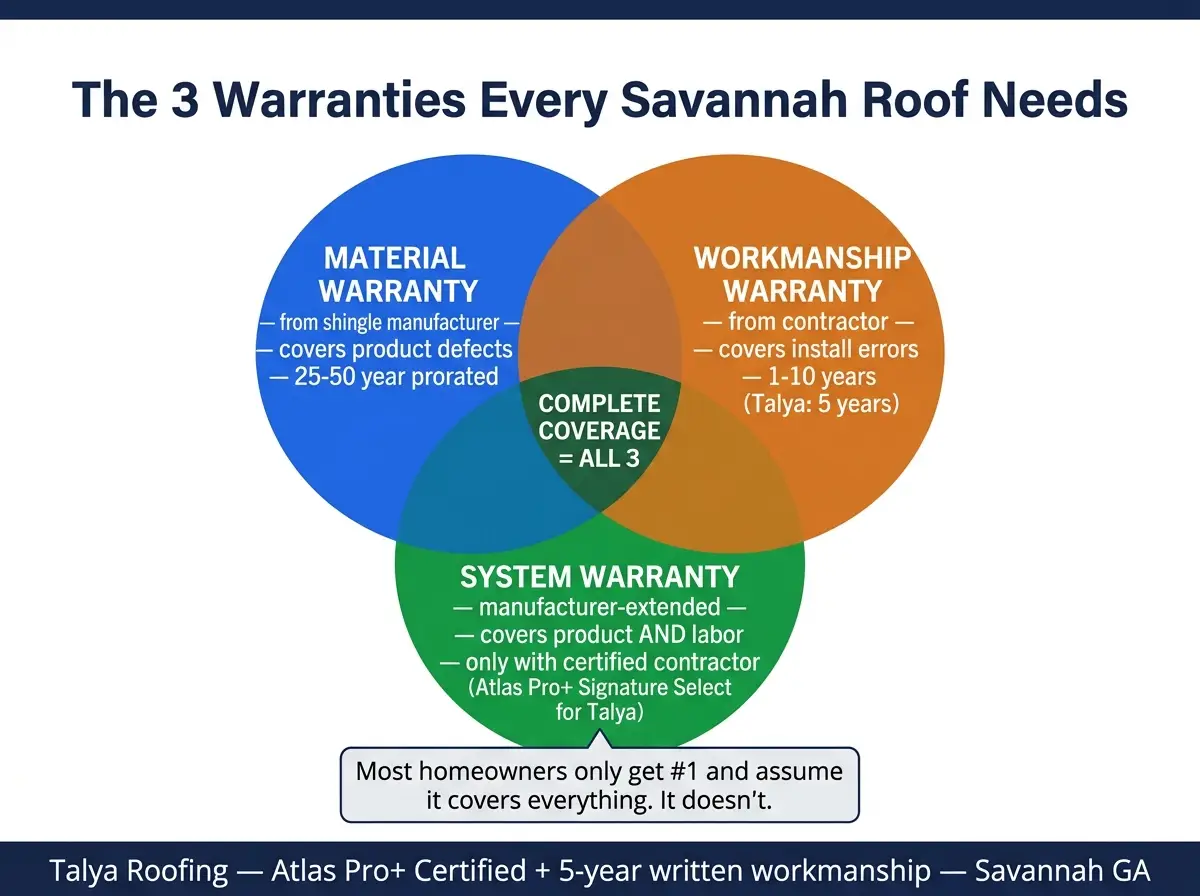
Three Warranty Types on a Savannah Roof — And Why You Need All Three
Every roof project sold in Coastal Georgia should come with three distinct warranty documents. Most homeowners only get the first one and assume it covers everything.
- Material warranty (from the shingle / metal panel manufacturer). Covers manufacturing defects in the roofing product itself — granule loss, premature aging, tab cracking, paint failure on metal. Issued by Atlas, GAF, Owens Corning, CertainTeed, McElroy, or whoever made the product. Term: 25-50 years on the box, but the "full coverage" window is usually only the first 10-15 years; after that, prorated coverage with escalating homeowner share. Labor is NEVER included unless you have a system warranty.
- Workmanship warranty (from the contractor). Covers install-related defects: wrong fastener pattern, flashing errors, sealant misapplication, leaks at installer-introduced flashings. Issued by the contractor on contractor letterhead. Term varies — 1 to 10 years industry typical; Talya Roofing's standard is 5 years. Labor IS included when the contractor honors it (good local contractors eat the full cost of fixing their own install mistakes).
- System or enhanced manufacturer warranty. These options may require a complete manufacturer-approved system, specific contractor status, eligible property and installation conditions, and timely registration or application. Coverage varies by program and can include different material, tear-off, disposal, or workmanship terms. Examples include Atlas Signature Select, GAF Golden Pledge, Owens Corning Platinum Protection, and CertainTeed enhanced warranty options. Always confirm the named warranty and current written eligibility requirements for the quoted project.
Most Savannah homeowners only get the first warranty (material) and assume the contractor handles labor implicitly. They don't — labor is contractor-bound by the workmanship warranty (separate document) or by the system warranty (only available with manufacturer-certified contractors). Always ask which one you're getting in writing.
Manufacturer Material Warranties — What 'Lifetime' Actually Means in 2026
The 'lifetime' designation on most major-brand shingles in 2026 actually means:
- Full-coverage period: years 1-10 (some brands 1-15). If a covered defect appears, the manufacturer provides replacement material at no cost. Labor is your responsibility (or your contractor's, under workmanship coverage).
- Prorated period: years 11-end-of-warranty. Your share of replacement material cost increases every year. By year 20, you typically pay 50-70% of replacement material. By year 25, 70-90%. The math is designed so the manufacturer's actual payout shrinks rapidly after the full-coverage window.
- "End of warranty": typically year 25-30 for "lifetime" architectural shingles — at which point coverage drops to $0 regardless of brand name.
A practical example: a $14,000 Atlas Pinnacle Pristine roof installed in 2026 with manufacturer material warranty. If a covered defect appears in year 5: manufacturer pays for ~$8,000 worth of replacement shingles (material only); you pay for labor (~$4,000-$6,000). If the same defect appears in year 20: manufacturer pays for ~$2,400 worth of replacement shingles (30% of material cost); you pay for the remaining $5,600 in material plus $4,000-$6,000 in labor. Same warranty, dramatically different financial outcome based on when the defect appears.
This is why the contractor's workmanship warranty and (where available) the manufacturer-extended system warranty matter so much. Material-only coverage gets thin fast.
Workmanship Warranties — What a Real Savannah Contractor's Guarantee Covers
A workmanship warranty covers defects that trace back to how the roof was installed — not how it was manufactured. The honest scope of a good workmanship warranty:
- Covered: improper fastener placement, flashing install errors, sealant misapplication, decking-replacement defects, ventilation install errors, leaks originating at installer-touched components (boots, vents, ridge cap, valley underlayment), tear-off-related damage to interior.
- Term length: industry varies wildly — some contractors offer 1 year (essentially nothing), some 2-3 years, the better local Coastal Georgia contractors offer 5 years. Talya Roofing's standard is 5 years.
- Repair-or-replace: includes both labor AND materials needed to correct the issue. A good contractor eats the full cost of fixing their own install mistakes (we do).
- NOT covered: storm damage (that's an insurance claim, not a workmanship defect), homeowner-introduced damage (walking on the roof, satellite dish install, etc.), normal weathering of shingle granules, work done by any contractor other than the original installer.
Verify the workmanship warranty in writing before signing. Ask: term length in years, what specifically is covered, what voids it, whether it transfers at sale, and how claims are processed (within how many days of notification?). A 5-year guarantee with vague terms is worse than a 3-year guarantee with crisp coverage language.
System Warranties — The Manufacturer-Extended Coverage That Requires Certification
System warranties are the longest-term and most valuable coverage available on a Coastal Georgia roof — but they're locked behind manufacturer certification of the installing contractor. Each major shingle manufacturer has a different certification program with different naming and tier structure:
| Manufacturer | Certification program | System warranty unlocked |
|---|---|---|
| Atlas | Atlas PRO+ membership / current Atlas requirements | Signature Select options depend on the quoted system, required components, installation, registration or application, project eligibility, and current written Atlas terms |
| GAF | GAF Master Elite (top tier) | GAF Golden Pledge / System Plus — only ~3% of US roofers hold this tier |
| Owens Corning | Owens Corning Platinum Preferred | Platinum Protection — non-prorated coverage extension |
| CertainTeed | CertainTeed SELECT ShingleMaster | Integrity Roof System — labor-included extended coverage |
Manufacturer programs do not all work the same way. Each has its own contractor requirements, product and component rules, eligible-property conditions, registration or application steps, exclusions, and coverage terms. Talya Roofing is an Atlas PRO+ Silver Member, but membership alone does not determine the warranty on a roof. We identify the Atlas products and system being quoted and provide the applicable current warranty information so the homeowner can review the actual eligibility requirements.
What Voids a Roof Warranty in Coastal Georgia (4 Common Mistakes)
From our claims-investigation log over the last 24 months in Coastal Georgia, the top 4 voiding patterns:
- Aftermarket rooftop installations without manufacturer pre-approval (~35% of voided claims). Solar panels, satellite dishes, attic fans, holiday-lighting clips, antennas. Most major shingle manufacturers require advance written approval before any rooftop modification. Installing without approval can void the entire material warranty even on the unrelated portions of the roof. Atlas's process: submit the proposed modification to their warranty team before install; they typically respond in 7-14 days.
- Aggressive foot traffic on the roof (~25% of voided claims). Asphalt-shingle adhesive softens at 120°F+ (typical Coastal Georgia summer roof temperature), and footprints become permanent damage when walking on the roof in those conditions. Frequent foot traffic — even for legitimate maintenance — can trigger manufacturer claims of "homeowner-induced damage" that voids coverage on the damaged sections. Mitigation: only walk on the roof when necessary, use foot pads, do it early-morning or evening when shingles are cooler.
- Inadequate attic ventilation per manufacturer spec (~20% of voided claims). Almost every major shingle manufacturer specifies a required net free ventilation area (NFA) for the attic — typically 1 sq ft of NFA per 150 sq ft of attic floor space. If your attic ventilation falls below the spec, premature shingle aging is essentially guaranteed and the manufacturer treats the resulting failure as homeowner-maintenance-related (not a material defect). Coastal Georgia homes with attic temperatures above 140°F regularly fail this spec.
- Non-certified contractor doing follow-up work (~20% of voided claims). If you use a non-certified contractor (or even a different certified contractor) for any future repair or supplement, some manufacturers consider the warranty's "single-installer" condition broken. Best practice: use your original installer (or another certified contractor for that specific manufacturer) for any follow-up work on a warrantied roof.
Warranty Transferability at Sale — What Carries Forward and What Doesn't
When you sell a Savannah home, the roof warranty story changes in a few specific ways:
- Manufacturer material warranties: typically transferable ONCE within 60 days of property transfer. The new owner registers the transfer via the manufacturer's portal and pays a $50-$150 transfer fee. The warranty value is usually capped at 50% of the remaining prorated coverage post-transfer — so a 15-year-old Atlas roof with 30-year prorated coverage doesn't carry forward at full value. Transferability is a meaningful selling point but worth less than buyers often assume.
- Workmanship warranties: usually do NOT transfer. They're tied to the original homeowner. Some contractors will allow a one-time transfer for a fee on request — verify in the original contract language.
- System or enhanced manufacturer warranties: transferability depends on the exact registered warranty and current written terms. For an Atlas Signature Select option, verify the transfer deadline, fee, eligibility conditions, and any coverage change before a property sale.
- What real-estate appraisers value: a fully-transferable warranty package adds modest resale value (typically $2,000-$5,000 on a recent install), but most appraisers don't itemize warranty value separately — they look at "age and condition of roof" as a single line item.
How to Evaluate Any Savannah Roofer's Warranty Offer Before Signing
Five questions to ask every Savannah contractor before signing a roof contract:
- What's the manufacturer material warranty term and when does it transition from full-coverage to prorated?
- What's your workmanship warranty term, exactly what does it cover, and what voids it?
- Are you certified to offer a system warranty for the manufacturer of these shingles? Show me the certification and the system-warranty document.
- Does your workmanship warranty transfer if I sell the home? Under what conditions?
- If a warranty claim is needed in year 7, year 12, year 20 — what's the process and how do I file? Who pays for labor in each scenario?
A contractor who can answer all five clearly and in writing is offering meaningful warranty protection. A contractor who waves the questions away with "lifetime warranty, you're covered" is offering material-only coverage that thins out fast.
Want the full Talya warranty stack on your Savannah roof?
Talya Roofing is an Atlas PRO+ Silver Member. When an Atlas Signature Select option is quoted, we identify the selected products and system, required components, registration or application steps, project eligibility conditions, and current written Atlas terms. Our separate contractor workmanship coverage is also stated in the proposal so you can compare it with any other Savannah quote.
Call (912) 999-7989 or request an estimate — turnaround typically 24-48 hours.