
Key Takeaways
- Talya Roofing follows a 12-step installation process that exceeds manufacturer minimum requirements
- Every step is documented with photographs and verified by a project manager
- Coastal-grade materials and enhanced fastening patterns are standard on every Savannah area installation
- Our process addresses the hidden details — ventilation, flashing, and deck integrity — that determine long-term performance
- Quality installation is the difference between a roof that lasts 15 years and one that lasts 25+
Two roofs can use identical materials and look the same from the ground on day one. Five years later, one is performing flawlessly while the other leaks at every storm. The difference isn't the shingles — it's the installation. At Talya Roofing, we've developed a premium installation process specifically for Savannah's coastal environment that goes beyond minimum manufacturer specifications at every step. Here's exactly what happens when our crew arrives to install your new roof.
Step 1: Property Protection Setup
Before any roofing material is touched, our crew protects your property. Heavy-duty tarps are placed around the entire foundation perimeter to catch falling debris. Landscaping beds, air conditioning units, and outdoor fixtures receive additional protection. Plywood runners protect the lawn from wheelbarrow traffic. We position the material dumpster for efficient loading while minimizing impact on your driveway and yard.
Step 2: Complete Tear-Off to Bare Deck
We never install over existing roofing materials. Every project starts with a complete tear-off down to the bare wood deck. This isn't just about building code compliance — it's the only way to thoroughly inspect the deck surface, identify and repair damage, and ensure the new underlayment bonds properly to a clean surface. Installing over old layers hides problems, traps moisture, and prevents proper adhesion of ice-and-water shield membranes.
Step 3: Deck Inspection and Repair
With the deck fully exposed, our project manager and crew chief walk every square foot. We probe for soft spots, check for delamination, and identify any areas where moisture has compromised the plywood. In Savannah's humid climate, it's rare to find a 20-year-old roof with zero deck damage — the question is how much. We replace every compromised panel with matching OSB or plywood sheathing, properly nailed to the rafters. This step is documented with photographs showing the condition before and after repairs.
Step 4: Drip Edge Installation
New aluminum drip edge is installed along all eaves and rakes. Drip edge serves two critical functions: it directs water away from the fascia board into the gutter, and it provides a clean, straight edge for the roofing materials. We install drip edge beneath the underlayment at the eaves and over the underlayment at the rakes — the correct sequence for maximum water protection that many contractors get backwards.
Step 5: Ice-and-Water Shield at Critical Areas
Self-adhering ice-and-water shield membrane goes down at every vulnerable point: the first 3 feet at all eaves, the full length of all valleys, around every penetration (pipes, vents, skylights), at all wall-to-roof transitions, and anywhere the roof slope changes. In Savannah's wind-driven rain environment, these are the areas where water is most likely to work its way beneath the roofing surface. The self-sealing membrane creates a waterproof barrier that remains effective even if nails penetrate it.
Step 6: Synthetic Underlayment
The entire remaining deck surface receives high-temperature synthetic underlayment — never traditional felt paper. Synthetic underlayment is stronger, more tear-resistant, provides better traction for the installation crew (a safety consideration), and won't wrinkle or deteriorate from UV exposure if left uncovered during multi-day installations. It serves as the secondary waterproof barrier for the entire roof surface.
Step 7: Starter Strip Application
Pre-cut starter strips with factory-applied adhesive are installed along all eaves and rakes. The starter strip seals beneath the first course of shingles, preventing wind uplift at the roof's most vulnerable edge. We use manufacturer-matched starter strips — not cut shingles — to ensure consistent adhesive coverage and proper overhang dimension.
Step 8: Field Shingle Installation
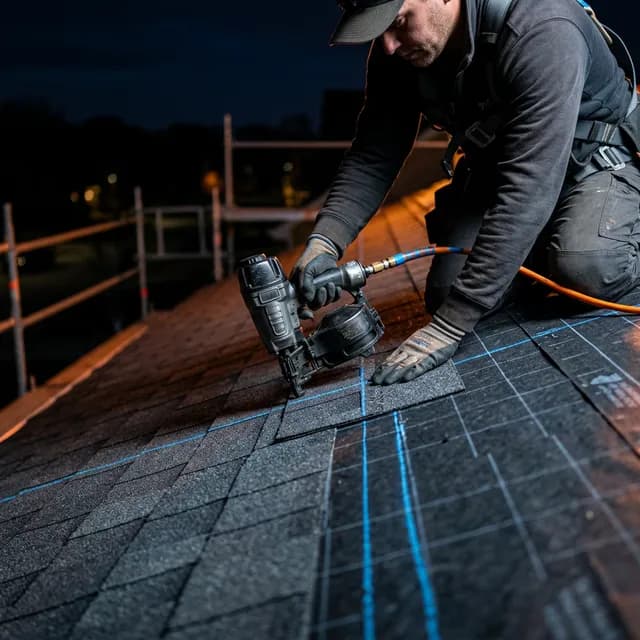
Shingles are installed from the eave upward in staggered courses following the manufacturer's specified offset pattern. For Savannah's high-wind zone, we use a six-nail pattern on every shingle — two more than the standard four-nail pattern. Each nail is placed in the manufacturer's designated nailing zone, driven flush with the shingle surface (not overdriven or underdriven). Nail placement accuracy determines wind resistance — a nail 1/4 inch out of zone can reduce the shingle's wind rating by 50%.
Step 9: Flashing Installation
All flashing is new — we never reuse old flashing regardless of its apparent condition. Step flashing at wall transitions, counter flashing at chimneys, pipe boot flashing at plumbing penetrations, and valley flashing (where applicable) are all installed with attention to overlap sequences and sealant application. In coastal Savannah, we specify aluminum or stainless steel flashing components that resist salt air corrosion far better than standard galvanized steel.
Step 10: Ventilation System
Proper ventilation is installed or verified at this stage. Ridge vent runs the full length of every available ridge, with baffles that prevent wind-driven rain from entering while allowing continuous hot air exhaust. We verify that soffit intake vents are clear and unobstructed, providing the balanced intake-to-exhaust ratio that keeps your attic cool and dry. Inadequate ventilation is one of the most common causes of premature roof failure in Savannah — we don't let it happen on our installations.
Step 11: Ridge Cap and Final Details
Hip and ridge cap shingles are the finishing touch on the visible roof surface. We use manufacturer-designed ridge cap products (not field-cut shingles) for consistent appearance and reliable wind resistance. Every ridge cap shingle receives the same six-nail pattern used in the field. Final details include checking all sealant points, verifying pipe boot connections, and confirming that every component is properly fastened and aligned.
Step 12: Cleanup and Final Inspection
Our cleanup process is thorough. All debris is removed from the roof, gutters, yard, and surrounding areas. A rolling magnetic nail sweeper makes multiple passes across the lawn, driveway, sidewalks, and street to collect stray fasteners. The project manager conducts a complete final inspection of every roof surface, flashing detail, and ground-level area. We then walk you through the completed installation, review warranty documentation, and ensure you're completely satisfied.
This 12-step process is what separates a premium roof replacement from a basic one. It's why our installations outlast the industry average and why our customers trust us with the most important protection their home has.
Experience the Talya Roofing Difference
Every roof we install in Savannah, Pooler, Richmond Hill, and Tybee Island follows our complete 12-step premium process. No shortcuts, no compromises — just roofing done right.
Get Your Free Estimate or call (912) 999-7989