
Key Takeaways
- A typical Savannah roof replacement takes 1–3 days for residential homes
- The process includes consultation, material selection, tear-off, deck inspection, underlayment, installation, and cleanup
- Weather delays are common — Savannah averages 50 inches of rain annually and work stops when it rains
- Your home remains habitable throughout the process though noise will be significant
- A quality contractor handles permits, HOA coordination, and debris removal as part of the job
Getting a new roof is one of the largest investments you'll make in your home — and one of the most unfamiliar experiences for most homeowners. If you've never been through a roof replacement before, the process can seem intimidating. At Talya Roofing, we've guided hundreds of Savannah, Pooler, Richmond Hill, and Tybee Island homeowners through successful replacements. Here's exactly what to expect at every stage.
Phase 1: Initial Consultation and Inspection
Everything starts with a thorough roof inspection. One of our project managers visits your home to evaluate the current roof condition, take measurements, photograph existing damage or wear, and assess the underlying structure for any concerns. This visit typically takes 45–60 minutes and includes both the roof surface and an attic inspection where accessible.
During this visit, we also discuss your priorities — budget, material preferences, color choices, timeline requirements, and any HOA or historic district guidelines that apply. We measure accurately using satellite imagery and on-site verification to produce a precise material estimate.
Phase 2: Proposal and Material Selection
After the project assessment, Talya Roofing can prepare a detailed written proposal with construction scope, material specifications, pricing, available warranty information, anticipated scheduling factors, and payment terms. Proposal timing is confirmed for the specific project.
Material selection is one of the most important decisions in the process. For most Savannah homes, the choice comes down to architectural shingles or standing seam metal, with variations in grade, color, and manufacturer within each category. We provide physical samples and can show you installed examples in local neighborhoods so you can see how different materials look on actual homes in our area.
Phase 3: Pre-Installation Preparation
Once you approve the proposal, we handle the logistics that homeowners often don't think about:
- Permits: We pull all required permits from the appropriate jurisdiction — City of Savannah, Chatham County, or the applicable municipality
- Material Ordering: Materials are ordered and delivery is coordinated to arrive the day before or morning of installation
- HOA Notification: If your neighborhood has an HOA, we submit the required documentation for material and color approval
- Dumpster Placement: A roofing dumpster is delivered to your property, positioned to minimize impact on your daily routine
- Neighbor Courtesy: We recommend notifying adjacent neighbors about the upcoming project — we provide a simple notice template
We also send you a detailed preparation checklist covering everything from moving vehicles to securing attic items. Following this checklist makes installation day significantly smoother.
Phase 4: Installation Day
Tear-Off (Morning)
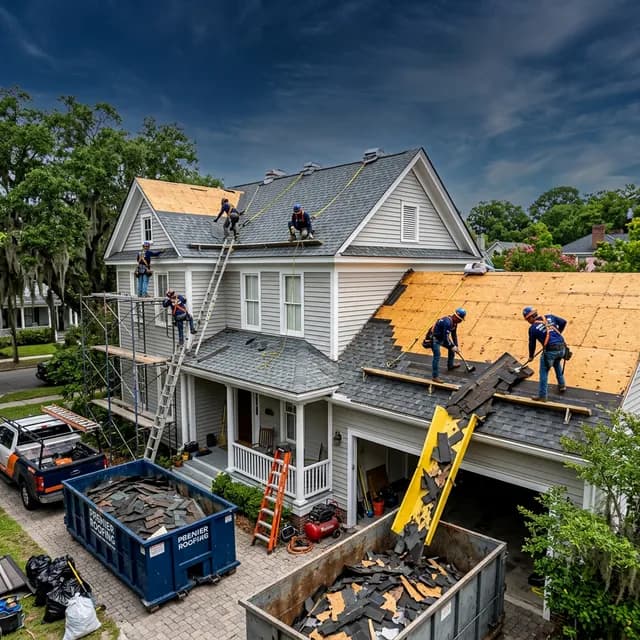
The crew arrives early — typically 7:00–8:00 AM — and begins by laying protective tarps around the foundation to catch falling debris. The tear-off phase strips the existing roofing materials down to the bare wood deck. For a typical 2,000 square foot Savannah home, tear-off takes 2–4 hours depending on the number of existing layers and complexity of the roof design.
Deck Inspection and Repair (Late Morning)
With the deck exposed, we inspect every square foot of sheathing for rot, water damage, delamination, and structural adequacy. In Savannah's humid climate, it's not unusual to find areas of compromised decking, especially around valleys, chimneys, and HVAC penetrations. Damaged plywood is cut out and replaced with matching material. Any rotten fascia boards or compromised rafter tails are repaired at this stage.
This is the most critical quality checkpoint in the entire process. The deck is the foundation of your new roof — installing premium materials over a compromised deck wastes your investment. We document all deck repairs with photographs for your records.
Underlayment and Flashing (Midday)
Synthetic underlayment goes down over the entire deck surface, providing a secondary waterproof barrier. At eaves, rakes, valleys, and around all penetrations, we install self-adhering ice-and-water shield membrane — critical in Savannah where wind-driven rain can push water uphill under shingles. New flashing is installed at every wall transition, chimney, pipe boot, and vent — we never reuse old flashing regardless of its apparent condition.
Roofing Material Installation (Afternoon)
With the waterproof base in place, the finish roofing material is installed starting from the lowest edge and working upward. Starter strips, field shingles or metal panels, and ridge caps are installed in sequence following manufacturer specifications for exposure, fastening pattern, and overlap. For Savannah's wind zone, we use enhanced nailing patterns — six nails per shingle in the high-wind zone versus the standard four.
Cleanup (Late Afternoon)
Our cleanup process is thorough: all debris is loaded into the dumpster, the yard is raked, and we make multiple passes with a rolling magnetic nail sweeper to pick up stray fasteners from the lawn, driveway, sidewalks, and street. We inspect the property from every angle to ensure nothing was missed.
Phase 5: Final Inspection and Walkthrough
After installation is complete, a project manager conducts a quality inspection of the entire roof. We check every detail: shingle alignment, flashing seal, ridge vent installation, drip edge attachment, and overall aesthetic quality. We then walk you through the completed project, explain any warranty documentation, and answer your questions. The dumpster is typically removed within 24–48 hours.
Weather and Timing Considerations
Savannah's weather adds a variable that doesn't exist in drier climates. Work stops at the first sign of rain, and the exposed deck must be protected with tarps if weather arrives mid-project. Our crews are experienced at reading coastal weather patterns and plan accordingly, but occasional delays are unavoidable. We always ensure your home is watertight at the end of each work day, even if the project isn't complete.
The best months for roof replacement in Savannah are October through May, when rainfall is lower and temperatures are more moderate. Summer replacements are absolutely feasible but may take slightly longer due to afternoon thunderstorm interruptions and mandatory heat safety breaks for the crew.
Ready for Your Roof Replacement?
Talya Roofing guides you through every step — from first inspection to final walkthrough. No surprises, no shortcuts, just quality roofing for Savannah homes.
Get Your Free Estimate or call (912) 999-7989