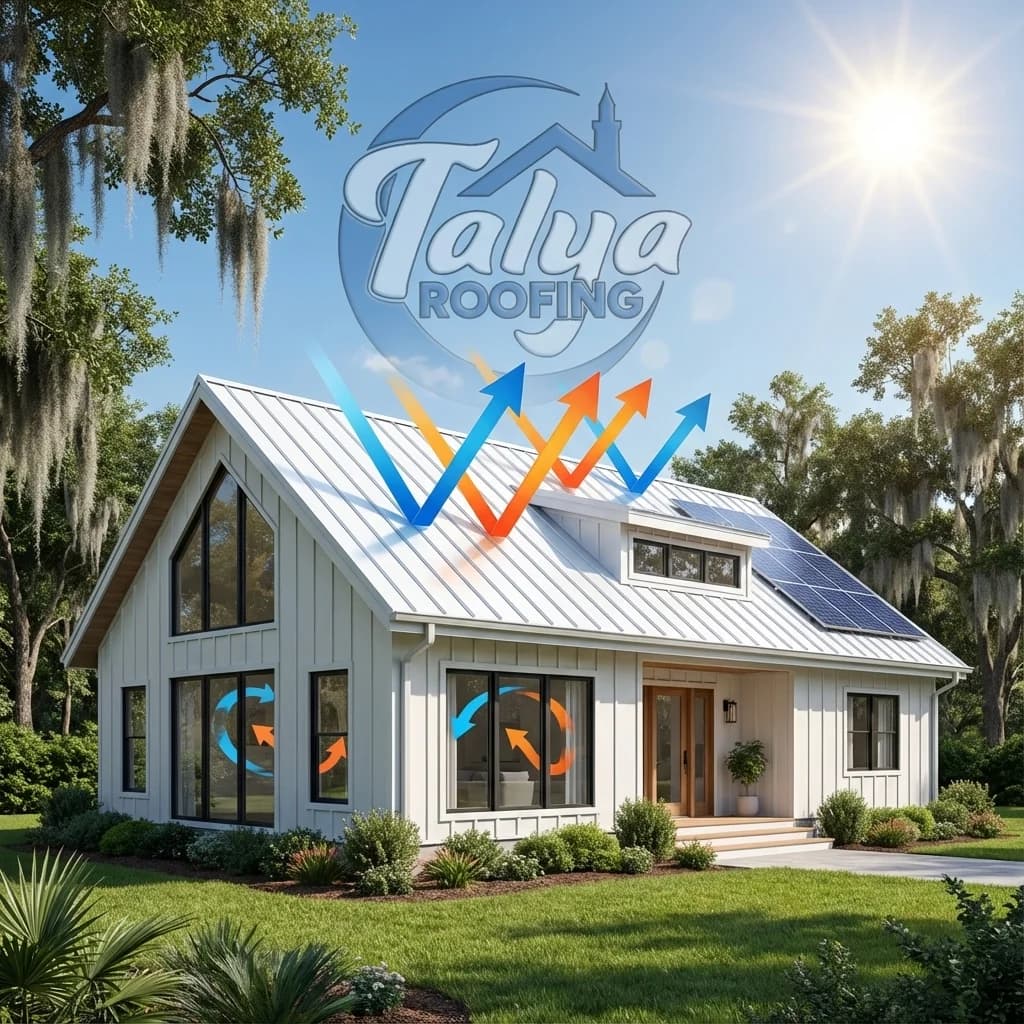

Key Takeaways
- Compare the selected roof product's published reflectance and emittance ratings. Any cooling benefit depends on the complete roof and home.
- Cool roof standards set minimum solar reflectance and thermal emittance values that significantly reduce heat transfer into your home.
- Radiant barriers in attic spaces block up to 97% of radiant heat, working synergistically with cool roof materials.
- Proper attic ventilation is as important as the roofing material itself — without it, even the best cool roof underperforms.
- Budget using the quoted project cost. Include an incentive only after its administrator confirms the project's eligibility and amount.
- The DOE recommends specific insulation and ventilation standards for Climate Zone 2A that many older Savannah homes don't meet.
Energy-Efficient Roofing: Why It Matters in Savannah
In Savannah and Coastal Georgia, air conditioning accounts for 40–50% of annual energy costs for a typical home. Your roof is the single largest surface area exposed to direct solar radiation, making it the most impactful component in your home's thermal envelope. Choosing the right roofing materials and ensuring proper installation can dramatically reduce the amount of heat entering your living space, lowering your energy bills and improving year-round comfort.
Talya Roofing helps homeowners across Savannah, Pooler, Richmond Hill, Tybee Island, and Chatham County make informed decisions about energy-efficient roofing options that deliver measurable returns on investment.
Comparing Current Roof-Product Ratings
The ENERGY STAR roof-products specification ended on June 1, 2022. Compare the selected product's published initial and aged solar-reflectance and thermal-emittance ratings. Confirm which requirements apply to the specific building and roof; a rating alone does not establish code compliance or tax-credit eligibility.
Cool Roof Standards and Performance
Solar reflectance and thermal emittance help describe a roof product's response to heat. The Cool Roof Rating Council (CRRC) maintains a database of rated products for comparison; use the exact product and color rather than a brand-wide assumption.
Solar Reflectance Index (SRI)
SRI combines reflectance and emittance into a single number on a scale of 0 to 100+. Higher numbers mean the material stays cooler in the sun. For Savannah's climate, roofing professionals recommend an SRI of 29 or higher for steep-slope residential roofs and 78 or higher for low-slope applications.
Cool Roof Material Options for Coastal Georgia
- Cool-color asphalt shingles: Special pigment technology reflects near-infrared radiation while maintaining traditional colors. SRI values of 25–40.
- Metal roofing with cool coatings: Factory-applied reflective finishes achieve SRI values of 50–80, making metal one of the most energy-efficient residential options.
- Clay and concrete tiles: Naturally reflective, especially in lighter colors. SRI values of 30–60 depending on color and finish.
- Single-ply membranes (TPO, PVC): White membranes achieve SRI values above 100, making them the coolest option for flat and low-slope roofs.
Radiant Barriers: The Hidden Performance Booster
A radiant barrier is a reflective material installed in the attic — typically on the underside of the roof rafters or on the attic floor — that reflects radiant heat rather than absorbing it. In Savannah's climate, where attic temperatures can exceed 150°F during summer, a radiant barrier can reduce heat transfer through the ceiling by up to 40%.
How Radiant Barriers Work
Traditional insulation slows heat transfer by conduction (direct contact). Radiant barriers address a different heat transfer mechanism — radiation. The sun heats your roof, which radiates that heat downward into the attic. A radiant barrier with an emittance of 0.03–0.05 reflects 95–97% of that radiant heat back toward the roof, preventing it from reaching the insulation and living space below.
The DOE estimates that radiant barriers can reduce cooling costs by 5–10% in hot climates like Coastal Georgia, and they're most effective when combined with cool roof materials and proper ventilation. Talya Roofing routinely recommends radiant barriers as part of comprehensive roof replacement projects.
Ventilation: The Critical Third Element
Even the best cool roof materials and radiant barriers underperform without adequate attic ventilation. Ventilation removes heated air from the attic space, reducing temperatures and preventing moisture buildup that can damage decking, insulation, and structural components.
Ventilation Requirements for Climate Zone 2A
- Minimum ratio: 1 square foot of net free ventilation area per 150 square feet of attic floor (1:150), reducible to 1:300 with a balanced intake/exhaust system.
- Balanced system: 50% intake (soffit vents) and 50% exhaust (ridge vents or powered attic ventilators).
- Ridge vents: Preferred over static box vents for continuous exhaust along the roof peak.
- Soffit vents: Must remain unblocked by insulation — baffles should be installed at every rafter bay.
Many older homes in Savannah's historic districts have inadequate ventilation by modern standards. During a roof inspection, Talya Roofing evaluates ventilation and recommends upgrades that bring your home into compliance with current building science standards.
DOE Guidelines for Climate Zone 2A
The U.S. Department of Energy classifies Savannah and Chatham County as Climate Zone 2A — hot and humid. Their recommended insulation and efficiency standards for this zone include:
- Attic insulation: R-38 to R-60 (many older Savannah homes have R-19 or less).
- Roof reflectance: Cool roofing recommended for all new construction and re-roofing projects.
- Air sealing: All attic penetrations (HVAC ducts, plumbing vents, electrical boxes) should be sealed to prevent conditioned air loss.
- Duct location: HVAC ducts in unconditioned attic spaces should be insulated to R-8 or moved into conditioned space when feasible.
Tax Credits and Incentive Programs
Incentive availability depends on the program, project and installation date; do not assume a roofing upgrade qualifies.
Federal Tax Credits (Inflation Reduction Act)
- Energy Efficient Home Improvement Credit (25C): For eligible improvements made during 2023–2025, this credit covered specified products such as qualifying skylights, insulation and air sealing, subject to limits. It was not a general credit for metal roofing or asphalt shingles. The credit ended for property placed in service after December 31, 2025.
- Residential Clean Energy Credit (25D): The 30% federal residential solar tax credit (IRS Section 25D) was repealed by the July 2025 "One Big Beautiful Bill" and expired December 31, 2025 — it is no longer available for new installations. Check any current state or utility program directly before relying on an incentive.
Georgia-Specific Incentives
- Ask the serving utility which current programs, if any, apply to the proposed work and obtain the eligibility requirements in writing.
- Ask the local tax assessor whether any exemption applies to the proposed solar equipment; do not assume the roof replacement qualifies.
- Confirm any incentive amount, application deadline and product requirements with the program administrator before including it in the budget.
Evaluate Energy Costs for Your Property
A roof upgrade does not establish a fixed cooling-cost reduction or payback period. Compare the proposed work with the building's current condition and energy use before budgeting.
- Existing conditions: Review the roof, insulation, ventilation, cooling equipment and available energy bills.
- Proposed work: Compare the selected products and written installation scope with a property-specific energy estimate.
- Financial assumptions: Confirm applicable energy rates, maintenance costs and any incentive or insurance-discount eligibility separately.
Do not multiply a generic savings percentage across an assumed roof lifespan or treat a projected resale benefit as guaranteed. Actual costs and results depend on the property and the agreed work.
Lower Your Energy Bills With a Smarter Roof
Talya Roofing specializes in energy-efficient roofing solutions designed specifically for Savannah's hot, humid climate. From cool roof materials to radiant barriers and ventilation upgrades, we help Coastal Georgia homeowners save money while improving comfort. Request a project estimate and review the property-specific assumptions behind any energy-savings projection.
Sources: ENERGY STAR — Roof Products • DOE — Cool Roofs