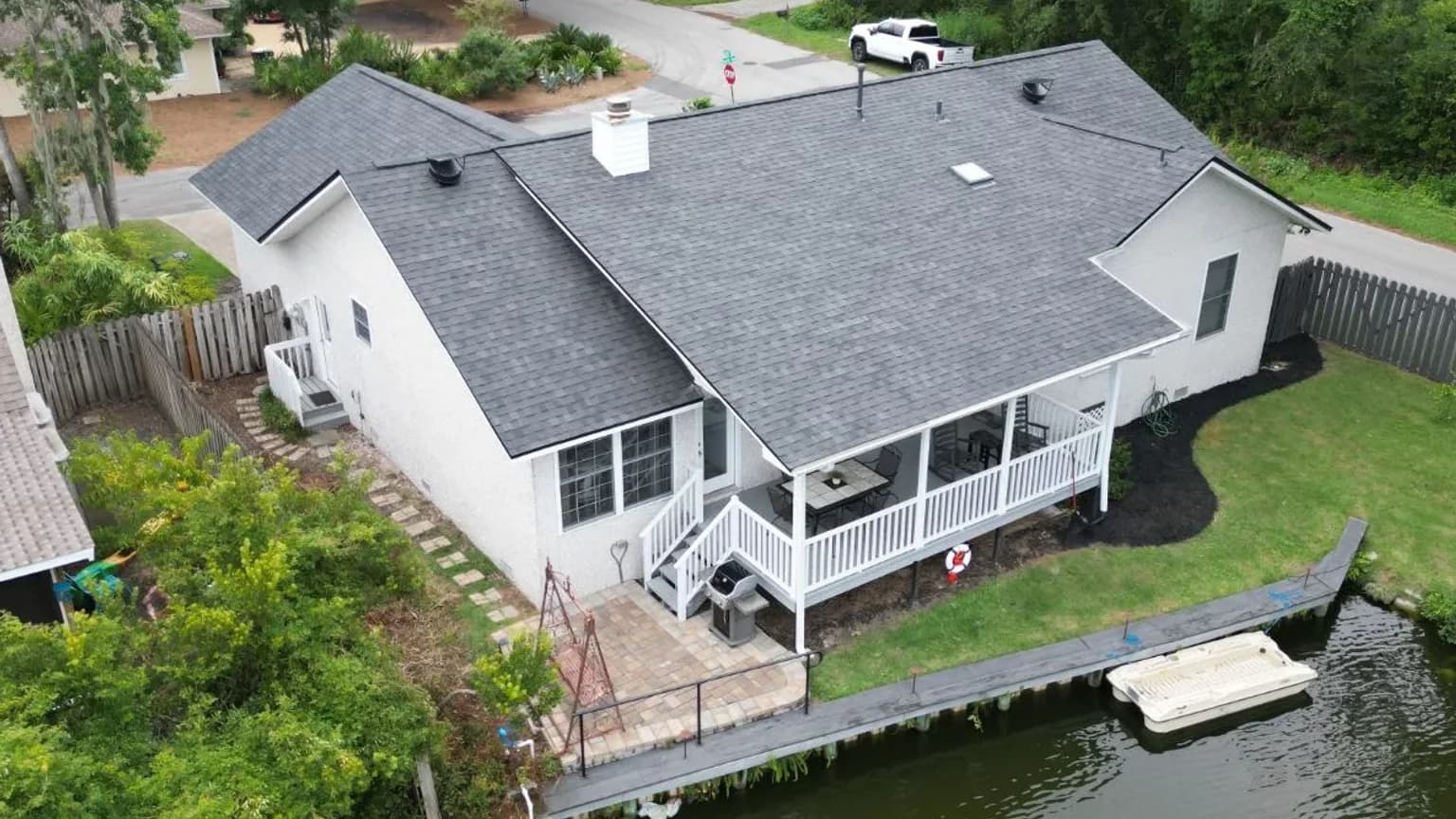

If your upstairs bedrooms are hot, your AC never seems to catch up, or your attic smells like a damp closet, someone has probably told you to put a vent on the roof. The two you will be offered are a spinning turbine vent — the whirlybird — and a solar-powered attic fan. They are usually compared on price and on the CFM number printed on the box. Both of those comparisons are close to useless, because neither one tells you the thing that actually decides the outcome: how many hours a day Savannah supplies the fuel each vent runs on.
A turbine burns wind. A solar fan burns sunlight. So we went and measured both. This guide compares them using every hourly wind observation recorded at three Coastal Georgia weather stations last summer, set against the sun’s actual position over a Savannah roof, hour by hour. It also answers the question homeowners ask us most about the hybrid models: if the fan can also run on house current, does the cooling it buys beat the electricity it spends?
Key Takeaways
- ✓ Across 2,204 hourly observations at Savannah/Hilton Head International last summer, wind reached 7 mph — roughly where a turbine starts moving useful air — about 9.2 hours a day, and was dead calm 9.9% of all hours.
- ✓ The sun clears 20° of altitude for about 11.0 hours a day in a Savannah summer, and peaks at 81.4° — nearly overhead — on June 21.
- ✓ Timing beats totals. From 11am–3pm, when the deck is loading heat fastest, wind hit 7 mph in only 42–50% of hours while the sun stood at 85–97% of its peak altitude — a clear-sky geometry figure, not a measured panel output.
- ✓ Where you live matters more than which product you buy. A midtown Savannah roof sat in dead-still air 24.3% of summer hours; 30 miles inland, 30.0%.
- ✓ A 42W hybrid fan on its 110V adapter costs about $0.80–$4.79 a month in Georgia electricity, against roughly $13.31/month of cooling energy in the most-cited field study.
- ✓ Neither one fixes a hot attic alone. Both are exhaust. Exhaust without matching soffit intake can pull conditioned air out of your house instead of hot air off the deck.
Turbine vent or solar attic fan — which actually works in Savannah?
For most Savannah homes a solar attic fan is the more dependable exhaust device, because Savannah supplies about 11.0 hours a day of usable sun against roughly 9.2 hours of usable wind — and the sun peaks exactly when the attic is hottest, while the wind does not fill in until late afternoon. The turbine is not a bad product. It is simply running on the less reliable of the two local fuels.
That is the short answer, and it comes with a large asterisk that the rest of this guide unpacks: neither device is a ventilation system. Both are the exhaust half. If the intake half is missing — and in most underventilated attics we open up in Chatham County, it is — then adding either one is at best wasted money and at worst actively harmful. We will come back to that, because it is the single most consequential thing on this page.
Here is the head-to-head on the dimensions that actually differ:
| Dimension | Turbine vent (whirlybird) | Solar attic fan |
|---|---|---|
| Powered by | Wind crossing the ridge | Sunlight on its own PV panel |
| Usable hours/day (Savannah summer) | ~9.2 h at 7+ mph | ~11.0 h with sun above 20° |
| Output during peak attic heat (11am–3pm) | Weakest relative to its own range | Sun at 85–97% of peak altitude (clear-sky geometry) |
| In dead-calm air | Stops; acts as a passive box vent | Unaffected — runs on sun |
| After dark | Works if wind is up (often is, 7–9pm) | Off, unless a 110V adapter is fitted |
| Operating cost | $0 — no power at all | $0 on solar; ~$0.80–$4.79/mo on the adapter |
| Moving parts in salt air | Bearings — the classic coastal failure | Motor + panel; product-dependent |
| Hardware cost tier | Lowest-cost exhaust option | Substantially higher per unit |
| Needs soffit intake to work | Yes | Yes — and more urgently |
How many hours a day does wind actually turn a turbine vent in Savannah?
About 9.2 hours a day in summer at the airport, with the air completely still for roughly 2.4 of the remaining hours. We pulled all 2,204 hourly observations logged at Savannah/Hilton Head International between June 1 and September 1, 2025. Mean wind was 6.7 mph. It sat below 7 mph in 61.6% of hours, and read exactly 0 mph in 9.9%.
A turbine has no cut-in switch, so there is no single official threshold. But the physics is simple: output scales with how fast the vanes turn, which scales with wind speed. Below about 5–7 mph a turbine is idling rather than ventilating, and at 0 mph it stops entirely and works as a plain static vent — still open, still passing whatever air the stack effect drives, but no longer a fan in any meaningful sense. A stationary whirlybird is not broken. It is just doing very little.
The hour-by-hour shape is the interesting part, and it is not what most people assume:
| Hour | Mean wind | % of hours at 7+ mph | Sun altitude | Solar panel output |
|---|---|---|---|---|
| 5 AM | 4.2 mph | 10% | below horizon | 0% |
| 7 AM | 5.5 mph | 28% | 21° | 35% |
| 9 AM | 7.1 mph | 40% | 46° | 72% |
| 11 AM | 7.0 mph | 46% | 70° | 94% |
| 12 PM | 7.6 mph | 50% | 77° | 97% |
| 2 PM | 9.0 mph | 62% | 62° | 88% |
| 4 PM | 9.9 mph | 75% | 37° | 60% |
| 6 PM | 9.4 mph | 73% | 12° | 21% |
| 8 PM | 7.3 mph | 48% | below horizon | 0% |
| 11 PM | 5.3 mph | 26% | below horizon | 0% |
Shaded rows are the peak attic heat-load window. Wind: KSAV hourly observations, Jun 1–Sep 1 2025 (n=2,204). Sun: computed solar altitude for 32.0809°N, 81.0912°W.
Savannah wind is a sea-breeze pattern. It is weakest before dawn (4.2 mph at 5am, calm or near-calm two-thirds of the time) and strongest between 3pm and 6pm, when the land has heated enough to pull air in off the ocean and the average climbs past 10 mph. So a turbine here is close to idle all night, mediocre through the morning, and genuinely good for about three hours in the late afternoon.
How many hours of usable sun does a solar attic vent get in Savannah?
About 11.0 hours a day in summer, falling to roughly 6 hours in late December. Savannah sits at 32.08°N. On June 21 the sun is up for 14.1 hours and reaches 81.4° — within nine degrees of straight overhead. Averaged across June through August, there are 13.7 hours of daylight and about 11.0 hours with the sun above 20°, the rough point where a roof-mounted panel produces real power rather than a trickle.
Unlike wind, this is not a statistical estimate that varies year to year — solar geometry is fixed by latitude and date. Cloud cover modulates it, and Savannah gets real summer afternoon convection, but the underlying resource is far more predictable than the wind resource. That predictability is worth something on its own when you are deciding what to bolt to a roof for the next fifteen years.
| Date | Daylight | Hours with sun above 20° | Peak sun altitude |
|---|---|---|---|
| June 21 | 14.1 h | 10.7 h | 81.4° |
| July 21 | 13.8 h | 10.5 h | 78.4° |
| August 21 | 13.0 h | 9.8 h | 69.7° |
| September 21 | 12.0 h | 8.8 h | 57.7° |
| December 21 | 9.9 h | 6.0 h | 34.5° |
The December numbers look like a weakness, and in raw output they are. In practice they matter far less than they appear, because in December a Savannah attic is not the problem you are trying to solve. Attic exhaust earns its keep in the cooling season, and the cooling season is precisely when the solar resource is at its strongest.
Does the answer change between Savannah, Pooler and Richmond Hill?
Yes — and the effect is larger than the difference between the two products. Wind speed collapses as you move away from open water and into tree canopy. Comparing three Coastal Georgia stations over the same 2025 summer, a turbine’s usable hours fell from 9.2 a day in open ground to 6.2 in midtown Savannah to 4.6 inland. Solar output is essentially unchanged across all three.
| Station | Setting | Mean wind | Dead-calm hours | Turbine hours/day at 7+ mph |
|---|---|---|---|---|
| KSAV | Airport — open ground, west Chatham (Pooler side) | 6.7 mph | 9.9% | 9.2 h |
| KSVN | Hunter AAF — midtown Savannah, inside the canopy | 5.1 mph | 24.3% | 6.2 h |
| KLHW | Wright AAF, Fort Stewart — ~30 mi inland | 4.4 mph | 30.0% | 4.6 h |
All three: hourly ASOS observations, Jun 1–Sep 1 2025. n = 2,204 / 2,090 / 2,104 respectively.
Read that middle row again. A house in midtown Savannah sits in completely still air for nearly a quarter of every summer hour. On an open lot in Pooler or out toward the marsh on Whitemarsh and Wilmington Island, a turbine has a real shot. Under the live oaks in Ardsley Park or Baldwin Park, it spends a great deal of its life not turning.
There is an honest complication here worth stating plainly: the same tree canopy that kills the wind will also shade a solar panel. But the two penalties are not equivalent. A panel only needs a clear view of the patch of sky directly above it, so a gap in the canopy is often enough. Wind speed near the ground is suppressed by surface roughness — every tree for a long distance upwind of your house, not just the ones over it. That asymmetry is why a shaded midtown lot punishes a turbine harder than it punishes a panel, and why the right recommendation genuinely differs between a treed Ardsley Park roof and an open one in Pooler.
Does a solar attic fan use electricity, and does the cooling beat the cost?
On its panel alone it uses none. With the optional 110V adapter fitted, a 42-watt fan costs roughly $0.80 to $4.79 a month in Georgia — against about $13.31 a month of cooling energy in the most-cited field measurement. On those numbers the electricity spent loses to the cooling gained by a wide margin, even in the worst case where the fan runs around the clock on house power.
This is the question we get asked most, and it is a sensible one. The whole appeal of “solar” is free operation, so bolting on a grid adapter feels like it undoes the point. It does not, because the numbers are small. Here is the arithmetic at 42 watts and Georgia’s average residential rate of about 15.84¢ per kWh:
| Hours/day on the 110V adapter | Electricity used | Cost per month |
|---|---|---|
| 4 h (evening top-up only) | 5.0 kWh | $0.80 |
| 8 h | 10.1 kWh | $1.60 |
| 12 h | 15.1 kWh | $2.40 |
| 24 h (worst case, continuous) | 30.2 kWh | $4.79 |
| Cooling energy displaced (FSEC field study) | 84 kWh | $13.31 saved |
The strongest argument for the adapter has nothing to do with money. It closes the one real gap in the solar fan’s day. A Savannah attic does not stop being hot at sunset — it has stored heat in the decking and framing all day and radiates it down into your bedrooms through the evening, which is exactly when you are trying to sleep. A solar-only fan is off for all of that. An adapter buys you the 7pm–11pm purge for under a dollar a month. That is the hour a turbine, incidentally, is still doing decent work, since Savannah wind is still running 7.3 mph at 8pm.
Two honest caveats before you treat $13.31 as your saving. First, that figure comes from a single instrumented test house, and your attic is not that house. Second, it is a measurement of what the fan displaced — it says nothing about whether the install cost is recovered, and the same study was blunt that at the installation costs of its day the payback ran past twenty years.
How much does each one really cool an attic?
The best-documented measurement of powered attic ventilation found a 22°F average drop in peak attic air temperature and a 6.0% reduction in space-cooling energy — about 2.8 kWh a day. That comes from a Florida Solar Energy Center study by Danny Parker and John Sherwin, published in 2000, on a 1,045 sq ft house in Cocoa, Florida fitted with two 10-watt PV attic fans.
We cite that study rather than a manufacturer’s brochure because it is instrumented, independent, and unusually candid about its own limits. The authors noted the test house already had a radiant barrier and R-19 ceiling insulation, and suggested savings could be larger in homes without those, with thinner insulation, or with the air handler sitting in the attic — a configuration extremely common in Coastal Georgia. They were equally clear that the payback period exceeded twenty years at then-current installed costs.
For turbines there is no comparable field study, for an understandable reason: their output is not a constant to be measured, it is a function of a wind speed that changes every hour. A turbine’s headline CFM — Lomanco rates its 12-inch Whirlybird at 542 CFM and the 14-inch at 741 CFM — is a maximum under favourable wind, not a number it holds all day. Read against the hourly table above, that maximum applies for a small fraction of a Savannah summer day, and the honest figure for 9.9% of hours is zero.
And now the caveat that outranks every number on this page. A powered exhaust fan pulling harder than the soffits can feed it will take the easiest air it can find. In a house with recessed can lights, a leaky attic hatch, or duct penetrations through the ceiling plane, the easiest air is the conditioned air you already paid to cool — and the fan quietly depressurises the attic and pulls it upward. This is the standard building-science objection to powered attic ventilators and it is a legitimate one. It is also entirely avoidable: it is a symptom of inadequate intake, not of powered exhaust as such. Measuring the intake first is not an upsell. It is the step that determines whether either device helps or hurts.
Which one survives Savannah’s salt air longer?
Both have moving parts in a marine environment, which is why we treat passive ridge-and-soffit ventilation as the primary system on coastal roofs and powered exhaust as a supplement rather than a substitute. A ridge vent has no bearings, no motor and no panel, and works silently for the life of the roof.
Turbine bearings are the classic coastal failure mode. They seize gradually in humid, salty air; the first symptom is usually a squeal on windy nights, and an aging unit can start to leak around its base as the flashing and fasteners age with it. That is a real maintenance liability within sight of the marsh — on Tybee, Wilmington Island, Whitemarsh and Isle of Hope especially.
A solar fan has a brushless motor and a PV panel, and its service life depends heavily on the specific product and its written warranty terms. We will not give you a universal number for either device, because there is not an honest one — it depends on the model. What we will do is name the exact product, its warranty, and what happens if it fails, in the written proposal. If a contractor quotes you a service life for a “solar fan” without naming the model, they are guessing.
So which should go on your roof?
Fix intake first, make a continuous ridge vent your primary exhaust if the roof geometry allows it, and add a solar fan where the ridge cannot do the job alone. Reach for a turbine only on an open, unshaded lot where budget is the deciding constraint — and know that in midtown Savannah it will sit still roughly a quarter of the summer.
Working through it in order:
- Intake before anything else. Code (IRC R806.2) asks for 1 sq ft of net free area per 150 sq ft of attic floor, or 1 per 300 when venting is balanced with 40–50% high near the ridge. Most failures we find are blocked or missing soffit intake, not insufficient exhaust.
- Passive ridge vent as the workhorse. No motor, no bearings, nothing to seize in salt air, and it exhausts along the entire ridge rather than at one point.
- Solar fan where the ridge cannot cover it. Complex rooflines, hip roofs with little continuous ridge, low-slope sections, or a stubborn hot zone over a bonus room.
- Add the 110V adapter if evening heat in the bedrooms is the actual complaint. Under a dollar a month buys the after-dark purge.
- Turbine when the lot is open, the budget is tight, and you accept the calm-air hours. It is a legitimate budget choice, not a scam — it is just running on the fuel Savannah supplies least reliably.
- Never mix competing exhaust types on the same attic space without a plan. A powered fan and a ridge vent on the same zone can short-circuit, with the fan drawing air back down through the ridge instead of from the soffits.
The best time to sort all of this out is during a roof replacement in Savannah, when the deck is already open and correcting intake and exhaust is incremental labour on work that is happening anyway. If you are not re-roofing, start with an assessment that measures your existing net free area instead of guessing. For what the various options cost, see our 2026 Savannah attic ventilation cost guide; if your symptoms include musty smells or staining, read attic mold and humidity in Savannah first, because that is a moisture problem with a ventilation component rather than the reverse.
Sources
- Wind data: Iowa State University Iowa Environmental Mesonet — ASOS/AWOS hourly archive. Stations KSAV, KSVN, KLHW, Jun 1–Sep 1 2025, retrieved August 2026.
- Attic fan field measurements: Parker, D. & Sherwin, J., “Performance Assessment of Photovoltaic Attic Ventilator Fans” (FSEC-GP-171-00), Florida Solar Energy Center, 2000.
- Georgia residential electricity rate (~15.84¢/kWh, August 2026): Choose Energy — Electricity Rates by State, August 2026 report, compiled from U.S. EIA data.
- Turbine CFM ratings: Lomanco Whirlybird turbine ventilator specifications.
- Solar altitude and daylight figures computed for 32.0809°N, 81.0912°W using standard solar-position geometry.
Not sure whether your attic needs exhaust or intake?
We measure the net free area you actually have before recommending anything — because on most of the hot attics we inspect in Chatham County, the problem is not the vent on the roof.
Call (912) 999-7989 or request an estimate online.