
Key Takeaways
- A typical asphalt shingle roof replacement on a Savannah home takes 1–3 days of active work, but the full process from contract to completion spans 2–6 weeks.
- Weather is the biggest variable — Savannah's summer rain and heat create frequent work stoppages that extend timelines.
- Permit processing, material delivery, and crew scheduling all add lead time before the first shingle is removed.
- Understanding each phase of the timeline helps you plan accordingly and set realistic expectations.
Setting Realistic Expectations
One of the most common questions we hear from homeowners across Savannah, Pooler, Richmond Hill, and Tybee Island is: "How long will my roof replacement take?" The answer depends on a dozen variables — but understanding the typical timeline for each phase prevents frustration and helps you prepare your household for the disruption.
This guide walks through every stage of a residential roof replacement in the Savannah area, from the initial inspection through final cleanup, with realistic time estimates adjusted for our local conditions.
Phase 1: Inspection and Estimate (Day 1–3)
Everything starts with a thorough roof inspection. A qualified inspector examines the existing roof system from the exterior and the attic, documenting the current condition, measuring the roof, noting penetrations and flashing details, and assessing the decking condition from below. This typically takes 60–90 minutes on-site.
Following a project assessment, Talya Roofing can prepare a property-specific estimate with material specifications, labor scope, anticipated scheduling factors, available warranty options, and total quoted cost. Estimate timing is confirmed for the project. A homeowner inspection report is a separate $250 documented service, and annotated documentation may support an insurance review; coverage decisions remain with the carrier.
Phase 2: Contract and Material Ordering (Days 3–10)
Once you approve the estimate and sign the contract, several things happen simultaneously:
- Material ordering — shingles, underlayment, flashing, ridge caps, starter strips, and accessories are ordered from the supplier; standard materials typically arrive at the local supply house within 3–5 business days
- Permit application — Chatham County requires a roofing permit for full replacements; processing takes 2–3 business days depending on current volume at the permitting office
- Crew scheduling — your project is placed on the installation calendar based on material delivery and crew availability
- Color and material confirmation — final verification of your shingle selection, color, and any upgrade decisions
During peak season (May through October in Savannah), material availability and crew scheduling can extend this phase. Storm events that damage many homes simultaneously create demand surges that push timelines further. Planning your replacement during the shoulder seasons (early spring or late fall) often results in faster scheduling.
Phase 3: Pre-Installation Preparation (Day Before)
The day before your scheduled installation, preparation includes:
- Material delivery — shingle pallets, underlayment rolls, and accessories are delivered to your property; materials are typically staged in the driveway or on the roof itself
- Dumpster placement — a roll-off dumpster is positioned for debris disposal
- Homeowner preparation — you should move vehicles away from the house, take down exterior decorations near the roofline, cover items in the attic with plastic sheeting, and inform neighbors about the noise and activity
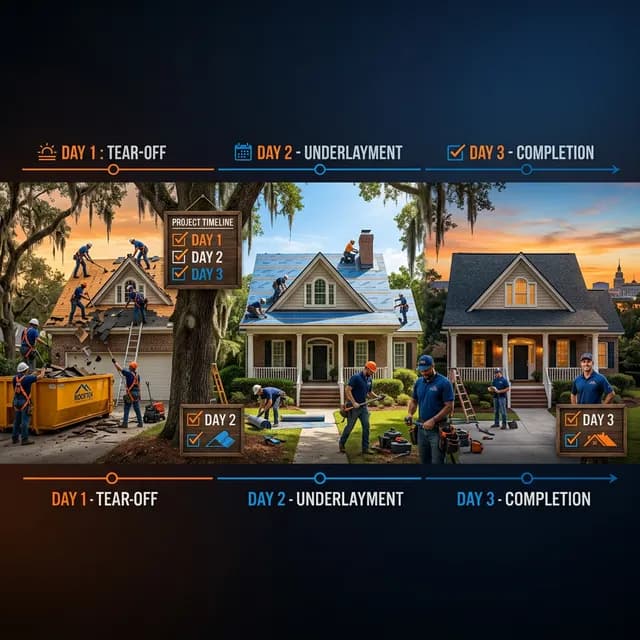
Phase 4: Tear-Off and Installation (1–3 Days)
This is the active construction phase that most people think of when they ask "how long does it take." For a standard Savannah-area home (1,800–2,500 square feet of roof area), the timeline breaks down as follows:
Day 1: Tear-Off and Decking
- Crew arrives at 7:00–7:30 AM (early start to maximize cool morning hours during summer)
- Tarps and protective boards are placed around the home's perimeter to catch debris and protect landscaping
- Old shingles, underlayment, and flashing are stripped down to the decking
- Decking is inspected for damage — soft spots, rot, water staining, and delamination are marked for replacement
- Damaged decking is cut out and replaced with new plywood or OSB
- Drip edge is installed along eaves and rakes
- If the day ends before installation begins, exposed decking is covered with synthetic underlayment to waterproof the home overnight
Day 2: Underlayment and Shingle Installation
- Ice-and-water shield is applied in valleys, at eaves, and around penetrations
- Synthetic underlayment covers the remaining deck area
- Starter strip shingles are installed along eaves and rakes
- Field shingles are installed from the eaves upward, row by row
- Flashing is installed at all penetrations, walls, and transitions
- Valley shingles are woven or cut according to the specified method
Day 3 (If Needed): Ridge, Cleanup, and Inspection
- Ridge vent is installed along the peak
- Hip and ridge cap shingles are installed
- Final flashing details and sealant application
- Thorough debris cleanup including magnetic nail sweep of the entire yard, driveway, and street
- Dumpster is loaded and scheduled for pickup
- Final walkthrough with the homeowner
Factors That Extend the Timeline
Weather
Savannah's weather is the single biggest timeline variable. Summer afternoon thunderstorms can halt work for hours. Rain forecasts can delay start dates. And extreme heat (heat index above 110°F) may require shortened work days to protect crew safety. During June through September, it's not uncommon for a 2-day project to span 4–5 calendar days due to weather interruptions.
Roof Complexity
Not all roofs are created equal. A simple gable roof with minimal penetrations can be completed faster than a complex hip roof with multiple valleys, dormers, skylights, and chimney penetrations. Steep pitches (above 8:12) require additional safety equipment and slow the crew's pace. Homes with multiple roof levels or cut-up designs (common in Richmond Hill subdivisions) add complexity and time.
Decking Damage
The extent of decking damage is unknown until the old shingles are removed. Minor damage (a few sheets) adds an hour or two. Extensive rot across large areas can add a full day and significant material cost. In Savannah's humid climate, decking damage is more common than in drier regions — budget a contingency in both time and cost.
Insurance Claim Process
If your replacement involves an insurance claim, carrier inspection, review, and payment timing can affect when work begins, and timing varies widely by event volume and policy. Talya Roofing can provide roof-condition documentation, an itemized construction estimate, and repair-scope explanations, but we do not negotiate the claim or ensure coverage.
How to Prepare Your Home and Family
- Plan for significant noise — tear-off and nailing are loud; work-from-home arrangements may need adjustments on installation days
- Move vehicles well away from the house — falling debris can damage cars parked nearby
- Secure or remove outdoor furniture, grills, and planters within 15 feet of the house
- Remove fragile items from walls inside the home — vibrations from roof work can shake pictures loose
- Cover attic belongings with plastic sheeting as a precaution
- Inform neighbors, especially those with shared driveways or adjacent parking
- Make arrangements for pets — the noise and activity can stress animals significantly
Ready to Start Your Roof Replacement?
Talya Roofing provides clear timelines, daily communication, and efficient execution for homeowners across Savannah, Pooler, Richmond Hill, and Tybee Island. Get your project on the calendar today.
Request Your Free Project EstimateOr call us: (912) 999-7989